Showing posts with label Oregon Department of Agriculture. Show all posts

Monday, March 24, 2008

FFA celebrates 80th with pride — and promise for the future

Oregon FFA executive secretary Mike Stebbins and Oregon FFA state president Sheryden Root accept the Excellence in Education award presented to the state FFA organization by Oregon director of agriculture Katy Coba during the Ag Progress Awards Dinner in Pendleton on March 18.

Chances are, if you’re involved in agriculture or have attended an agricultural event, you’ve seen the familiar blue jackets, or perhaps interacted with or been helped by a member of the National FFA Organization.

Across the country, along with Puerto Rico and the Virgin Islands, there are 7,358 chapters and almost 501,000 members in the organization that is celebrating its 80th anniversary this year.
Their motto since 1928 has been “learning to do, doing to learn, earning to live, and living to serve.”

There is a good chance that FFA members will continue to serve agriculture, even long after they are no longer members.

In Pendleton this week, the state annual meeting gave enthusiastic members a chance to demonstrate their speaking skills, agricultural production and marketing knowledge, and their science projects to help agriculture in the future.

Members shared how they work on their parents’ farms, doing such hands-on things as developing grass seed varieties and eliminating exotic weeds, and breeding and raising sheep and cattle for sale. But they also showed their work on science experiments, such as extracting oil from the invasive weed Scotch broom and turning it into biofuel.

Known as Future Farmers of America until 1988, FFA has continued to grow and adapt to the changing times and challenges.

This was one of the reasons the state FFA was honored just a few days earlier by the Oregon Department of Agriculture with an Ag Progress Award.

The Oregon Department of Agriculture noted, when the Excellence in Education Award was presented, that FFA has “more contemporary ag programs (that) are now capturing the attention of students, including greenhouse and nursery operations, landscape management, and agri-business. These new fields reflect the diversity of Oregon agriculture and forestry, and have resulted in an increase in the number of students involved in Oregon FFA following years of decline.”

“Any student in grades 7 to 12 who is enrolled in an agriculture course at a public school may join FFA,” explains national FFA literature. While many people might assume FFA is mostly rural teenagers, that’s not the case. More than 70 percent of its membership “are from rural non-farm, urban and suburban areas,” according to FFA’s website.

However, the organization remains a strong influence on the goals it has focused: to develop leadership, personal growth, and career success through agricultural education.

While each week the kids learn about agriculture in classrooms, meetings and even attending agricultural shows, the success of FFA has a lot to do with the passion and involvement of the members, their advisors and the agribusiness community that has helped support the program for so many decades.

It has become a win-win for all sides. The agribusinesses have been able to influence and hire bright, talented, well-educated, confident and eager FFA members to help the industry for the future. Most importantly, these teenagers have shown how passionate they can be about agriculture — whether or not they will remain in it after they graduate.

In the West, there are many agricultural business leaders that proudly share they have been involved in the past with FFA, or currently have children that are FFA members, and they are praise the influence of the organization.

Oregon FFA state president Sheryden Root, when she accepted the ODA award from director of agriculture Katy Coba on March 18 in Pendleton, talked about how she and state officers traveled around the state this past year to “every single FFA chapter” — an impressive accomplishment, with the 104 chapters scattered around the state serving more than 4,600 members.

Root talked about what she met: “A truly amazing group of students that are excited about agriculture, that are ready to make a difference in the industry.”

In Oregon, as well as the other Western states, indeed the agriculture industry will benefit from the difference this next generation will make from their involvement in FFA.

(More online: To see more on the FFA annual meeting in Pendleton, including a photo gallery, see coverage in www.eastoregonian.com). For more on national FFA, see www.ffa.org)

Monday, May 07, 2007

Searle outlines ag trends at CP staff meeting

Whenever statistics come out about a state, a newspaper always has a responsibility to report more than just the numbers.

A newspaper should look beyond the numbers: provide analysis of them, show how numbers are relevant to the newspaper’s audience and try to give some forecasts of what experts think will happen next.

Last week, Capital Press invited one of the experts from the Oregon Department of Agriculture to do a presentation to some of the newspaper’s staff. The purpose was to help us get a better understanding of what is happening but also what is coming next in agriculture.

Brent Searle, originally from a farm in Idaho, serves as a special assistant to ODA agriculture director Katy Coba in Salem.

Searle emphasized this his department does not collect the statistics, but evaluates those that are collected by others, whether at the state or federal level. One of the roles his department does is later put into context some of those other numbers: for example, he and his colleagues will point out mistakes in the data and hopefully influence changes to be made.

Some of the trends he outlined to CP staff included:

Productivity in Oregon agriculture has increased about two percent per year in the past decade.

But farm income has stayed flat because while its productivity has gone up, the cost of production has also risen.

USDA research probably underestimates Oregon’s input costs, such as in electricity and labor.

Government payments to farmers in the past had been mainly for program crops, but now conservation program are triggering more money benefiting Oregon farmers.

Custom farming and grass cleaning has increased.

Employment increased 30 percent in the last decade, and 80 percent of that is nursery-related. The payroll has gone up, almost doubled.

In the food processing sector, the state has lost 10 major food processors, and lost more than 20 percent during that time in jobs relating to that industry.

The food industry continues to consolidate: six major food retailers produce half the food in the U.S. Wal-Mart was especially aggressive in how it has grown: it has 12 percent of all U.S. food sales, and expects that to rise to more than 20 percent in the next 8 years.

Between 1995 and 2005, Oregon lost 73,000 acres of primary processing crops such as berries and vegetable crops. Taking their place to a large extent is grass seed, with more than a 100,000-acre increase during that same time period.

More U.S. children have visited a zoo than a farm, but there is growing interest in where food comes from and how it is grown.

More land is being involved in certification programs: a total of 2,613,000 acres are enrolled in 5 certification programs in Oregon as of last year, about 15 percent of the total acres under production. The certification includes 49,000 as organic and 2.5 million were with Food Alliance. Half of the wine production is certified under one of the programs.

The number of small farms declined last year in numbers, for the first time in the last decade, as urban pressure convinces people to sell — especially when their farms might not be very economically viable. Measure 37 is expected to also have an impact.

Searle spent a considerable amount of time discussing energy: the cost to the state, as well as the growth of alternative sources of energy. He noted that Oregon spends $12 million per day on energy, and 85 percent of that leaves the state.

“All that money is sucking out of our economy,” he said.

Searle’s job involves talking to groups and communities that are interested in creating renewable fuels plants, and he admits there has been a lot of “kicking the tires.” There have been 40 –50 groups he has talked to, and probably about 20 projects out there, he said. In ethanol, there’s “10 talking, 2 under construction, and a third that’s close” and he predicted maybe half that will be built.

However, he believes there continues to be a lot of potential for those in agriculture looking to build or be involved in producing another energy option, especially since he expects gas prices to reach $4 by summer. Searle doesn’t believe they’ll go below $3 per gallon again.

Searle gave the Capital Press staff a lot of fodder to think about, as well as ideas on what to write about. Now it’s up to CP staff to take those numbers and trends and make sense of them for an audience that is impacted by these statistics.

Links:
Capital Press
Oregon Department of Agriculture
Wal-Mart
Food Alliance

Technorati tags:


Friday, March 31, 2006

Pass the baton to promote agriculture


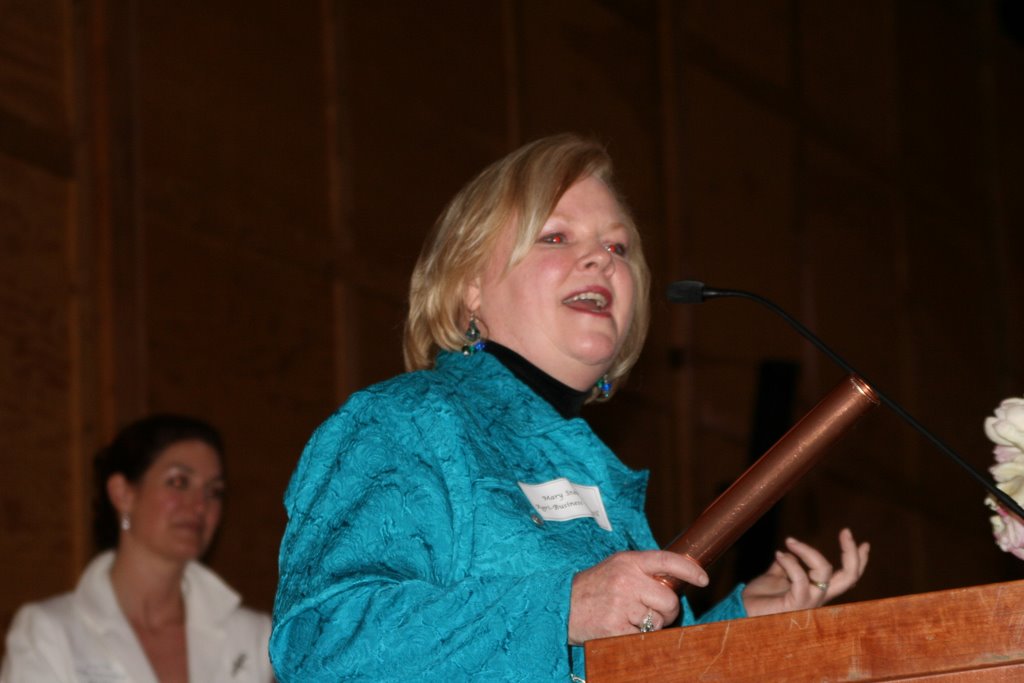
Mary Stewart, at the Oregon Department of Agriculture Ag Progress Dinner, displayed a baton to encourage others to carry on the positive message of agriculture after she leaves her position of executive director for the Oregon Agri-Business Council on March 31. Director of Agriculture Katy Coba, background, gave Stewart an award for the Keeping Ag Viable campaign.


By Elaine Shein

When organizations change the head of the organization, such as a president, often a gavel is ceremoniously passed on to recognize the role of the next leader. However, what would be appropriate when there is a change in the executive director position at an agricultural organization?

Mary Stewart, who officially steps down today as executive director of the OregonAgri-Business Council , provided an appropriate prop at the Oregon Department of Agriculture Ag Progress Awards a week earlier ago in Silverton, Ore.

At the podium, she held up a baton — and said that it represents the teamwork done by different people on the Agri-Business Council’s Keeping Ag Viable committee who have served as volunteers to help spread a positive message of agriculture. The baton also represents what everyone needs to continue to do: pass on that positive image of agriculture beyond the ag community and also to the next generation.

Baton appropriate

Why was a baton so appropriate? Because the race continues, slow and steady. This is a team effort, and while it may seem like an endless race with a few tough hurdles along the way, ultimately there will be rewards for those who have worked so hard to continue to support agriculture.

Perhaps it’s time for the team to thank Stewart for the work she has done with ABC for more than 10 years. Often executive directors receive little credit for their accomplishments and little notice for when things go right with an organization. Everyone expects a flawless performance, whether to create a strong financial position, increase membership, educate the public, put out fires in the media, arrange promotion of agricultural products, influence buying habits of customers and plan large fundraising events.

Changes at the top

Executive directors serve many bosses: the Agri-Business Council has a large board of directors, for example, which has just undergone a change in leadership as Mac McCarter took over the presidency from Dick Severson. ABC is currently going through long-term strategic planning which will influence greatly what happens to the organization celebrating its 40th anniversary this year.

ABC represents more than 900 members, organizations that range from the Oregon Farm Bureau Federation to NORPAC to small farm businesses that have recognized the benefits of belonging to a larger umbrella organization.

Keeping Ag Viable a success

During Stewart’s tenure at ABC, one of the most significant accomplishments was the formation of the Keeping Ag Viable program. On ABC’s website, it’s described as “an industry-wide, state-wide effort initiated in 1996 and housed at the Agri-Business Council of Oregon (ABC), seeks to unite agriculture’s diverse voices and leverage its combined resources to effect statewide awareness. Taking this a step farther, the goal is to motivate Oregonians — rural and urban, consumer and legislator, student and business leader —to actively support Oregon agriculture by buying local products and considering the industry's needs at the ballot box and in the policy arena.”

Ask three questions

How successful has this program been? Just ask yourself three questions.
Have you ever heard the phrase “Oregon Agriculture. Everywhere. Everyday”, perhaps mentioned by someone in the agricultural industry, or used on packaging, or become part of in media campaigns?

And if you have driven on some of Oregon’s roads, have you come across some bright yellow signs that promote Agriculture? There are some on the I-5 between Portland and Salem, for example, and follow the old Burma Shave advertising campaigns. Cute rhymes with a touch of humor are used to help catch people’s attention. Tens of thousands of vehicles each day passing by these signs, and surveys have shown that people do remember these signs later.

On these same roads people can often see signs identifying what crops are in the fields. In a place like Oregon, where crops are so diversified, few people could identify what is being grown, and they appreciate the opportunity to learn along the way.

All these three things came from the Keeping Ag Viable program, and Mary Stewart played an important role in helping ensure these ideas came to fruition.

Excellence in Education award

It was definitely appropriate that Stewart accepted the award from ODA on March 23, about a week before she ended her job. She accepted the ODA’s award for Excellence in Education for the work that KAV has done, tearfully acknowledging that her job as executive director was almost over although the need for ag promotion will never end.

In the video announcing the award, Bruce Pokarney from ODA explained “One of the biggest challenges for Oregon agriculture has been bridging the urban-rural gap….making sure that all Oregonians understand and appreciate all that is done by farmers and ranchers.”

He added: “The Keeping Agriculture Viable in Oregon Committee, with the support of the Agri-Business Council of Oregon, has an impressive track record of accomplishment the past five plus years in making the connection between agriculture and the daily lives of all Oregonians.” In regards to the ‘Oregon Agriculture. Everywhere. Everyday’ campaign he said “Those messages have connected with the target audience more than 110 million times. Well over half of those surveyed actually recall seeing the ads and messages. Surveys show the percentage of those seeking Oregon products has grown because of the campaign…”

Pokarney, who serves on the KAV committee himself, put into perspective what KAV has done but what remains the challenge ahead for everyone.

More than quick fix

“Keeping Agriculture Viable has been more than a quick-fix media blitz,” said Pokarney. “It has maintained its momentum, recognizing that there are many people out there who still need to be reached. Strong, positive, consistent, and effective messages about all the good things represented by Oregon agriculture will always find a way of reaching the target audience thanks to the efforts of those involved with the campaign.”

Stewart has handed to everyone in agriculture, not just her successor, the baton now to carry. Success will come only as long as everyone continues to recognize as a team they need to work together and continue moving forward.


Link:

OregonAgri-Business Council


Thursday, March 23, 2006

Oregon Department of Agriculture honors industry leaders

The Oregon Department of Agriculture is celebrating its 75th birthday, but it was people in the state's agriculture industry that got the presents tonight.

The event, held in conjuction with National Agriculture Week, was the Oregon Department of Agriculture's Ag Progress Awards Dinner. Even Gov. Ted Kulongoski made an appearance long enough to present opening remarks at the event.

Kulongoski, who is facing a slate of challengers, even from his own Democratic Party, in his re-election bid this year, praised the agriculture industry for its contributions to the state. Kulongoski spoke about agriculture's economic impact to the overall state economy, but also how Oregon farm and ranch families contribute to the social fabric of the state with their committment to hard work and community.

Kulongoski did not bring up his re-election bid in his public remarks at the Oregon Garden in Silverton, Ore., but he did make note of several achievement in the ag sector during his administration and made a pitch asking for the support of the industry leaders in attendance to keep working with him to build the state's infrastructure and economy.

The department and its director, Katy Coba, also received a gift from one of the honorees. Tomio Ao of Japan, who the department credits with being the key figure in establishing Oregon's seafood export industry with Japan, was one of the award recipients for individual contribution to agriculture in the state. After Coba presented Ao with his plaque, Ao gave Coba an ornate banner honoring the Department of Agriculture's 75th anniversary.

Others honored for individual contribution to agriculture were Dalton Strauss, a Central Point, Ore., cattle rancher, and Dave and Rita Doerfler of Silverton, Ore., for their work with various ag committees, organizations and events in the state.

Bob's Red Mill Natural Foods of Milwaukie, Ore., which produces whole grain foods distributed in the U.S. and Canada, was honored as high-valued products producer.

Sabroso Inc. of Medford, a fruit processor that makes fruit purees, concentrates and other ingredients for national and international food companies, was honored as processor of the year.

Yule Tree Farms of Aurora was honored for leadership in conservation for its work to control erosion and improve water quality.

The Agribusiness Council of Oregon was honored for excellence in education for its Keeping Ag Viable campaign.

Check out the Capital Press website for photos from the event.

I also realized that if I ever decide to get serious about this whole blogging thing, I may have to invest in some sort of wireless device so I can post whenever, and wherever, I go. There really is no escaping the wonders of technology for distribution of information, as Oregon State University President Ed Ray demonstrated at the event. Ray kept some in the audience up to date on the scores from the NCAA basketball tournament, which were delivered to his BlackBerry wireless device.

And here I had to drive all the way home to make a post.


Ag in the West social media watch

Capital Press videos on YouTube

Our most popular videos