Showing posts with label Katy Coba. Show all posts

Monday, May 07, 2007

Searle outlines ag trends at CP staff meeting

Whenever statistics come out about a state, a newspaper always has a responsibility to report more than just the numbers.

A newspaper should look beyond the numbers: provide analysis of them, show how numbers are relevant to the newspaper’s audience and try to give some forecasts of what experts think will happen next.

Last week, Capital Press invited one of the experts from the Oregon Department of Agriculture to do a presentation to some of the newspaper’s staff. The purpose was to help us get a better understanding of what is happening but also what is coming next in agriculture.

Brent Searle, originally from a farm in Idaho, serves as a special assistant to ODA agriculture director Katy Coba in Salem.

Searle emphasized this his department does not collect the statistics, but evaluates those that are collected by others, whether at the state or federal level. One of the roles his department does is later put into context some of those other numbers: for example, he and his colleagues will point out mistakes in the data and hopefully influence changes to be made.

Some of the trends he outlined to CP staff included:

Productivity in Oregon agriculture has increased about two percent per year in the past decade.

But farm income has stayed flat because while its productivity has gone up, the cost of production has also risen.

USDA research probably underestimates Oregon’s input costs, such as in electricity and labor.

Government payments to farmers in the past had been mainly for program crops, but now conservation program are triggering more money benefiting Oregon farmers.

Custom farming and grass cleaning has increased.

Employment increased 30 percent in the last decade, and 80 percent of that is nursery-related. The payroll has gone up, almost doubled.

In the food processing sector, the state has lost 10 major food processors, and lost more than 20 percent during that time in jobs relating to that industry.

The food industry continues to consolidate: six major food retailers produce half the food in the U.S. Wal-Mart was especially aggressive in how it has grown: it has 12 percent of all U.S. food sales, and expects that to rise to more than 20 percent in the next 8 years.

Between 1995 and 2005, Oregon lost 73,000 acres of primary processing crops such as berries and vegetable crops. Taking their place to a large extent is grass seed, with more than a 100,000-acre increase during that same time period.

More U.S. children have visited a zoo than a farm, but there is growing interest in where food comes from and how it is grown.

More land is being involved in certification programs: a total of 2,613,000 acres are enrolled in 5 certification programs in Oregon as of last year, about 15 percent of the total acres under production. The certification includes 49,000 as organic and 2.5 million were with Food Alliance. Half of the wine production is certified under one of the programs.

The number of small farms declined last year in numbers, for the first time in the last decade, as urban pressure convinces people to sell — especially when their farms might not be very economically viable. Measure 37 is expected to also have an impact.

Searle spent a considerable amount of time discussing energy: the cost to the state, as well as the growth of alternative sources of energy. He noted that Oregon spends $12 million per day on energy, and 85 percent of that leaves the state.

“All that money is sucking out of our economy,” he said.

Searle’s job involves talking to groups and communities that are interested in creating renewable fuels plants, and he admits there has been a lot of “kicking the tires.” There have been 40 –50 groups he has talked to, and probably about 20 projects out there, he said. In ethanol, there’s “10 talking, 2 under construction, and a third that’s close” and he predicted maybe half that will be built.

However, he believes there continues to be a lot of potential for those in agriculture looking to build or be involved in producing another energy option, especially since he expects gas prices to reach $4 by summer. Searle doesn’t believe they’ll go below $3 per gallon again.

Searle gave the Capital Press staff a lot of fodder to think about, as well as ideas on what to write about. Now it’s up to CP staff to take those numbers and trends and make sense of them for an audience that is impacted by these statistics.

Links:
Capital Press
Oregon Department of Agriculture
Wal-Mart
Food Alliance

Technorati tags:


Thursday, November 09, 2006

A peak behind the curtain

Today, I'm going to offer a look behind the scenes of at what happens when an opinion piece is written for the Capital Press.

One of our editorials in the Northwest editions of Capital Press first came to life here on Blogriculture as a post to our blog by Executive Editor Elaine Shein. Elaine is currently up in Canada, but was monitoring U.S. and Oregon election results from up there. She filed an opinion piece yesterday via e-mail and also and posted it on the Blogriculture site.

Two of the other members of our editorial board, Managing Editor Carl Sampson and I, read the piece and discussed it. We added a few refinements based on our observations of Oregon Gov. Ted Kulongoski and his election win Tuesday night.

We edited the piece a little and used it on the Opinion page that will appear in the Northwest editions of the Capital Press that will hit newsstands, subscribers' homes and our CapitalPress.com website tomorrow.

But since you got a sneak peak at the "rough draft" of the editorial here at Blogriculture, I thought I would let our blog readers also get an advance copy of the final editorial as it will read tomorrow in print and online.

Here it is:

Kulongoski still has work to do to win over rural Oregon

Editorial

While Ted Kulongoski has won a second term as governor of Oregon, voters have sent him a strong message: He has a lot of work still to be done to gain the respect of rural Oregon -- particularly the farm and ranch community.

Unofficially, Kulongoski received just under 51 percent of the votes in this week's election. Republican Ron Saxton received 43 percent. As expected, Saxton did best in the rural areas, including the eastern and southern parts of the state. Kulongoski won Portland, the place Saxton needed to crack if he wished to be a serious contender.

Considering how poorly Republicans did nationally in both the House and Senate, and how well they did in other Oregon races, Kulongoski should note that his margin of victory was rather modest due to rural voters who opposed him in large numbers.

So what should Kulongoski do during a second term if he wants to create a legacy for all of Oregon and earn some respect from farmers and ranchers?

First, keeping Katy Coba in her job as director of the Oregon Department of Agriculture would be an admirable start. She has done an impressive job of representing the interests of agriculture at the state, national and international levels.

Secondly, Kulongoski should immediately arrange to start meeting more with the agricultural organizations and their representatives in this state. Kulongoski must do more to understand and work with the agricultural and rural communities. During his campaign, Kulongoski boasted that he travels extensively in Oregon and knows the state and its issues. However, it is apparent that rural communities don't feel they know the governor or that he has their best interests at heart.

He can, and should, do a much better job of learning the issues important to farm and ranch communities, seek common ground and collaborate on solutions. He has to show respect for those people who toil on the land and spend time talking with farmers and farm leaders on issues vital to farmers and Oregon's economy. The state's economy -- meaning the state's workers and taxpayers -- still heavily depend on natural resource industries such as farms, ranches, forests and fisheries.

Kulongoski needs to be more visible in rural Oregon. He must show he listens and can be influenced by those he meets in farm country, not just the traditional Democratic base of state employees and labor unions.

Thirdly, Kulongoski needs to show leadership. This is especially true now that his party also has control of the Legislature. However, he needs to show he can work with politicians from both parties, as the Republican legislators largely represent the parts of Oregon where Saxton captured the majority of votes. Kulongoski needs to find solutions to streamline confirmation of his appointments to commissions and boards; lead state government leaders to work toward solutions; and make the Oregon of tomorrow a progressive, viable, dynamic place to live and do business.

Kulongoski should meet with the small business association and see what can be done to encourage and support the growth of that sector.

Fourthly, the universities and education system are relying heavily on Kulongoski to deliver on promises he has made in recent months. They will watch the next state budget closely to see whether he truly believes Oregon State University and others should continue to have the resources and support they need.

And finally, Kulongoski and other Democrats elected Tuesday need to work to restore the faith of voters in politics here in the West. During Kulongoski's first term, the agricultural community became very disillusioned with him and the Democratic party. They felt more than just a power vacuum in Salem. They felt ignored, frustrated and forgotten.

If Kulongoski believes the election gave him a mandate to continue doing what he has in the last four years, he is forgetting that his own party was disillusioned with his leadership, which is why he faced such a crowded field of challengers in the spring primary election.

If he uses the election as a wake-up call and lesson on how to do things better and makes an honest attempt to work harder with the agricultural community, then there is hope for the future.

However, this election serves as a sobering reminder for the agriculture community as well. Democrats are even more solidly the party of power in Oregon and now have control of most seats in Congress. Agriculture leaders will need to court Democratic support for the issues important to their industry.

Political power in the West isn't based on acreage, it's based on population.


Wednesday, November 08, 2006

Oregon election shows governor has work to do

While Ted Kulongoski has won a second term as governor of Oregon, voters have sent him a strong message: he has a lot of work still to be done to gain the respect of rural Oregon and particularly of the farm and ranch community.

Unofficially, Kulongoski received just under 51 percent of the votes in this week's election. Republican Ron Saxton received 43 percent. As expected, Saxton did best in the rural areas, as well as the eastern and southern parts of the state. Kulongoski won Portland, the place Saxton needed to crack if he wished to be a serious contender.

Considering how poorly Republicans did nationally, in both the House and Senate, and how Oregon has been more traditionally a Democrat stronghold, Kulongoski should find it sobering that almost half of the state's voters would rather have someone else lead them.

Nationally, polls before yesterday showed that three out of four voters were leaning towards Democrats because of disgust against corruption and scandals involving politicians, and in particular Republicans. There were also great discontent about the Iraq war.

In that context, Kulongoski's win shows it is even more shaky. Getting just over 50 percent of the votes does not show the state's voters are confident in his leadership. The votes may have emerged because of fear of what might happen if Saxton won, especially with some of the comments he has made about the employment of state workers and how he wanted to continue to attack their retirement plan.

So what should Kulongoski do during a second term if he wants to create a legacy or at the very least earn some respect from farmers and ranchers?

First, keeping director Katy Coba in her job in the agriculture department would be admirable. She has done an impressive job of representing the interests of agriculture at the state, national and international levels.

Secondly, Kulongoski should immediately arrange to start meeting more with the agricultural organizations and their representatives in this state. Instead of waiting for a big issues to hit the wall and be forced to react or veto what he doesn't like, Kulongoski should do more to understand and work with the agricultural and rural communities. Learn more about the issues, seek common ground and resolutions, and more importantly show respect for those people who toil the land.

Kulongoski needs to be more than just more visible to rural areas, but actually show he listens and can be influenced by those he meets.

Thirdly, Kulongoski needs to show leadership. This includes working with other politicians on both sides of politics. Kulongoski needs to find the solution so appointments can be made to commissions and boards; influence the government to work towards solutions; and move the state ahead to where it needs to be in the future, as a progressive, viable, dynamic place to live and do business. Kulongoski should meet with the small business association and see what can be done to encourage and support the growth of that sector.

Fourthly, the universities and education system are relying heavily on Kulongoski to deliver on promises he has made in recent months. They will watch the next state budget closely to see whether he truly believes Oregon State University and others should continue to have the resources and support they need.

And finally, Kulongoski needs to work to restore the faith of voters in politics here in the West. Under Kulongoski, the agricultural community has become very disillusioned with him and the Democrats. They have felt more than just a power vacuum in Salem: they have felt ignored, frustrated, and forgotten.

If Kulongoski feels the election gave him a mandate to continue doing what he has in the last four years, then he didn't deserve to win.

If he uses the election as a wake-up call and lesson on how to do things better, and makes an honest attempt to work harder with the agricultural community, then there is hope for the future.

Wednesday, May 03, 2006

Ag Fest teaches 10 lessons to a volunteer


Brent Searle and his wife Shelley help teach four-year-old Mikayla Wolf how to make a "living necklace" out of a wet cotton ball, bean, plastic bag and piece of string. Parents Samantha and Brent Wolf watch during Ag Fest, held in Salem April 29-30.


By Elaine Shein


SALEM — Last weekend, more than 17,000 kids visited Ag Fest in Salem, Ore., to learn more about agriculture, especially in an interactive, hands-on way.

After dealing single-handedly with what seemed to be several thousand, although since it was only a three or four-hour shift as a volunteer I may be mildly exaggerating, I found that I had learned a lot from the kids themselves.

First, some background. My modest role, as a volunteer for the Oregon Ag in the Classroom Foundation, seemed simple enough. At least, that was what I was told by AITC’s program director, Tami Kerr, and a former AITC president, Brent Searle.

In his day job, Brent is a special assistant of Director Katy Coba at the Oregon Department of Agriculture. However last weekend Brent, with the assistance of his wife Shelley, could be found leaning over a big container of wet cotton balls and teaching kids how to grow a miraculous bean plant.

When I arrived for my shift, Brent looked relieved and exhausted, but was doing a great job interacting with the kids. His wife also did a super job helping out. Together they assured me the task was simple and really rewarding.

Introduce to the children the exciting concept of living necklaces. Encourage them to take a wet cotton ball, flatten it like a pancake to take out the excess water, place a kidney bean in the center, fold it over like a hotdog to hide the bean, place it in a small plastic bag that had a string attached, and ask the child to take it home and place it in a nice sunny spot for a few days. Voila: a bean should sprout and begin to grow.

There were even people who freely gave testimonials that the bean experiment was so successful that in the past, bean plants were moved outside into garden soil and grew into tall healthy bean plants.

I still cannot verify that anyone named Jack climbed these huge beanstalks to raise his income by a giant profit, but many sources mentioned Jack.

Kerr offered great encouragement, repeating several times that she believed it was a good experience for AITC board members to help out at Ag Fest and experience firsthand what she does do often in classrooms around the state and at events such as this.

While teaching kids to appreciate and understand agriculture, I also learned a few lessons myself.

The valuable lessons included:
1) Mingling chewing gum with cotton balls is never a good thing.

2) Never ask a child holding a lollipop in one hand, an ice cream cone in another, to use both hands to help with an activity. The child will shrug and drop one or both items anywhere without a second thought. Look desperately for a nearby mother or a compassionate grandmotherly-type stranger to help out.

3) Drink lots of fluids since it’s easy to lose one’s voice after repeating over and over again “So, would you like to make a living necklace out of a bean and a cotton ball?”

4) After losing one’s voice, being a mime with kids is not the most effective way to get their attention, unless you’re trapped in an invisible box and are painted like a clown and you are expected not to have a voice. Otherwise, you are only mildly amusing to the children and very scary to their parents.

5) Never force parents to take home bean plants that they really don’t want in their house. Chasing them down and begging them to take the plants their kids made won’t help the situation. Explaining that a bean plant is much less maintenance than a puppy also does not earn points with the parents. They will now despise you for mentioning a puppy.

6) Telling the children of vegetarians to fold a cotton ball over the bean “like a hotdog” really leads to bewildering looks. Say “like a blanket” instead.

7) Asking a child to gently flatten a wet cotton ball and squeeze out the water like a pancake will not always be the best advice to give. They miss the “gently” part and slap and squish and mangle the poor cotton ball heartily until it is gasping for even a drop of water.

8) If the child has just come from the “how to make a dirt baby” booth, be prepared to see the cotton balls become rather brown, grimey wads of cotton. Consider the soil as extra nourishment for the bean.

9) After child mixes chewing gum, lollipop, ice cream cone, wet cotton ball and a bean, hastily move unto the next child while the parent desperately attempts to settle the mess. And finally,

10) Never forget to tell all the children out loud what a super job they are doing, then later whisper to the parent to go home and add more water or change the bean. “Any bean will do … really … just hide it in the cotton, add water and sun, and pretend it’s the same bean! Just like what you did with their pet hamsters in the past!"

I have whole new appreciation for what Tami and others do when they help teach kids hands-on lessons about agriculture.

And I brought home a couple bean living necklaces myself to see how they will grow.

Perhaps in a few days I will update readers of this blog on what happened, and provide pictures of the great success that may take place.

Or I’ll go shopping for more beans and cotton.

Links:
Oregon Ag Fest


Friday, March 31, 2006

Pass the baton to promote agriculture


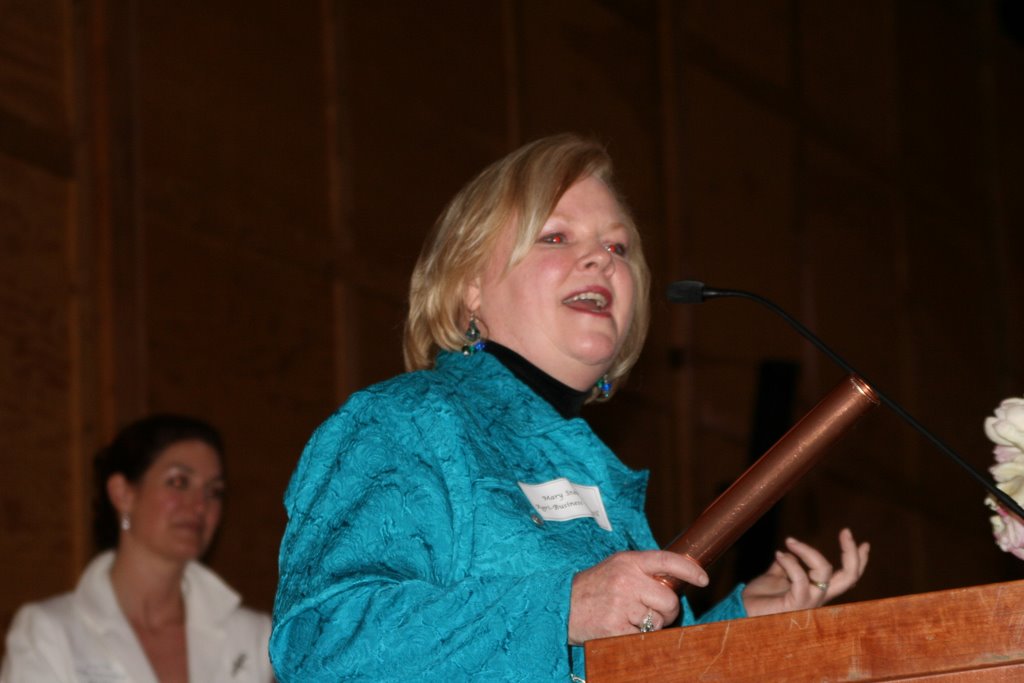
Mary Stewart, at the Oregon Department of Agriculture Ag Progress Dinner, displayed a baton to encourage others to carry on the positive message of agriculture after she leaves her position of executive director for the Oregon Agri-Business Council on March 31. Director of Agriculture Katy Coba, background, gave Stewart an award for the Keeping Ag Viable campaign.


By Elaine Shein

When organizations change the head of the organization, such as a president, often a gavel is ceremoniously passed on to recognize the role of the next leader. However, what would be appropriate when there is a change in the executive director position at an agricultural organization?

Mary Stewart, who officially steps down today as executive director of the OregonAgri-Business Council , provided an appropriate prop at the Oregon Department of Agriculture Ag Progress Awards a week earlier ago in Silverton, Ore.

At the podium, she held up a baton — and said that it represents the teamwork done by different people on the Agri-Business Council’s Keeping Ag Viable committee who have served as volunteers to help spread a positive message of agriculture. The baton also represents what everyone needs to continue to do: pass on that positive image of agriculture beyond the ag community and also to the next generation.

Baton appropriate

Why was a baton so appropriate? Because the race continues, slow and steady. This is a team effort, and while it may seem like an endless race with a few tough hurdles along the way, ultimately there will be rewards for those who have worked so hard to continue to support agriculture.

Perhaps it’s time for the team to thank Stewart for the work she has done with ABC for more than 10 years. Often executive directors receive little credit for their accomplishments and little notice for when things go right with an organization. Everyone expects a flawless performance, whether to create a strong financial position, increase membership, educate the public, put out fires in the media, arrange promotion of agricultural products, influence buying habits of customers and plan large fundraising events.

Changes at the top

Executive directors serve many bosses: the Agri-Business Council has a large board of directors, for example, which has just undergone a change in leadership as Mac McCarter took over the presidency from Dick Severson. ABC is currently going through long-term strategic planning which will influence greatly what happens to the organization celebrating its 40th anniversary this year.

ABC represents more than 900 members, organizations that range from the Oregon Farm Bureau Federation to NORPAC to small farm businesses that have recognized the benefits of belonging to a larger umbrella organization.

Keeping Ag Viable a success

During Stewart’s tenure at ABC, one of the most significant accomplishments was the formation of the Keeping Ag Viable program. On ABC’s website, it’s described as “an industry-wide, state-wide effort initiated in 1996 and housed at the Agri-Business Council of Oregon (ABC), seeks to unite agriculture’s diverse voices and leverage its combined resources to effect statewide awareness. Taking this a step farther, the goal is to motivate Oregonians — rural and urban, consumer and legislator, student and business leader —to actively support Oregon agriculture by buying local products and considering the industry's needs at the ballot box and in the policy arena.”

Ask three questions

How successful has this program been? Just ask yourself three questions.
Have you ever heard the phrase “Oregon Agriculture. Everywhere. Everyday”, perhaps mentioned by someone in the agricultural industry, or used on packaging, or become part of in media campaigns?

And if you have driven on some of Oregon’s roads, have you come across some bright yellow signs that promote Agriculture? There are some on the I-5 between Portland and Salem, for example, and follow the old Burma Shave advertising campaigns. Cute rhymes with a touch of humor are used to help catch people’s attention. Tens of thousands of vehicles each day passing by these signs, and surveys have shown that people do remember these signs later.

On these same roads people can often see signs identifying what crops are in the fields. In a place like Oregon, where crops are so diversified, few people could identify what is being grown, and they appreciate the opportunity to learn along the way.

All these three things came from the Keeping Ag Viable program, and Mary Stewart played an important role in helping ensure these ideas came to fruition.

Excellence in Education award

It was definitely appropriate that Stewart accepted the award from ODA on March 23, about a week before she ended her job. She accepted the ODA’s award for Excellence in Education for the work that KAV has done, tearfully acknowledging that her job as executive director was almost over although the need for ag promotion will never end.

In the video announcing the award, Bruce Pokarney from ODA explained “One of the biggest challenges for Oregon agriculture has been bridging the urban-rural gap….making sure that all Oregonians understand and appreciate all that is done by farmers and ranchers.”

He added: “The Keeping Agriculture Viable in Oregon Committee, with the support of the Agri-Business Council of Oregon, has an impressive track record of accomplishment the past five plus years in making the connection between agriculture and the daily lives of all Oregonians.” In regards to the ‘Oregon Agriculture. Everywhere. Everyday’ campaign he said “Those messages have connected with the target audience more than 110 million times. Well over half of those surveyed actually recall seeing the ads and messages. Surveys show the percentage of those seeking Oregon products has grown because of the campaign…”

Pokarney, who serves on the KAV committee himself, put into perspective what KAV has done but what remains the challenge ahead for everyone.

More than quick fix

“Keeping Agriculture Viable has been more than a quick-fix media blitz,” said Pokarney. “It has maintained its momentum, recognizing that there are many people out there who still need to be reached. Strong, positive, consistent, and effective messages about all the good things represented by Oregon agriculture will always find a way of reaching the target audience thanks to the efforts of those involved with the campaign.”

Stewart has handed to everyone in agriculture, not just her successor, the baton now to carry. Success will come only as long as everyone continues to recognize as a team they need to work together and continue moving forward.


Link:

OregonAgri-Business Council


Thursday, March 23, 2006

Oregon Department of Agriculture honors industry leaders

The Oregon Department of Agriculture is celebrating its 75th birthday, but it was people in the state's agriculture industry that got the presents tonight.

The event, held in conjuction with National Agriculture Week, was the Oregon Department of Agriculture's Ag Progress Awards Dinner. Even Gov. Ted Kulongoski made an appearance long enough to present opening remarks at the event.

Kulongoski, who is facing a slate of challengers, even from his own Democratic Party, in his re-election bid this year, praised the agriculture industry for its contributions to the state. Kulongoski spoke about agriculture's economic impact to the overall state economy, but also how Oregon farm and ranch families contribute to the social fabric of the state with their committment to hard work and community.

Kulongoski did not bring up his re-election bid in his public remarks at the Oregon Garden in Silverton, Ore., but he did make note of several achievement in the ag sector during his administration and made a pitch asking for the support of the industry leaders in attendance to keep working with him to build the state's infrastructure and economy.

The department and its director, Katy Coba, also received a gift from one of the honorees. Tomio Ao of Japan, who the department credits with being the key figure in establishing Oregon's seafood export industry with Japan, was one of the award recipients for individual contribution to agriculture in the state. After Coba presented Ao with his plaque, Ao gave Coba an ornate banner honoring the Department of Agriculture's 75th anniversary.

Others honored for individual contribution to agriculture were Dalton Strauss, a Central Point, Ore., cattle rancher, and Dave and Rita Doerfler of Silverton, Ore., for their work with various ag committees, organizations and events in the state.

Bob's Red Mill Natural Foods of Milwaukie, Ore., which produces whole grain foods distributed in the U.S. and Canada, was honored as high-valued products producer.

Sabroso Inc. of Medford, a fruit processor that makes fruit purees, concentrates and other ingredients for national and international food companies, was honored as processor of the year.

Yule Tree Farms of Aurora was honored for leadership in conservation for its work to control erosion and improve water quality.

The Agribusiness Council of Oregon was honored for excellence in education for its Keeping Ag Viable campaign.

Check out the Capital Press website for photos from the event.

I also realized that if I ever decide to get serious about this whole blogging thing, I may have to invest in some sort of wireless device so I can post whenever, and wherever, I go. There really is no escaping the wonders of technology for distribution of information, as Oregon State University President Ed Ray demonstrated at the event. Ray kept some in the audience up to date on the scores from the NCAA basketball tournament, which were delivered to his BlackBerry wireless device.

And here I had to drive all the way home to make a post.


Ag in the West social media watch

Capital Press videos on YouTube

Our most popular videos