FFA supporters will ask the 2014 Idaho Legislature for $2.24 million to help maintain and improve the state’s secondary agricultural education programs. Click here for the full story


3 days ago
FFA supporters will ask the 2014 Idaho Legislature for $2.24 million to help maintain and improve the state’s secondary agricultural education programs. Click here for the full story
The RAM Truck Super Bowl ad featuring legendary radio broadcaster Paul Harvey’s “So God Made a Farmer” tribute has been called a huge success. With more than 10 million views online in less than a week after the ad first aired, RAM Truck’s goal was reached, resulting in a $1 million donation to the National FFA Organization’s hunger relief efforts, according to RAM Truck.
Subscribe to this podcast in iTunes or your favorite RSS reader.
To listen, click here.
Slade Beck, 18, of Burley, is headed to Indianapolis to compete in the FFA National Finals in specialty crop production after winning district and state competitions. The Burley High School graduate is the only national finalist from Idaho and one of only four finalists in the specialty crop production competition in the country.
Subscribe to this podcast in iTunes or your favorite RSS reader.
To listen, click here.
Idaho FFA members have donated $1,100 to the Idaho Foodbank and the money came at a good time, with the Foodbank struggling to find enough resources to handle a large increase in demand for emergency food.
Subscribe to this podcast in iTunes or your favorite RSS reader.
To listen, click here.
In this podcast, editors and reporters take a look at businesses riding the wave of demand for backyard chickens, the federal government's shifting stance on child labor on family farms, and a tractor raffle to raise money to help send Idaho FFA members to college.
To order raffle tickets for the 1952 John Deere B and three-point sprayer, call 208-861-2467 or e-mail Laura Wilder at lwilder@idffafoundation.org.
Subscribe to this podcast in iTunes or your favorite RSS reader.
To listen, click here.
Idaho farmers and ag-related businesses are rallying around a tractor raffle program that funds scholarships for FFA members.
Subscribe to this podcast in iTunes or your favorite RSS reader.
To listen, click here.
Shelby (right) , a sophomore at Red Bluff High makes a big sale of raffle tickets to Jon Smith, who is visiting the Red Bluff Bull and Gelding Sale for the first time with his fiance, Jennifer Gardner.
Jon is a mechanic with the U.S. army who just returned from Iraq and will soon be stationed in Afghanistan. His fiance Jennifer (left) and he have set a date to be married in September.
Jon bought a double arm's length of raffle tickets...39 purchases supporting local FFA in their effort to travel to the State FFA Conference in Fresno.
 Oregon FFA executive secretary Mike Stebbins and Oregon FFA state president Sheryden Root accept the Excellence in Education award presented to the state FFA organization by Oregon director of agriculture Katy Coba during the Ag Progress Awards Dinner in Pendleton on March 18.
Chances are, if you’re involved in agriculture or have attended an agricultural event, you’ve seen the familiar blue jackets, or perhaps interacted with or been helped by a member of the National FFA Organization.
Across the country, along with Puerto Rico and the Virgin Islands, there are 7,358 chapters and almost 501,000 members in the organization that is celebrating its 80th anniversary this year.
Their motto since 1928 has been “learning to do, doing to learn, earning to live, and living to serve.”
There is a good chance that FFA members will continue to serve agriculture, even long after they are no longer members.
In Pendleton this week, the state annual meeting gave enthusiastic members a chance to demonstrate their speaking skills, agricultural production and marketing knowledge, and their science projects to help agriculture in the future.
Members shared how they work on their parents’ farms, doing such hands-on things as developing grass seed varieties and eliminating exotic weeds, and breeding and raising sheep and cattle for sale. But they also showed their work on science experiments, such as extracting oil from the invasive weed Scotch broom and turning it into biofuel.
Known as Future Farmers of America until 1988, FFA has continued to grow and adapt to the changing times and challenges.
This was one of the reasons the state FFA was honored just a few days earlier by the Oregon Department of Agriculture with an Ag Progress Award.
The Oregon Department of Agriculture noted, when the Excellence in Education Award was presented, that FFA has “more contemporary ag programs (that) are now capturing the attention of students, including greenhouse and nursery operations, landscape management, and agri-business. These new fields reflect the diversity of Oregon agriculture and forestry, and have resulted in an increase in the number of students involved in Oregon FFA following years of decline.”
“Any student in grades 7 to 12 who is enrolled in an agriculture course at a public school may join FFA,” explains national FFA literature. While many people might assume FFA is mostly rural teenagers, that’s not the case. More than 70 percent of its membership “are from rural non-farm, urban and suburban areas,” according to FFA’s website.
However, the organization remains a strong influence on the goals it has focused: to develop leadership, personal growth, and career success through agricultural education.
While each week the kids learn about agriculture in classrooms, meetings and even attending agricultural shows, the success of FFA has a lot to do with the passion and involvement of the members, their advisors and the agribusiness community that has helped support the program for so many decades.
It has become a win-win for all sides. The agribusinesses have been able to influence and hire bright, talented, well-educated, confident and eager FFA members to help the industry for the future. Most importantly, these teenagers have shown how passionate they can be about agriculture — whether or not they will remain in it after they graduate.
In the West, there are many agricultural business leaders that proudly share they have been involved in the past with FFA, or currently have children that are FFA members, and they are praise the influence of the organization.
Oregon FFA state president Sheryden Root, when she accepted the ODA award from director of agriculture Katy Coba on March 18 in Pendleton, talked about how she and state officers traveled around the state this past year to “every single FFA chapter” — an impressive accomplishment, with the 104 chapters scattered around the state serving more than 4,600 members.
Root talked about what she met: “A truly amazing group of students that are excited about agriculture, that are ready to make a difference in the industry.”
In Oregon, as well as the other Western states, indeed the agriculture industry will benefit from the difference this next generation will make from their involvement in FFA.
(More online: To see more on the FFA annual meeting in Pendleton, including a photo gallery, see coverage in www.eastoregonian.com). For more on national FFA, see www.ffa.org)
Wearing his blue FFA jacket, 15-year-old Thomas Moore listened to a presentation about how his ancestor, William Hatchette Vaughan, was part of the first wagon train to go all the way from Missouri to Oregon in 1843’s migration, eventually settling near Molalla. Cattle are still raised on a 107-acre parcel left from the original claim made 164 years ago.
Moore’s family was one of 14 that received sesquicentennial awards at a ceremony held by the Oregon Century Farm and Ranch Program on Feb. 14 in Salem.
For Moore, who traveled seven hours with his grandparents from Fox, Ore., to attend the ceremony, it was a learning experience. Although his grandfather had shared stories about the past, Moore said he “didn’t really know about this stuff, and I learned a lot today about agriculture.” One of the things that stood out was “people sticking with the family farms and not letting other people take it over.”
Speakers during the ceremony said several times how agriculture faces challenges, and hasn’t always been viewed in a positive light.
“There are some who I think would opine that we rape and pillage the land, and take from it and don’t give back,” said Republican Sen. Jeff Kruse, a farmer himself. He said the best way to fight this is for those critics “to be able to hear the real story of the struggles, of the love for the land, of what we’ve done to give back.” Kruse said farmers all have given back to the farms, the land and their communities.
Kruse said he hoped that sharing the stories might influence urban people and politicians so they “won’t try to stop us from farming.”
Democratic Rep. Chris Edwards, a non-farmer from Lane County, is a fifth-generation Oregonian. He described his district: “If there’s an issue that is controversial and involves land use, pesticide use and a whole lot of people continuously growing out into the farm country, it resides right in my district.”
However, Edwards thanked farmers for what they do. “You’ve been a rich part of Oregon’s history, and will continue to be a good part of Oregon’s future, if any of us have something to say about it in Oregon’s Legislature.”
He admitted that there are people who don’t understand natural resource-based industries, “but there are a lot of us that do get it and will continue to support you from both sides of the aisle.”
Moore and his family know what it’s like to have other people try to influence their farming practices.
“I understand that very well,” said Moore’s grandfather, Jack Johns. “I’m in two lawsuits right now, trying to keep my cattle, to be able to turn them out on national forest.”
Johns’ family has two century farms, including the one in Fox and the one on Molalla that is run with 30 cousins as a partnership.
On his Eastern Oregon ranch, Johns has about 650 cows and has fought the last 10 years — with the last three in courts — to graze his cattle on Malheur National Forest land.
“If we don’t win this one, we might not turn them out this spring. We’ll just have to cut our cattle in about half,” Johns said.
Yet Johns knows his ancestor, William Hatchette Vaughan, faced big challenges of his own. He explained that Vaughan came to Oregon in 1843 on the wagon train. He first was in Oregon City, where he built a barn “where the courthouse is now, and in the spring of ’44, he raised his wagon, right where the elevator is, with horses and ropes and came to Molalla.” Vaughan was only the second white man to try to settle in Molalla — the first one was run off the land the year before.
“It had to be very, very tough,” he said. “Just think, raising a wagon where that elevator is, just to get started to go home, to make a home. And he had many a scrape with the Indians before he became friends with them.”
The original farmhouse still stands near Molalla, and is owned by a cousin, Champ Vaughan. The original Vaughan “never put a dime in it. It was all barter, he had his own sawmill, and he cut his own lumber.”
Other sesquicenntenial award winners could relate.
Jim Heater’s ancestors also worked with timber. They needed to slash, cut and burn heavy timber to open enough ground to grow crops for their cattle.
Lorenzo and Sophia Heater founded their farm in 1852 near Sublimity, Ore. Lorenzo Heater had first seen the land when he came out from Iowa with his brothers. He left for the California gold fields, went to Panama and crossed it, and didn’t get back to Oregon until a year and a half later.
“But in the meantime, there was a squatter that had come on some of the land that (Lorenzo) had intended to homestead,” said Heater. “The squatter hadn’t done too well. One of his oxen had died, and he was kind of in a bad condition.”
So Lorenzo Heater struck a deal. He gave the squatter one of his oxen and a new pair of britches he had brought back from Missouri — and got his land back.
His descendants have raised everything from cattle to hops, small grains to strawberries. Jim Heater said they mainly grow Christmas trees along with nursery and small grains crops.
Heater reminisces about the past. “It was a lot different then. Things moved a lot more slowly, you accomplished things a lot more slowly. The world events weren’t quite as close on your coattails as today. … I’ve often thought that I’d like to go back and live in that time once in a while, and just kind of get a good flavor for what those ancestors had to go through, because they had to be terribly stout, terribly dedicated people.”
Executive editor Elaine Shein is based in Salem. E-mail.
More online
Audio: Click here.
Oregon Century Farm and Ranch Program: www.oregon.gov/ODA/cfr.shtml.
Information: Glenn Mason, coordinator, at 503-297-5892 or e-mail.
The 14 families honored on Feb. 14 were:
Robert Friedrich, Clackamas County.
Jack E. Johns, Clackamas County.
William MacFarlane, Clackamas County.
Victor Ted Birdseye II, Jackson County.
Stephen Ford-Ford Farms, Lane County.
Dwane Richardson, Lane County.
Donald H. and Dona Coon, Mike and Tami Coon, Linn County.
Frank E. Herrling, Linn County.
Joyce Jackson Martinak and Art J. Martinak, Linn County.
Richard Rice, Linn County.
James and Timothy Heater, Marion County.
Dean Arthur McKay, Marion County.
Guy and Mary Ann Scott, Marion County.
Ann D. Vasconi and John H. Davenport, Marion County.
Any farmer with some old machinery around the fields or yard may be considering what’s the best thing to do when it’s time to get rid of it.
There’s always the auction route, but you never what that final bid will look like. There’s a possibility to trade in that machine at a dealership, depending on how well it works. A newspaper classified ad is another option, since one farmer’s junk might be another one’s treasure when it comes to filling a need for parts. More farmers lately have also decided higher scrap metal prices are a nice incentive to clean up some of that broken down machinery piled up around the yard.
And now there’s another option that perhaps has some potential: why not market it a celebrity piece of equipment?
A press release from New Holland explained how a small tractor helped raise $7,100: “The one-of-a-kind New Holland compact tractor autographed by more than two dozen celebrities who competed in the popular “Michael Peterson/New Holland Celebrity Tractor Race” during the 2006 CMA Music Festival Fan Fair in Nashville is now owned by Kyle Wilson, Agro Equipment Co., Uvalde, TX. Wilson was the online auction winner for this first celebrity tractor.”
The money went for a valuable cause. “Proceeds from the auction will benefit St. Jude Children’s Research Hospital and Habitat for Humanity, the charity selected by 2006 Celebrity Tractor Race winner, country music artist Wade Hayes, who also autographed the tractor….
“The winner of the 2007 “Michael Peterson/New Holland Celebrity Tractor Race” which was held on June 10 at this year’s CMA Music Festival in Nashville is Todd Fritsch, country music star. Fritsch beat out 40 other celebrities to win this year’s race and chose Saddle Up!, a therapeutic recreational horseback riding program for children with mental and physical disabilities, for his charity. When this year’s celebrity-autographed tractor is auctioned off, the proceeds will be split between the National FFA and Saddle Up!” said the release.
The tractor that was auctioned off was a blue New Holland TZ22DA Boomer sub-compact tractor with a 60” mower deck.
True, it looks a bit smaller, newer and cleaner than some of the machinery around farms, but don’t give up. Remember, the autographs on the machine will be worth more than the nice paint job and whether the machinery actually works.
Why, who knows, someone might think a few layers of rust and dust add authenticity and show this is a longtime, hard-working machine that deserves respect.
So gather up those who tractors, plows, seeders, and anything else you can find, and start writing celebrities and their agents. It’s time to start a campaign to encourage celebrities to autograph farm machinery; even better, warmly invite the celebrities to work an hour or two on the fields sitting in the seats of those tractors, combines or swathers. That way, it’s easier to market as being actually operated by the star, the celebrity gains a whole new appreciation for the job of a farmer — and some work gets done, too.
When selling the machinery later, explain it’s for a good cause: you can donate funds to FFA, 4-H or another organization that benefits your community.
Or, use the money to help your own bottom line. You deserve a few extra dollars for helping feed the world.
Technorati tags: Agriculture

So how was Ag Day at the Oregon State Fair?
Busy.
For those who are interested in agriculture, there was a lot to enjoy.
Some of the special invents included the Century Farm awards, the Oregon Auctioneers Association annual competition, an Ag Day reception for an invitation-only crowd, a professional bull riders event, and more than 20 agricultural business vendors that came with special displays for the day.
One of the highlights was a large Case IH combine and a Caterpillar tractor just outside the main gates inviting people into the state fair and being their last image when they departed.
While unfortunately those curious to see the inside of these great machines were faced with yellow tape to keep them off the steps, kids as well as adults enjoyed the chance to see up close what usually toils hard in the fields.
Holding an Ag Day was a brilliant idea: while during a state fair there is the usual showing of animals and poultry, 4-H and FFA displays and competitions, and awards for everything from huge pumpkins to exquisite quilting patterns, these other events helped to show other sides of American agriculture.
The Century Farm program, held in the Jackman-Long building, involved a ceremony to honor families who have been at least 100 years in Oregon. In the few minutes that sometimes large families gathered on the stage, visitors heard a short version of why these families settled here, how they did it, how they grew and change and adapted to survive until now. What came through was how much they did adapt, how proud these family members are to be on the same homestead, and how important it is to them to know their heritage. This includes the triumphs but also the challenges along the way.
One of the families also mentioned how much they learned and enjoyed researching to know more about their family history when they were preparing their application for the program.
It’s too bad the awards program allowed only a few minutes to be told about each family. Such a rich family history deserves so much more honor and time to share.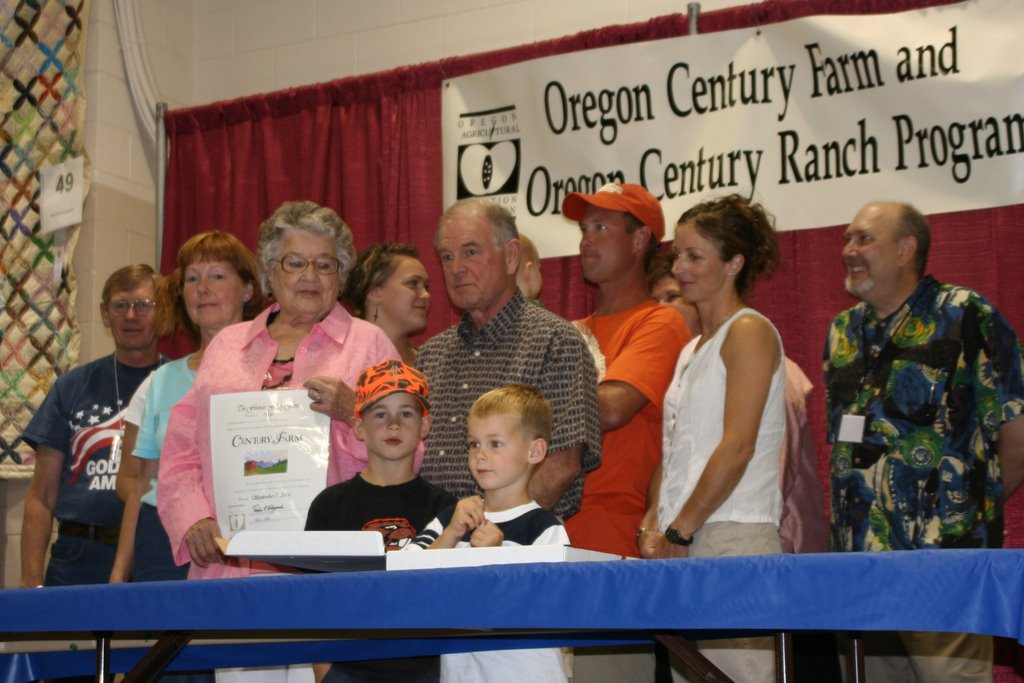
However, one of the bright spots was seeing the kids who accompanied parents and grandparents upon the stage. There remains hope that the family farms will continue.
Later in the afternoon was a reception held by the Oregon State Fair Foundation. This was the third and final reception in a series that were held during the state fair, and allowed Dave Koellermeier, the new manager of the Oregon State Fair under the state Parks and Recreation Department, to announce some of the changes that were done for this year. More importantly, he shared his vision for the future, including the themes for the state fair for the next three years.
Kollermeirer’s enthusiasm was infectious to the crowds. He invited them to share with him what changes they thought were needed for the future. He then spent considerable time going table to table, introducing himself to everyone and asking for their feedback.
Combined with the feedback he was receiving from the survey booths he introduced around the fairgrounds this year, each day he could examine the results.
Kollermeirer got a good idea of what people like and don’t like about the fair. Add that he had held several meetings around the state long before the state ran this year, and he presented a good formula to change the trend of declining attendance at the fair. By last night, he was predicting that overall attendance should be up about 10 percent from the year before.
He plans more follow-up meetings in the future.
A farmer himself, Kollermeirer really emphasized bringing agriculture back to being a significant part of the state fair, while still appealing to a more general audience with a variety of entertainment, exhibits and events to attract more people to come, stay longer and spend more money.
One of the events that helped attract people was a chance to watch professional bull riders challenge tough bulls while rock music boomed in the Pavilion. Glancing around at who attended the event, it included a lot of people who had participated in other events earlier in the day either as exhibitors, competitors or spectators. Obviously they felt it was worth it to stay a few extra hours.
One of the people who enjoyed the rodeo event the most was Marcus Morgan, a farmer and auctioneer from the Dalles who won the Oregon auctioneer competition, the first time in his three years of competing that he has won the top award.
For Morgan, it was an extra treat to watch the bucking bulls. Why?
He admitted that in the past he had been a bullrider himself. The highest he ever got in an event was second place, the winner’s buckle eluding him. As he began to near 30 years old, he decided to try earning a buckle a different way: as an auctioneer. 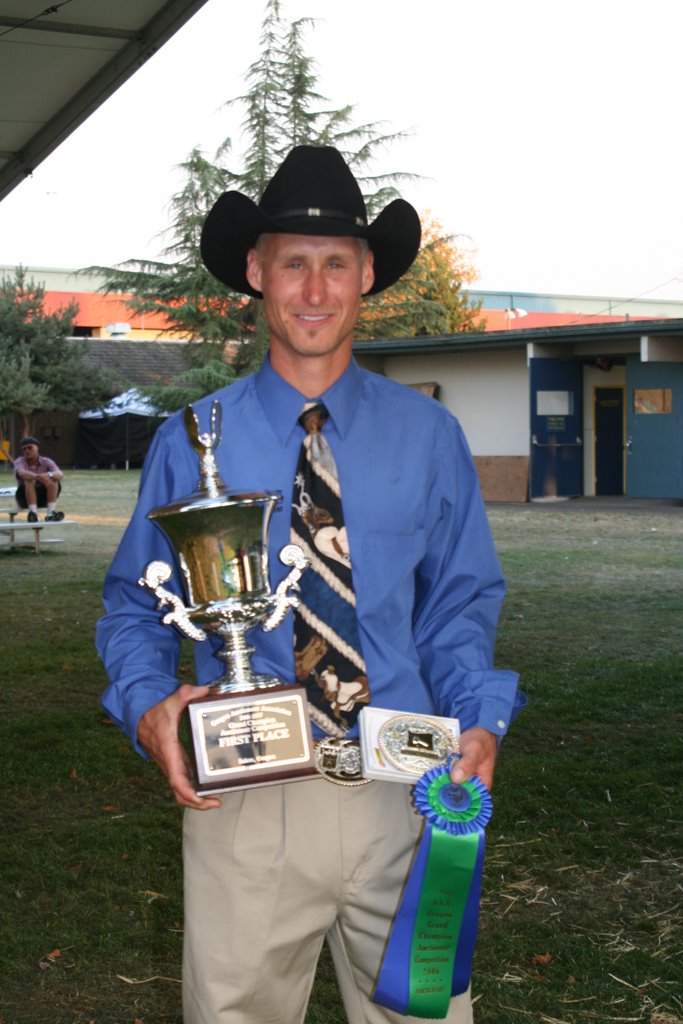
He had a shiny silver buckle and a huge trophy at the end of the day to show his success, while still wearing a silver rodeo buckle from Las Vegas that one of his uncles had given him.
As people left at the end of the day, they saw the last reflections of whirling rides in the windows of the combine, heard a mix of music and chatter, and carried off their large prizes or slipped away with empty pockets.
No matter what they did for the day, they had received at least a glimpse of agriculture and a taste of the roots of the state fair, as well as a hint of where it will go in the future.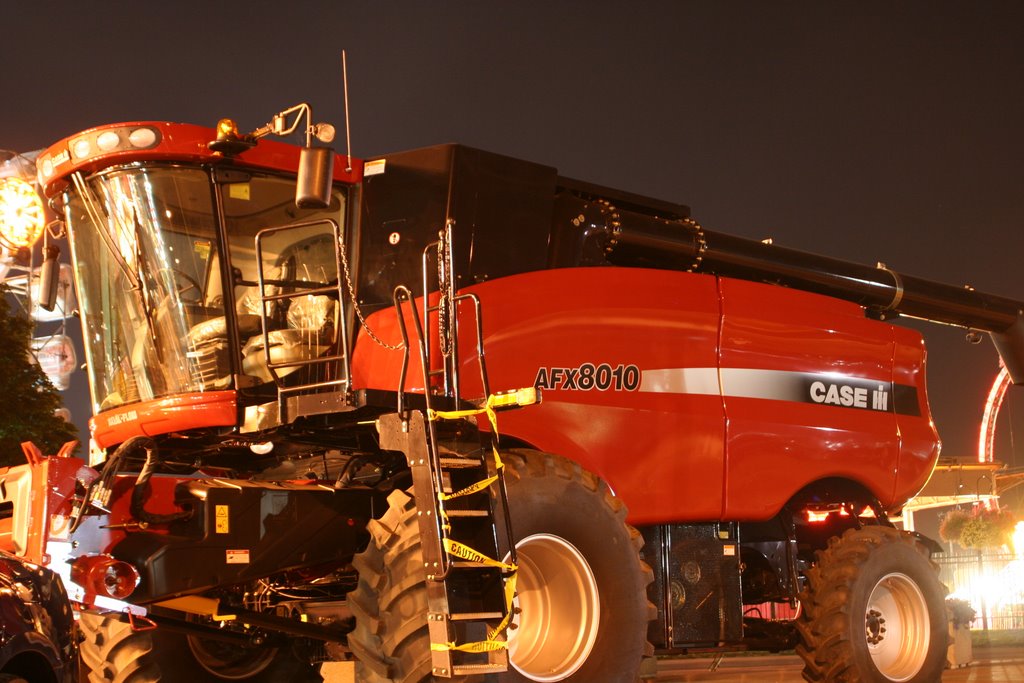
Agriculture

Anyone who loves to hear the chant of a good auctioneer will love to attend the Oregon Auctioneer Championship being held at the Oregon State Fair on Saturday night in Salem.
The event takes place from 5 to 7:30 p.m. in the 4-H/FFA Judging Tent as the competitors hold a live public auction and are judged on several different criteria.
Being a good auctioneer involves a lot of things. It’s not just what they say but how they say it, what are their showmanship skills like, how successful are they interacting with the crowd and influencing them to buy.
And for anyone who hires these auctioneers, such as at farm auctions, one of the most important things is how high can they raise the bids so the bottom line will be successful.
For people who attend this event each year, they’ll hear some familiar voices competing. Often it’s the same group of auctioneers, with a few exceptions, and it’s enjoyable to witness their recognizable styles but also to see what they change from year to year.
Holding these types of competitions are great because the auctioneers do learn from each other and often support each other. They will sometimes bid on each other’s items. Sometimes it’s because they really want to go home with a good deal, but sometimes it’s to help out their competitors.
Stay tuned to Capital Press (and this blog space) to find out who the winners are this year.
Agriculture


