Showing posts with label 4-H. Show all posts

Monday, April 18, 2011

Youngsters show skills at horse show

...


In the top photo, Patty Doolittle (left), 12, talks with Ashley Neau, 11, both of Redding, Calif., before competing in Saturday's West Valley 4-H buckle horse show at the Palo Cedro Riders' arena in Palo Cedro, Calif. At bottom, 16-year-old Will Fletcher of Susanville was the only boy in the contest.

About 20 youngsters participated. For my story on Saturday's horse show, check CapitalPress.com soon.

Thursday, January 20, 2011

Local 4-Hers help the homeless

Sharyn Cornelius of the East Valley Times in Palo Cedro, Calif., reports:

Members of local 4-H clubs have formed a mobile soup kitchen to provide a hot lunch for homeless people one day a month. On Monday, Jan. 17, a school holiday, three members of the Twin Palms and Cow Creek clubs—Dani Plake, Karah Harbuck, and Ruth Bailey–gathered in the Millville kitchen of Adrienne Hulst, Cow Creek 4-H community leader, to cook up a batch of chili and bake cornbread muffins. They will also hand out bottled water and canned peaches.

Hulst, who is also the goat project leader, had to help one of her young charges with a goat-birthing emergency that morning, but she left the young cooks under the capable supervision of her daughter Sierra, Twin Palms community leader Lynette Plake, and mothers Heather Dyer and Jennifer Collins.

As the girls poured cornbread batter into muffin cups and stirred the chili, they talked about what it meant to them to be able to help the homeless and what they had learned from the experience.

More here.

Thursday, May 13, 2010

Hog-callers turn into swinemasters at California fair


Chase Ruiz, 5, of Dixon, a first-year hogcalling contest, won his age division to the delight of emcee Donnie Huffman of Vacaville, president of the Friends of Dixon May Fair. (Photo by Marilyn Sexton)

From Kathy Keatley Garvey at UC-Davis:

DIXON, Calif.--Hogcallers turned into “swinemasters” at the eighth annual Dixon May Fair Hogcalling Contest as they tried to coax 250-pound porkers into four-squeal drive and hamward bound.

“Boss Hog” Nick Stacey of Dixon won the adult division for the fifth year with a series of oinks and “soo-eys” while the 2009 high school champion Annaley Herzog, 16, of Vacaville teamed with Rachel Fink, 16, to win the 14-17 age division by doing a rap song about much-desired Billy Currington tickets.

Chase Ruiz, 5, of Dixon won his age category, 5 and under. He brought home the bacon with loud snorts. Lindsay Tryba, 11, of Dixon, a member of the Roving Clovers 4-H Club, Dixon, swept the 6-to-13 age category by pleading “I need some bacon with my eggs.”

“It was fantastic and a swine time at the fair,” said emcee Donnie Huffman of Vacaville, president of the Friends of Dixon May Fair, which sponsors the annual event. “We had great participants and we held it in our new swine pavilion.”

Hogcallers had one minute to call the hogs, using only their voice. First-place winners in the upper age categories received two tickets to the Billy Currington concert at the fair. Winners in the under 5 and 6 to 13 age groups received carnival tickets, compliments of Butler Amusements.

Contestants yelled everything from “Soo-ey!” to “Here, piggy, piggy” to specific food references in attempts to coax them over. Judging was on hog response, audience response, creativity and originality.

Judges were Mary Harris of Vacaville, vice president of the Dixon May Fair Board of Directors; Hendrick Crowell of Fairfield, member and past president of the fair board; Richard Byrum of Fairfield, president of Butler Amusements; and JoAn Giannoni of Dixon, secretary of Friends of Dixon May Fair.

None of the hogs pulled any hamstrings, Huffman said, but one hog wanted to root in the sawdust and take a nap.

Stacey, whose daughter used to raise pigs, wore a shirt lettered with “Boss Hog” on the front. The back indicated the years he’s won the competition.

Herzog, accompanied by Fink, rapped out why they wanted tickets to the Currington concert.

Herzog, a contestant in the Dixon May Fair’s Royalty Court and a member of the Tremont 4-H Club, Dixon, with horse and poultry projects, wrote and delivered a rap song:

“Here piggy, pig
Come over here
Please hurry up
The prize is near
I want some Billy Currington tickets
All for me
So, come over her
Please, please, please.”

She later reported that the Currington concert was “awesome” and that she’ll be back to the hogcalling next year to defend her title.

When Roving Clovers 4-H Club member Katie Luedke, 15, of Dixon called the hogs, on cue her friend and fellow Roving Clovers 4-H’er Stephanie Marshall, 16, of Vacaville squealed, jumped the fence, entered the ring and hugged her, much to the audience’s delight.

When it was her turn to call, Marshall, wearing her 4-H uniform, got the “pig idea” and went whole hog, coaxing two hogs over to her at the same time.

Champion Chase Ruiz, in his first time hogcalling, said he learned how to hogcall from his brother, a contestant from previous years.

Three members of the Gary and Lisa Short family of Dixon called the hogs. Dad Gary won second; son, Eli, 10, won third in the 6-13 age division, while son Caleb, 12, also participated but didn’t land in the winners’ division.

Providing the hogs were Garrett Pryor, 10, and his sister, Allison Pryor, 12, of Dixon and their friend, Cody Meitrott, 10, all members of the Maine Prairie 4-H Club. Garrett’s hog is named Jimmy (after Jimmy Dean of hot pork sausage fame); Cody named his hog, Bacon, and Alison named hers Lefty.

The winners:

Adults: 1st, Nick Stacey of Dixon; 2nd, Gary Short, Dixon; and 3rd, Silvin Forcier of Dixon.

14-17 or in high school: 1st: Annaley Herzog, 16 and Rachel Fink, 16, both of Vacaville; 2nd: Katie Luedke of Dixon; and 3rd, Stephanie Marshall, 16, Vacaville.

6 through 13: 1st, Lindsay Tryba, 11, Dixon; 2nd, K-La Duncan, 11, Dixon; 3rd, Eli Short, 10, Dixon; and 4th, Josh Marshall, 7, Vacaville.

5 and under: 1st, Chase Ruiz, 5, Dixon; 2nd, Dallan Roebemy, 5, Dixon; 3rd, Natasha Patterson, 3, Benicia; and 4th, Parker Franceschi, 5, Dixon.

Huffman, a former 4-H club swine leader, entertained the crowd with pig jokes, including

“How do you take a pig to the hospital?”
In an hambulance.

“Do you know the name of a famous ice cream company?”
Hog ‘n Dazs (Haagen-Dazs)

“What do you call a pig that studies karate?”
Pork chop.

Why should you never tell a pig a secret?
Because he might squeal.

Saturday, February 21, 2009

4-H Fundraiser Gathers Excitement in Polk County, Oregon

February 21st made for a big Saturday night at the Polk County Fairgrounds in
Rickreall, Oregon.

The 4-H Spaghetti Feed was hosted by area Polk County 4-H Clubs, including The 4-H Achievers, Spring Valley Riders and Small Animal Express. The colorful array of events included cake walk, games, 50 silent auctions items, and two bike raffles. Proceeds for the event went to the 2009 Polk County Relay for Life to support the American Cancer Society.


Polk Country members of the 4-H Achiever's Club: Lori Smith (parent), Zachary Odegard, Sierra McBeth and Debbie Macbeth (parent). Zachary and Sierra were instrumental in getting donations for the auction and dinner at tonight's event. Dinner was prepared by Tater's Cafe of Dallas.

Friday, June 29, 2007

Celebrity machinery: a new line of income?

Any farmer with some old machinery around the fields or yard may be considering what’s the best thing to do when it’s time to get rid of it.

There’s always the auction route, but you never what that final bid will look like. There’s a possibility to trade in that machine at a dealership, depending on how well it works. A newspaper classified ad is another option, since one farmer’s junk might be another one’s treasure when it comes to filling a need for parts. More farmers lately have also decided higher scrap metal prices are a nice incentive to clean up some of that broken down machinery piled up around the yard.

And now there’s another option that perhaps has some potential: why not market it a celebrity piece of equipment?

A press release from New Holland explained how a small tractor helped raise $7,100: “The one-of-a-kind New Holland compact tractor autographed by more than two dozen celebrities who competed in the popular “Michael Peterson/New Holland Celebrity Tractor Race” during the 2006 CMA Music Festival Fan Fair in Nashville is now owned by Kyle Wilson, Agro Equipment Co., Uvalde, TX. Wilson was the online auction winner for this first celebrity tractor.”


The money went for a valuable cause. “Proceeds from the auction will benefit St. Jude Children’s Research Hospital and Habitat for Humanity, the charity selected by 2006 Celebrity Tractor Race winner, country music artist Wade Hayes, who also autographed the tractor….

“The winner of the 2007 “Michael Peterson/New Holland Celebrity Tractor Race” which was held on June 10 at this year’s CMA Music Festival in Nashville is Todd Fritsch, country music star. Fritsch beat out 40 other celebrities to win this year’s race and chose Saddle Up!, a therapeutic recreational horseback riding program for children with mental and physical disabilities, for his charity. When this year’s celebrity-autographed tractor is auctioned off, the proceeds will be split between the National FFA and Saddle Up!” said the release.

The tractor that was auctioned off was a blue New Holland TZ22DA Boomer sub-compact tractor with a 60” mower deck.

True, it looks a bit smaller, newer and cleaner than some of the machinery around farms, but don’t give up. Remember, the autographs on the machine will be worth more than the nice paint job and whether the machinery actually works.

Why, who knows, someone might think a few layers of rust and dust add authenticity and show this is a longtime, hard-working machine that deserves respect.

So gather up those who tractors, plows, seeders, and anything else you can find, and start writing celebrities and their agents. It’s time to start a campaign to encourage celebrities to autograph farm machinery; even better, warmly invite the celebrities to work an hour or two on the fields sitting in the seats of those tractors, combines or swathers. That way, it’s easier to market as being actually operated by the star, the celebrity gains a whole new appreciation for the job of a farmer — and some work gets done, too.

When selling the machinery later, explain it’s for a good cause: you can donate funds to FFA, 4-H or another organization that benefits your community.

Or, use the money to help your own bottom line. You deserve a few extra dollars for helping feed the world.

Technorati tags:

Thursday, November 09, 2006

4-H isn't just about sheep anymore

It's not just some new politicians that earned tickets to Washington, D.C., this week. A special tree from Washington state is also on its way to the nation's capital.

A lot of Pacific Northwest media outlets have picked up on the story since, shockingly, it is the first time a tree from Washington state has been picked for the national Christmas tree. But there is one news outlet that had some special coverage of the event.

Young Claire Turner of 4-H Network News interviewed Gov. Chris Gregoire in Olympia about the honor for the Evergreen State. You can follow the link at below to see video of that interview. And if you are interesting in some of the other things happening with 4-H in Washington state, you might want to check out the 4-H Network News blog out of Jefferson County, Wash.

While you check that out, I'll be polishing up my resume, because if people like Miss Claire Turner are delving into this whole multimedia reporting thing at such a young age, I may soon be replaced by a 12-year old.

Cookson Beecher, a Capital Press staff writer in Washington forwarding the link to the video, thanks to a head's-up she got from Gov. Gregoire's staff.

Claire Turner Interviews Gov. Gregoire About the Capitol Christmas Tree


Sunday, September 03, 2006

Ag Day mixes history with future


So how was Ag Day at the Oregon State Fair?

Busy.

For those who are interested in agriculture, there was a lot to enjoy.

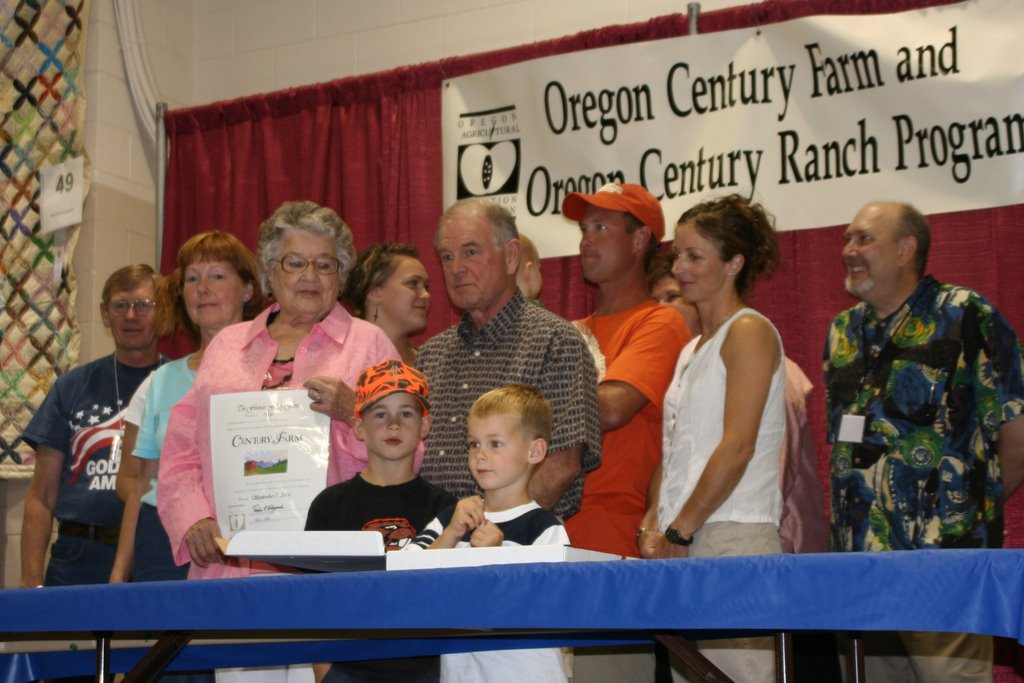
Some of the special invents included the Century Farm awards, the Oregon Auctioneers Association annual competition, an Ag Day reception for an invitation-only crowd, a professional bull riders event, and more than 20 agricultural business vendors that came with special displays for the day.

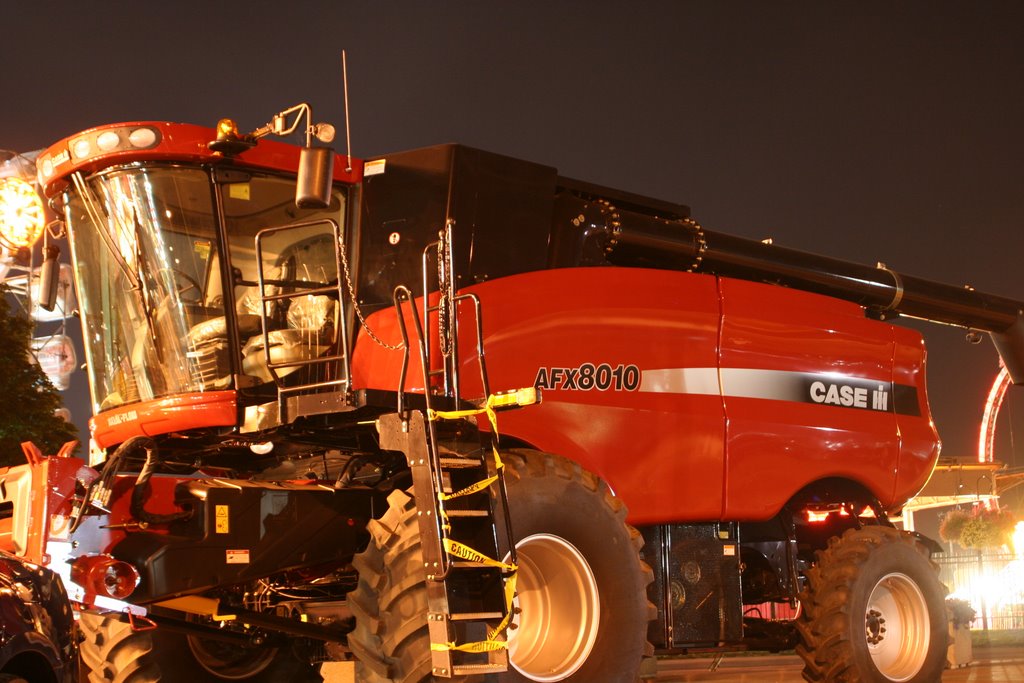
One of the highlights was a large Case IH combine and a Caterpillar tractor just outside the main gates inviting people into the state fair and being their last image when they departed.

While unfortunately those curious to see the inside of these great machines were faced with yellow tape to keep them off the steps, kids as well as adults enjoyed the chance to see up close what usually toils hard in the fields.

Holding an Ag Day was a brilliant idea: while during a state fair there is the usual showing of animals and poultry, 4-H and FFA displays and competitions, and awards for everything from huge pumpkins to exquisite quilting patterns, these other events helped to show other sides of American agriculture.

The Century Farm program, held in the Jackman-Long building, involved a ceremony to honor families who have been at least 100 years in Oregon. In the few minutes that sometimes large families gathered on the stage, visitors heard a short version of why these families settled here, how they did it, how they grew and change and adapted to survive until now. What came through was how much they did adapt, how proud these family members are to be on the same homestead, and how important it is to them to know their heritage. This includes the triumphs but also the challenges along the way.

One of the families also mentioned how much they learned and enjoyed researching to know more about their family history when they were preparing their application for the program.

It’s too bad the awards program allowed only a few minutes to be told about each family. Such a rich family history deserves so much more honor and time to share.
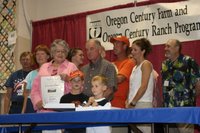


However, one of the bright spots was seeing the kids who accompanied parents and grandparents upon the stage. There remains hope that the family farms will continue.

Later in the afternoon was a reception held by the Oregon State Fair Foundation. This was the third and final reception in a series that were held during the state fair, and allowed Dave Koellermeier, the new manager of the Oregon State Fair under the state Parks and Recreation Department, to announce some of the changes that were done for this year. More importantly, he shared his vision for the future, including the themes for the state fair for the next three years.
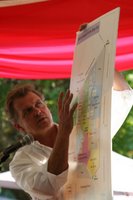


Kollermeirer’s enthusiasm was infectious to the crowds. He invited them to share with him what changes they thought were needed for the future. He then spent considerable time going table to table, introducing himself to everyone and asking for their feedback.

Combined with the feedback he was receiving from the survey booths he introduced around the fairgrounds this year, each day he could examine the results.

Kollermeirer got a good idea of what people like and don’t like about the fair. Add that he had held several meetings around the state long before the state ran this year, and he presented a good formula to change the trend of declining attendance at the fair. By last night, he was predicting that overall attendance should be up about 10 percent from the year before.
He plans more follow-up meetings in the future.

A farmer himself, Kollermeirer really emphasized bringing agriculture back to being a significant part of the state fair, while still appealing to a more general audience with a variety of entertainment, exhibits and events to attract more people to come, stay longer and spend more money.

One of the events that helped attract people was a chance to watch professional bull riders challenge tough bulls while rock music boomed in the Pavilion. Glancing around at who attended the event, it included a lot of people who had participated in other events earlier in the day either as exhibitors, competitors or spectators. Obviously they felt it was worth it to stay a few extra hours.
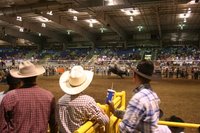


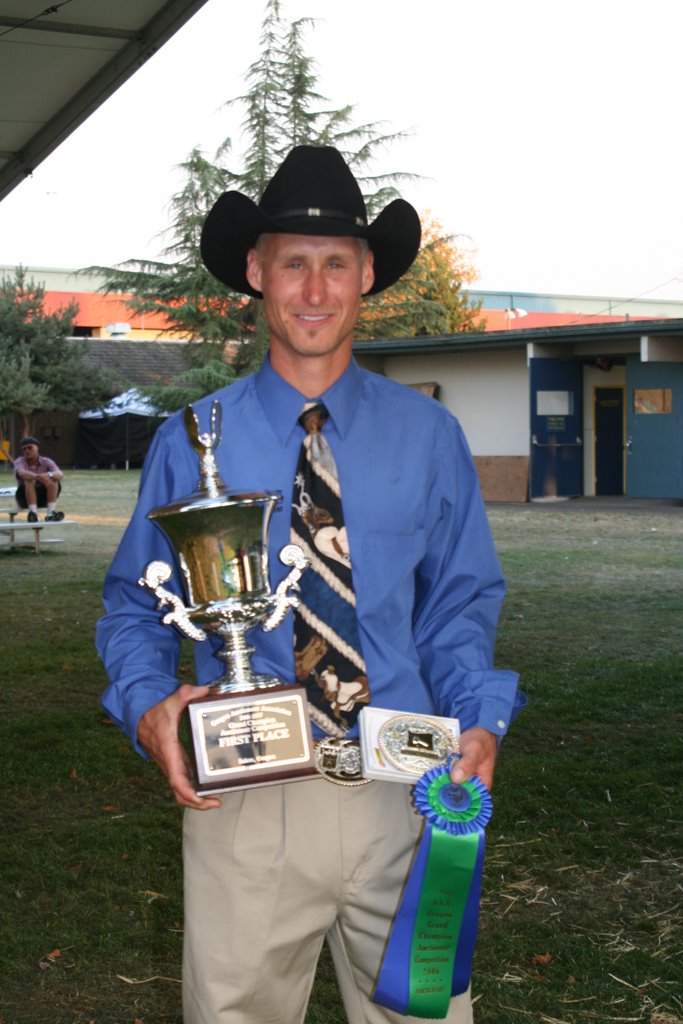
One of the people who enjoyed the rodeo event the most was Marcus Morgan, a farmer and auctioneer from the Dalles who won the Oregon auctioneer competition, the first time in his three years of competing that he has won the top award.
For Morgan, it was an extra treat to watch the bucking bulls. Why?

He admitted that in the past he had been a bullrider himself. The highest he ever got in an event was second place, the winner’s buckle eluding him. As he began to near 30 years old, he decided to try earning a buckle a different way: as an auctioneer.
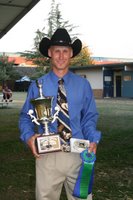


He had a shiny silver buckle and a huge trophy at the end of the day to show his success, while still wearing a silver rodeo buckle from Las Vegas that one of his uncles had given him.

As people left at the end of the day, they saw the last reflections of whirling rides in the windows of the combine, heard a mix of music and chatter, and carried off their large prizes or slipped away with empty pockets.

No matter what they did for the day, they had received at least a glimpse of agriculture and a taste of the roots of the state fair, as well as a hint of where it will go in the future.


Friday, September 01, 2006

Going once... going twice....going Saturday?


Anyone who loves to hear the chant of a good auctioneer will love to attend the Oregon Auctioneer Championship being held at the Oregon State Fair on Saturday night in Salem.

The event takes place from 5 to 7:30 p.m. in the 4-H/FFA Judging Tent as the competitors hold a live public auction and are judged on several different criteria.

Being a good auctioneer involves a lot of things. It’s not just what they say but how they say it, what are their showmanship skills like, how successful are they interacting with the crowd and influencing them to buy.

And for anyone who hires these auctioneers, such as at farm auctions, one of the most important things is how high can they raise the bids so the bottom line will be successful.

For people who attend this event each year, they’ll hear some familiar voices competing. Often it’s the same group of auctioneers, with a few exceptions, and it’s enjoyable to witness their recognizable styles but also to see what they change from year to year.

Holding these types of competitions are great because the auctioneers do learn from each other and often support each other. They will sometimes bid on each other’s items. Sometimes it’s because they really want to go home with a good deal, but sometimes it’s to help out their competitors.

Stay tuned to Capital Press (and this blog space) to find out who the winners are this year.


Ag in the West social media watch

Capital Press videos on YouTube

Our most popular videos