This week at Capital Press we are busy putting together the final touches on a climate change package, the second installment of a three-part series we’re doing together with our sister newspapers in the East Oregonian Publishing Company.
Using our resources from various newspapers in different locations in the West helps give an interesting perspective to this upcoming special section. We have stories that look at the impact on crops, animals and forests, but our newspapers on the coast also picked up what happens to ocean life as the climate changes even a few degrees.
Tackling a large issue like climate change can be daunting: almost every day there seems to be research papers or political discussions in different parts of the world on how to deal with what appears to be definitely happening in our world. How can our newspapers stay on top of everything happening? The truth is, we can’t, especially not with modest resources of a small publishing company as we continue to also serve our readers — whether they are a farm audience, for the Capital Press, or a seaside audience like that of the Daily Astorian, or a mixed rural-urban audience like the East Oregonian serves.
But we tried to touch on some of the things that are happening in the West and put it into perspective on how climate change has already or may affect things that grow. This ranges from animals to plants to forests to sea life.
Our print edition carries the section on Sept. 22. Stay tuned to www.capitalpress.com in upcoming weeks as we post our whole special section online, or see how the Daily Astorian's packaged the latest installment here. You and also see our previous installments of the series here.
Again, feedback is welcomed.
Agriculture
Climate change
Monday, September 11, 2006
Climate change package coming soon
Posted by
Elaine Shein
at
1:39 PM
0
comments
Labels: climate change
Round-Up time again
This blog, or an earlier incarnation of it anyway, was born one year ago this month. It began as posts on the main Capital Press website.
If was our first attempt at providing "live" coverage of an event, the Pendleton Round-Up. And it didn't look or act very bloggish (click here to see last year's "blog" posts related to the Round-Up). There were 14 posts in all, with entries from before, during and after the event, in addition to the coverage that ran in the Sept. 23, 2005, edition of Capital Press. Ten of the posts were made from the Round-Up grounds or some more remote location in Eastern Oregon (namely using a dial-up connection from my parents' home/business on Buttercreek Highway outside the small town of Echo).
But it was something of the beginning of an experiment. When I first started talking about creating a blog for our website or making multiple live updates a day from an event, there were a few people that looked at me a bit funny. You could read the "why?" in their eyes.
Even now, I'm not sure I have a good answer. In no small part, the potentially unsatisfying answer was simply "Because we can."
The world of technology has come a long way since 1985, the year I covered my first Pendleton Round-Up. But if you drive east on Interstate 84 toward Pendleton, the landscape looks much as it did 21 years ago. In fact there are probably at least a few pieces of farm equipment that work those rolling wheat fields now that were working those same fields more than two decades ago.
You have to look close to see the difference. Some of the equipment used to farm that land today is filled with all sort of technological gadgets not found in wide use, if used at all, back them. Cell phones are standard issue for everyone from the farm operator to the lowest-paid farm hand. Global positioning satellite equipments directs the airplanes that apply fertilizer, pesticides and herbicides to the crops. Farmers not only have e-mail, they can check it from their cell phones or other palm-sized electronic devices they can carry with them.
And even on the Round-Up grounds, there were phone lines for laptop computers and even wireless access in 2005. That's what made posts from the grounds possible, sometimes mere minutes after an event had ended.
While the people who make of the core rodeo fan base -- farmers, ranchers and rural residents -- are the same folks who make up the Capital Press subscriber base, our newspaper has not made a habit of covering the sport as a sport. Our staff members have been known to attend a rodeo or two, and put a picture or even a short story in the paper. But we have not covered the sport per se, complete with results event-by-event. For our sister paper, the East Oregonian, which is based in Pendleton, Round-Up is part sports event, part community festival, part tourist attraction and and part freak show, all wrapped in rawhide and topped off with a fancy felt hat. They cover the event like a proverbial Pendleton blanket.
This week I will be heading back to Pendleton, along with Mark Rozin, the Capital Press photo coordinator. And the plan at the moment is to do more blog posts from the event, on Thursday and Friday. So look for live updates here and on CapitalPress.com, and see Mark's photos in the Sept. 22 edition of Capital Press.
Agriculture
Pendleton Round-Up
Rodeo
Blogging
Posted by
Unknown
at
11:12 AM
0
comments
Labels: rodeo
Friday, September 08, 2006
Living (temporarily) with a crown: what does a dairy princess do?

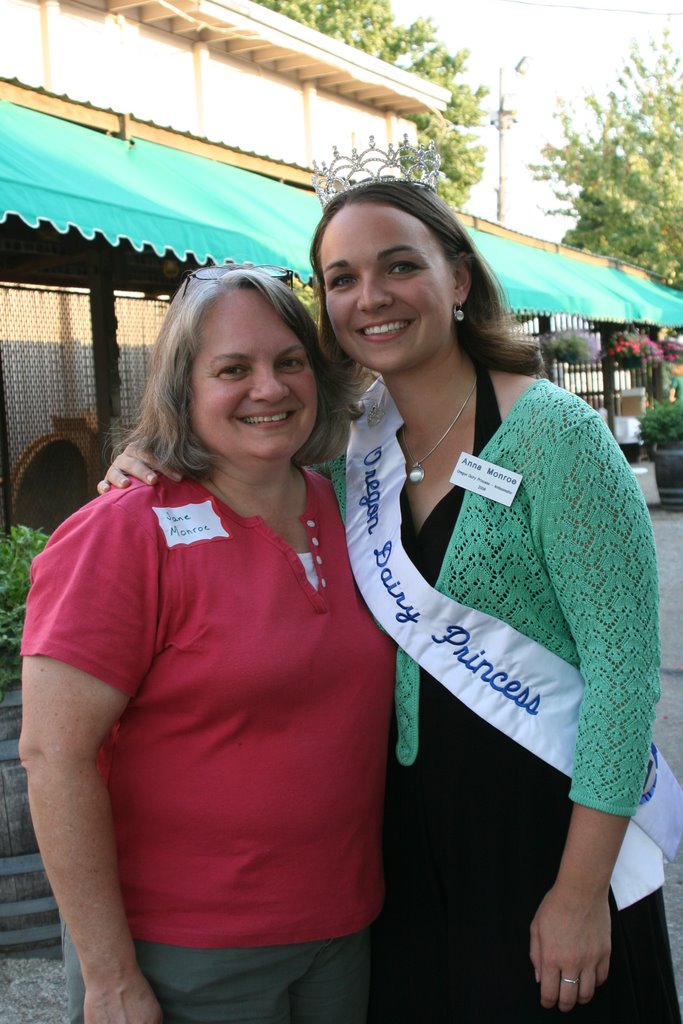
When I first saw the Oregon Dairy Princess Anna Monroe do a speech earlier this year at a Dairy Herd Improvement Association meeting in McMinnville, I wondered at that point how many times she had already done her same speech over and over again about how healthy and nutritious milk is for people.
It was obvious she had the speech and all its statistics memorized by that point, as well as calculated how much time she had to do her presentation.
Last weekend, during the Oregon State Fair, we met again. She had time for an interview, and next week’s paper will profile the interview and some of her audio quotes will appear on www.capitalpress.com.
There were a few things that stood out when I meet her this time around.
First, how much her self-confidence has grown. This is one of the best things about any of these people that serve in ambassador positions, whether it’s a rodeo queen, a dairy princess, or some other position that represents an organization, an event, a community or a state. After doing so many presentations to different groups of people and often to schools, these young ambassadors mature and learn a lot of skills they can apply to other jobs later in life.
Another thing that stood out was how she was more comfortable and able to adapt to her audiences. She explained that one day she may talk to dairy farmers who have been involved in the business for years, and the next she may talk to 6-year-olds who ask questions about whether chocolate milk comes from brown cows or why isn’t there a dairy queen instead of princess.
In one case, a young boy was quite determined to become better than princess. Crying, he kept insisting he wanted to be a dairy queen some day.
And then there are questions from kids that a lot of us probably would not have imagined.
Like when do cows give milk. When they calf, she’d reply.
That would then open the doors to questions like, when do they calf, how do they calf, and how did the calf get inside the cow in the first place.
At times like that, Monroe hesitates, thinks again about what would be age-appropriate information to share, and can launch into rather detailed explanations especially if it’s a teenage audience.
For younger kids, it’s sometimes easier to say their teachers or parents should handle those questions.
Another lasting impression from Monroe last weekend was how close she is to her mom, who escorted her around the fairgrounds last weekend while Monroe did her duties complete with crown and sash.
It was evident that the mother was very proud of her daughter, but best of all they genuinely enjoy hanging out together, as Anna Monroe explained.
She said she had been in university a couple of years but being the dairy princess allowed her to spend this summer traveling around and getting to know her mother better. At the same time, her mother had a chance to see her daughter mature and grow as she performed her duties.
Often as reporters we cover events where we hear speeches done by these ambassadors. We do stories in the beginning when they first start these honorary positions, such as what is their background, what are their ambitions and goals and why did they think they won. We quote some of their speeches, and present the messages they have given their audiences.
However, we don’t always follow up later with how does the reign go, what have these people learned, and what are some of their experiences.
Last weekend's meeting with Monroe and her mother showed a temporary glimpse of her life beyond the crown, as well as when she's wearing it.
Stay tuned to the Capital Press website for the story next week.
Agriculture
Posted by
Elaine Shein
at
2:42 PM
1 comments
Labels: dairy
Wednesday, September 06, 2006
Sharing stories about staff in house ads

A new house ad campaign by Capital Press is a bit different than in the past.
Rather than try to entice people to subscribe, advertise or to buy something to support our Newspaper in Education program, the campaign focuses on how our newspaper has ties to agricultural communities.
In some cases, our staff shares how they grew up on or worked on farms in the past. Some of our staff still farm today, even while working different jobs at Capital Press.
Other staff volunteer to help out in their communities or give back to organizations they respect.
Other parts of the ad campaign show that Capital Press often gives back to communities in different ways, such as sponsoring events ranging from 4-H shows to charity banquets.
The pictures combines quotes, a bit of background, and pictures of the staff. The pictures include talking to farmers, being in Legislative buildings, riding a horse, visiting a farmers’ market, picking vegetables from their gardens and doing other such things.
Not everyone will be in an ad, but the campaign does give the newspaper a chance to show our customers who are the people that put this newspaper together. It includes editorial reporters, but also people in circulation, advertising and administration, and also highlights the contributions of our staff in other states we cover.
Perhaps the most rewarding part of this whole campaign is that it is not only our customers who might feel they get to know our staff better.
Even within our newspaper’s office we are getting a glimpse of another side of some of the people we may have worked alongside for years.
Who knew they had a farming background or what jobs people had before Capital Press, or why they wanted to work for this newspaper? It’s always humbling to learn about what people do as volunteers in the community when they aren’t at work. And what really comes through is everyone’s passion for agriculture, their respect for farmers, their pride of working for Capital Press, and their sincerity and desire to do their best for customers.
It will take a few months for all the ads to rotate through the various editions of the newspaper. We first concentrated on having the zoned editions focus on our staff who work in that state. For example, Washington has seen ads on Cookson Beecher, Idaho on Pat McCoy, and California on Ali Bay.
We may put all the house ads in one place on our website in case our readers want to see the ads all in one place. Hopefully, we’ll also receive feedback on what people think of this ad campaign.
The ads also give the contact information for these staff so people know who they can call in their area with story or photo ideas, or who to call for ads in their region.
Some examples of what our staff said in the ads:
“I was attracted to the opportunity because my dad and grandparents always had a CP laying around to read on Sunday morning. When I was little I would look at the pictures. As I grew up I started to read it. It seemed like a great way for me to use my degree in marketing while still being able to be in the ag industry that I grew up in and loved.”
Lindsey Harder, ad rep for eastern Washington, Northern Idaho and Montana
“We’re not writing news, we’re writing history.”
Cookson Beecher, reporter, Washington state
“I see a lot of people really committed and dedicated to provide their membership with the things they need — they’re trying to help their industry and help them understand the issues, and it’s impressive to watch because of their sincerity and commitment.”
Pat McCoy, reporter, Idaho
“I enjoy traveling off the beaten path, meeting unique people in the industry who have fascinating stories.”
Ali Bay, reporter, California
“Working on farms has given me more of an appreciation for farming and ranching.
As a teenager, working on farms in western Idaho gave me an appreciation for the hard work that is required on farms.”
Dave Wilkins, reporter, Idaho
“We like to talk to the customers to get their feedback so that we can provide them with a relevant, informative and useful product and better customer service.”
Terrie Reisner, circulation manager.
Agriculture
Posted by
Elaine Shein
at
10:26 AM
1 comments
Labels: Capital Press
Monday, September 04, 2006
In memory of George Petroccione
I was goofing round online, not doing anything in particular, and ended up on the website of the Albany Democrat-Herald newspaper in Albany, Ore. I've known several people who've worked there over the years, people I've worked with at other newspapers and such, and decided to see if an old friend of mine from college was still working there.
I ran his name through the search on the website, figuring it would lead me to some recent article he may have written. And I got a blank. So I went to Google and ran his name through there. And the first item that came up floored me. It was an obituary from the National Press Photographers Association for the name I was looking for, George Petroccione.
I've been back in Oregon for more than a year and while I've wondered what George has been up to several times, I've never tried to get in touch with him. I've always been too busy or some other excuse. And now I find out I'm too late, by more than two months.
I met George in college. He worked for me as a photographer on the staff of The Daily Barometer, the campus student newspaper. He eventually succeeded me as photo editor and surpassed me, becoming editor of the paper before he left Oregon State. I made it to managing editor, but the year I graduated another person we were both close to in college, Debra Rogers, became editor. George succeeded her the following year.
George and I spent a lot of time together my last couple of years at school. One year we drove from Corvallis to Los Angeles to cover the Pac-10 basketball tournament together. On the way south we stopped in Sacramento where his mother lived. She welcomed me in like a long lost member of the family.
His wife Sharon was always welcoming too and kind when I knocked on their door or called at some odd hour. Sharon had an easy smile, quite a contrast to George's almost stoic nature.
George took me out to dinner at a very nice restaurant, The Gables, in Corvallis once. I think it was for my birthday. Somewhere in my collection of photos and mementos I still have a Polaroid picture pasted into a stiff paper cover to commemorate the occasion. I think I'll have to dig that out.
It was funny. On one hand I was George's boss, but in another way, George and his wife Sharon took me under their wing to look out for me and make sure I was OK. They were sort of like, a favorite uncle and aunt in that way. You see George, though an undergraduate at Oregon State, had lived some life before pursuing his degree. He was what we called an "older than average student." Being notoriously bad at guessing people's ages, I never had a good feel for how much older George was, and really it never mattered. He was a good photographer, a good journalist and a friend. That was all I needed to know. As it turns out, I think he would have been somewhere about the age I am now.
One of my great professional regrets involved George and occurred a few years after graduating from college. I had been hired as the editor of a weekly paper in Northeast Oregon. I don't remember how the conversation started, but I had contacted George about the opening. Maybe I was just wondering if he knew anyone that might be interested. But I ended up hiring George, convincing him to move from his longtime home in Albany. Not long after, the newspaper and I parted company. And I felt like I had abandoned and let down a friend. Years later I told George of that great regret, but in his typical fashion he mostly waved it off and let me off the hook.
George was a pretty laid-back guy. Nothing seemed to rattle him or throw him off stride. He could look gruff at times, but if you were lucky enough to see that hint of a smile curl up the corners of his lips, you knew he was a guy with a kind heart. But he was a mysterious man as well. As much time as we spent together talking about photography and philosophy and how to make our little corner of the journalistic world a better place, I didn't truly know the man beneath the mustache so pale it was hard to tell if it was blond or white.
The sad irony is I've thought about George several times since returning to Oregon. We were in touch off and on over the years when I was in California. But I had not been in touch since returning home. Just the other day while stopped at a traffic light, I could have sworn the man in the car next to me was George. He had less hair than I remembered George having, but then again so do I. If it wasn't George, it could easily have been a relative. And he was driving a green pickup-type vehicle. I can't remember the model, but seeing the man behind the wheel and the color of the pickup reminded me so much of this old green import truck George drove when we were in school together. I think it was a Datsun with a camper shell on it. I made a mental note to look up George's phone number when I got home. It seemed a good excuse to call and catch up on some old times.
I guess I got distracted at home and never looked to see if I could find out where he might be, until today. Now I know that wasn't George in the truck next to me. He had already moved on down another road.
Memorial
Posted by
Unknown
at
2:20 PM
1 comments
Sunday, September 03, 2006
Ag Day mixes history with future

So how was Ag Day at the Oregon State Fair?
Busy.
For those who are interested in agriculture, there was a lot to enjoy.
Some of the special invents included the Century Farm awards, the Oregon Auctioneers Association annual competition, an Ag Day reception for an invitation-only crowd, a professional bull riders event, and more than 20 agricultural business vendors that came with special displays for the day.
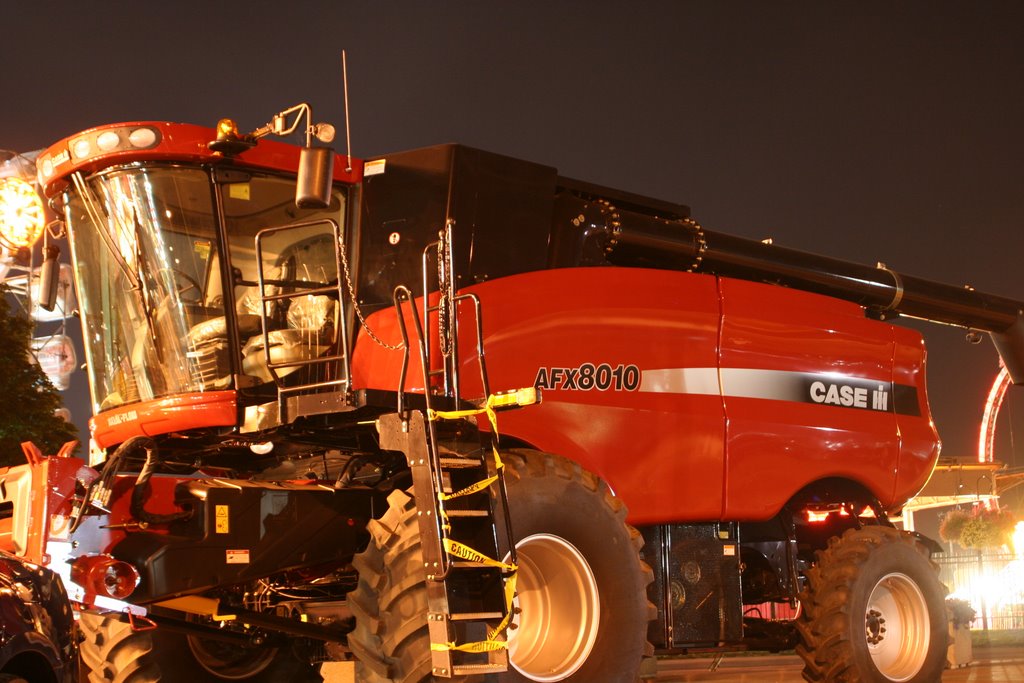
One of the highlights was a large Case IH combine and a Caterpillar tractor just outside the main gates inviting people into the state fair and being their last image when they departed.
While unfortunately those curious to see the inside of these great machines were faced with yellow tape to keep them off the steps, kids as well as adults enjoyed the chance to see up close what usually toils hard in the fields.
Holding an Ag Day was a brilliant idea: while during a state fair there is the usual showing of animals and poultry, 4-H and FFA displays and competitions, and awards for everything from huge pumpkins to exquisite quilting patterns, these other events helped to show other sides of American agriculture.
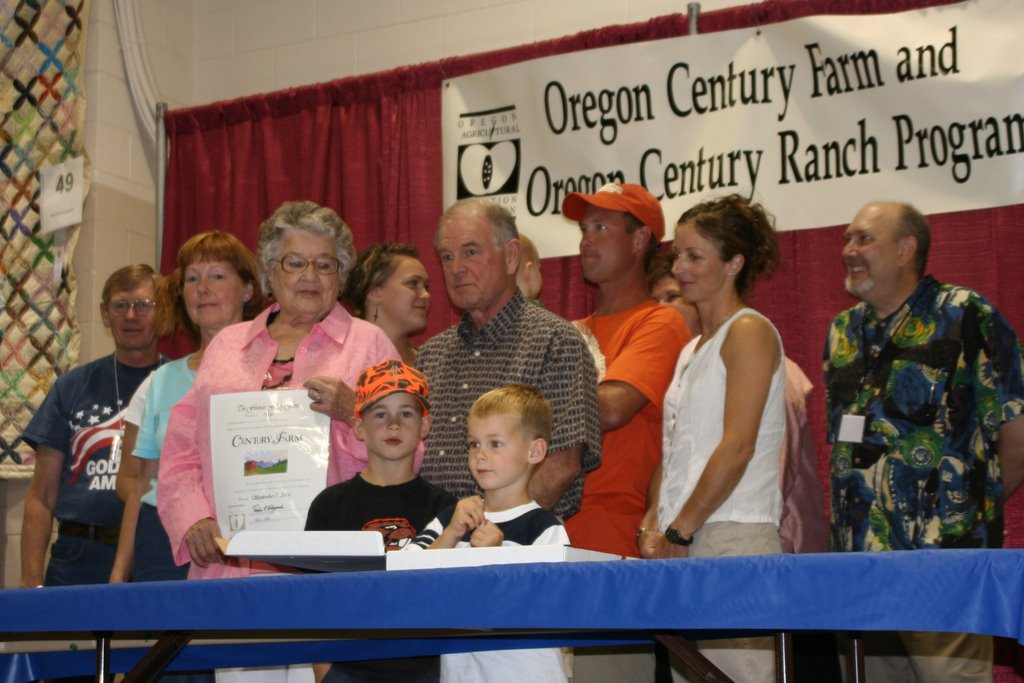
The Century Farm program, held in the Jackman-Long building, involved a ceremony to honor families who have been at least 100 years in Oregon. In the few minutes that sometimes large families gathered on the stage, visitors heard a short version of why these families settled here, how they did it, how they grew and change and adapted to survive until now. What came through was how much they did adapt, how proud these family members are to be on the same homestead, and how important it is to them to know their heritage. This includes the triumphs but also the challenges along the way.
One of the families also mentioned how much they learned and enjoyed researching to know more about their family history when they were preparing their application for the program.
It’s too bad the awards program allowed only a few minutes to be told about each family. Such a rich family history deserves so much more honor and time to share.
However, one of the bright spots was seeing the kids who accompanied parents and grandparents upon the stage. There remains hope that the family farms will continue.
Later in the afternoon was a reception held by the Oregon State Fair Foundation. This was the third and final reception in a series that were held during the state fair, and allowed Dave Koellermeier, the new manager of the Oregon State Fair under the state Parks and Recreation Department, to announce some of the changes that were done for this year. More importantly, he shared his vision for the future, including the themes for the state fair for the next three years.
Kollermeirer’s enthusiasm was infectious to the crowds. He invited them to share with him what changes they thought were needed for the future. He then spent considerable time going table to table, introducing himself to everyone and asking for their feedback.
Combined with the feedback he was receiving from the survey booths he introduced around the fairgrounds this year, each day he could examine the results.
Kollermeirer got a good idea of what people like and don’t like about the fair. Add that he had held several meetings around the state long before the state ran this year, and he presented a good formula to change the trend of declining attendance at the fair. By last night, he was predicting that overall attendance should be up about 10 percent from the year before.
He plans more follow-up meetings in the future.
A farmer himself, Kollermeirer really emphasized bringing agriculture back to being a significant part of the state fair, while still appealing to a more general audience with a variety of entertainment, exhibits and events to attract more people to come, stay longer and spend more money.
One of the events that helped attract people was a chance to watch professional bull riders challenge tough bulls while rock music boomed in the Pavilion. Glancing around at who attended the event, it included a lot of people who had participated in other events earlier in the day either as exhibitors, competitors or spectators. Obviously they felt it was worth it to stay a few extra hours.
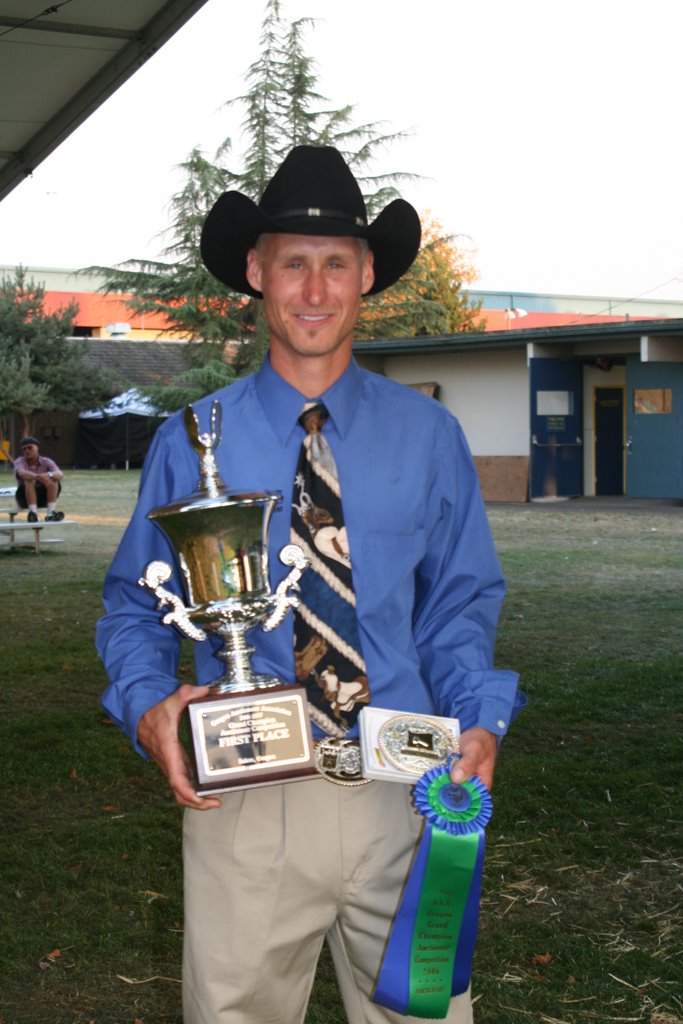
One of the people who enjoyed the rodeo event the most was Marcus Morgan, a farmer and auctioneer from the Dalles who won the Oregon auctioneer competition, the first time in his three years of competing that he has won the top award.
For Morgan, it was an extra treat to watch the bucking bulls. Why?
He admitted that in the past he had been a bullrider himself. The highest he ever got in an event was second place, the winner’s buckle eluding him. As he began to near 30 years old, he decided to try earning a buckle a different way: as an auctioneer. 
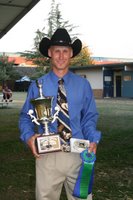
He had a shiny silver buckle and a huge trophy at the end of the day to show his success, while still wearing a silver rodeo buckle from Las Vegas that one of his uncles had given him.
As people left at the end of the day, they saw the last reflections of whirling rides in the windows of the combine, heard a mix of music and chatter, and carried off their large prizes or slipped away with empty pockets.
No matter what they did for the day, they had received at least a glimpse of agriculture and a taste of the roots of the state fair, as well as a hint of where it will go in the future.
Agriculture
Posted by
Elaine Shein
at
7:19 PM
0
comments