Showing posts with label pets. Show all posts

Sunday, July 27, 2008

Onward (Eastward?) on the Oregon Trail

Next year, Oregon will celebrate its 150th anniversary as a state — its sesquicentennial.

Celebrations will include people talking about where they came from, a lot of them from the Midwest and other parts of the country, venturing forth along the challenging Oregon Trail as so many people sought to start new homes in the Western frontier.

I’m bucking the trend — I’m moving from the West to Nebraska later this week. I’m actually planning to travel along the Oregon Trail route, although in less time than the covered wagons needed. It depends a bit on how heavy traffic is during the summer tourist season.

To relive the spirit of moving livestock along the trail, I’m taking one of my cats with me: I expect yowling from the cat carrier most of the way. At 14 years old (72 in human years), Mac will be quite cranky about the trip from Oregon to Nebraska. I might be pretty cranky myself about Mac by the time we reach Nebraska, and I expect to age a few years myself.

It’s amazing how many people in the West have ties to Nebraska. As soon as I mentioned I’m moving to Omaha, people began to share they were from there, their grandparents or parents were from there, they went to university there, what they know about college football or the college baseball championships in Nebraska, or even that they have a tie with corn on it from there…

Corn has become the main topic of conversation for people. As in “they grow a lot of corn there, right?” or “I hope you like corn.”

Some people just decided to share corny jokes with me. I’d pop one into the blog if I had a good one, but people might be looking to this blog for kernels of wisdom.

OK, here’s one: What has ears but cannot hear? A field of corn.

Maybe I should stick to my day job… hmm … actually, I am at a point where I am between my day jobs. But before anyone runs off screaming from the corn punishment, I assure you I am much too busy packing boxes for my move and couldn’t possibly think of any more corn humor to puntificate about.

But I digress from the subject of moving.

As I prepare to move, I have found nightly visitors have decided it’s time to bid me farewell. Currently I am juggling a family of raccoons and a skunk. The latter seems most determined to visit the cats’ food dish. The cats seem determined to run after the skunk. I fear that at some point the skunk will run after the cats. I am willing to bet it will be the day I leave for Nebraska, and the cats will be determined to climb into the car as I load it up for the trip. That would be a catastrophe. Especially if the cats decide to hitch a ride with me up until say, Hood River.

So if you see a packed car — with a yowling cat, Oregon license plates, and faint skunk odor trailing it pass through your West/Midwest states later this week — don’t worry.

I’m just reliving the settlers’ journey (with a few changes) on the Oregon Trail in the opposite direction.

Wednesday, May 14, 2008

The cat came back — 22 days later


When our cat disappeared April 15, it was just another reason to hate tax deadline day.

What surprised us was this was the toughest, most street-savvy cat of our three cats. Originally a stray cat, she adopted us more than four years ago as a scrawny, starving, bob-tailed cat that was determined to convince us that our home was actually her home.

Or at least the yard was her domain.

We learned to respect her wishes, and also begain to provide food daily to her as well as a comfy cushion bed and several blankets for her just outside our house door. She even trained us to tuck her in at night when it was cold.

Gentle, loving and easy to purr, Bobbi became part of our family that has since grown to include three cats in total. She also adopted a second family — our neighbors across the street, and she constantly walked back and forth to share her time almost equally between our two yards.

But Bobbi also showed us how tough she can be. She would chase off any stray cats, wild animals or anything else that challenged her territory. A couple of times we saw her not just raccoons out of the yard, but actually ride their backs — she would stand on them, all her claws sunk deep into the poor confused animals that were several times her size.

Needless to say, we always thought this cat could take care of herself, even with all the wild animals on the prowl each night and eagles often soaring overhead.

But then she disappared on April 15. Not a clue of her was around, no signs of fights or scuffles and even fur. Our neighbors and us mourned her absence as the days stretched.

We checked ads for missing/found cats, phoned veterinarian offices, and animal shelters. It was heart-wrenching to go to the humane society and see so many other lost or homeless cats and dogs — but no signs of her.

"I'm sorry," apologized one of the workers at the humane society. "I know you wanted closure."

I found that word was one of the most troubling emotionally. When you hear "closure" you think immediately that hope is gone that she might still be found alive.

Our cat who spent the most time with Bobbi outside was also deeply mourning the loss of his companion. Several years younger than her, he meowed often each day for her and continually searched familiar and unfamiliar places, attempting to find her. He wanted more attention from us than usual, and wanted in and out of the house more often, so determined to continue his search for her.

But then, 22 days after she disappeared, Bobbi came home.

She had lost many pounds. She just walked into the yard one afternoon, meowing loudly to let us know she was back. One could easily feel her ribs and backbone, and she seemed as light as feather when we lifted her up. But somehow she had found her way home, hungry and exhausted, but apparently happy to return to two families — and a cat buddy — that missed her so much. Rusty quickly ran to her and rubbed heads with Bobbi, both of them purring.

We wish Bobbi could talk. We wish we had a tracking device or camera on her, to find out what she did for so many days. We wonder if she accidentally climbed into one of the many construction vehicles that had been on our street April 15, or whether she got locked accidentally in someone's garage, or if someone stole her or whether she had decided to go for one last big adventure by herself.

We just don't know. In a city where there are so many other cats on the streets, perhaps no one even noticed this bobtailed skinny tabby with the big heart as she wandered in search of her home.

All we know is Bobbi is home — and it's good to have her back.

Friday, January 04, 2008

I won't give a finch!

By Kevin Duling

Animals typically rule the roost at my place. I always presumed I would just have a dog and maybe even a cat. Throughout time and a few unfortunate events, I was left with two cats, fourteen chickens, a barn full of guinea hens, a pet steer, a dog, some wild quail which must be fed daily, and lastly, two finches.

When I leave for a small vacation, (all my vacations must be small with that many animals) I have to print out a detailed map of instructions on the appropriate care of each animal. The two finches, Frederick and Francine Finch, are by far the highest maintenance of all.

Daily care for finches involves simply changing their water, blowing the chaff off their food dish, giving them five fresh leaves of spinach, replacing the millet stalk, and wiping the poop off the perches. For the sake of time and entertainment value, I did not mention the cage cleaning, mite control, the proper mixing of charcoal with the gravel, the cuttlebone, and keeping the thermostat constantly above 65 degrees.

A few years back I was contemplating whether to give them to someone else or keep them. Frederick was busy trying to get a small piece of a millet branch into their nest. It was slightly too big and too slippery to stay inside. Frederick would place it in position and the branch would slide back out, falling the far twelve inches to the cage floor.

Two hours later, Frederick was still trying to get the small stick to stay up in his nest, while Francine waited patiently on the nearby perch. Finally, after hours of work and toil, Frederick got his branch to stay. With a cheerful little song he decided to get some approval from Francine.

As they sat together on the perch looking horizontally at their nest, the branch decided to fall back out. Frederick’s reaction was an ear piercing “CHIRP!” I do not speak finch well, but I do know this was not a kind word. After Frederick’s sinful outburst, Francine glanced at Frederick and began to verbally let him have it.

It was not until evening when I discovered the extent of Frederick’s verbal discharge. For the first time, Francine would not let Frederick into the nest. He had crossed a line and he was in big trouble. For a full week Frederick slept on top of the nest, while his spouse slept inside.
Finally, after trying for seven long nights, she allowed him to come back in and sleep in the bedroom. The happy little couple hasn’t had a problem like that since. I have managed to witness at least a dozen traits from these two that would correspond directly to a married couple.

Being engaged, I have to ask myself what verbal outburst I am capable of that will end with me on the couch for a week. I am also curious what I will have to do to get me off the couch. One would not think one could learn so much from a pair of birds, whose aggregate weight equals about 2 ounces.

Life hasn’t always been perfectly rosy for the two finches. They have suffered through a week of paint thinner fumes, a week of staying at the grandparents while the paint dried, numerous temporary furnace outages, some heat waves, a cat dangling from the cage, and the time I tried to start a fire with the chimney completely plugged. All of these events were life-threatening to the finches, but together they made it through.

Hardship comes every spring and fall when I clean out their nest, which requires them to rebuild with tiny sticks and pieces of napkin. After a couple of hours of remorse and complaining, they get to work.

These little guys may be the highest maintenance pets in the world, but their character, perseverance, trust, and loyalty make them almost worth it. I won’t give a finch.

Kevin Duling is a wheat farmer from Maupin, Ore. His stories will be posted on the Capital Press blog every Friday. Comments are welcomed at kevinddul@aol.com .

Copyright, January 2008, Kevin Duling

Monday, October 08, 2007

Just call me trapper...

Just call me Trapper.

Who would have thought I would need to move into a city to become a successful trapper of wild animals. I had grown up in a family of hunters, trappers and fishers: I’m the type of person that carries a fishing rod and reel in the back of my car wherever I go.

But I usually left trapping to my father and brothers.

However, welcome to Salem. Who would have imagined there would be so many wild animals around? We have deer bringing their fawns into our backyard to nibble on any freshly-planting bulb plants and nestle in for the night under a large evergreen tree.

Raccoons have made us part of their weekly visiting tours of the neighborhood. Nutria occasionally wandered into the area. Opossums have really started to hang out in our yard, several of them taking turns to climb over our deck furniture to see if there is any leftover cat food goodies spilled around from other critters. Squirrels love running along our fences, up the trees, and scamper over our house roof several times a day … before they leap several feet to tree branches.

Needless to say, this wildlife party needed to be stopped. The midnight snacks for them were starting to get expensive. When I would adjust the times of when our cat’s food was outside, the animals changed their habits of finding the food. Nocturnal animals switched their wanderings faster than humans adapt to the fall time change. At times, it seemed like a revolving door at our place, where I would chase away one animal in time to see another waddling, hopping, crawling or simply meandering curiously into the yard. I swear they had a code they shared among each other: one would divert my attention, another would dash to the food bowl.

Borrowing a cage trap from a neighbor, I became … the Trapper. I learned how to set the trap, what was the best bait, and when to set it.

We promptly caught one of our cats twice, and another of our cats once. The first time the younger cat was caught — while he still a young kitten — our horrified neighbors that the cat was dead. There it was, an orange furball with its eyes closed, and all four legs stuck in the air.

As she hurried to what she thought was its corpse, she heard … snoring. Yes, the kitten, tired of playing within it trap, had simply tuckered itself out and fell asleep in that position. It wasn’t until Rusty yawned that my neighbor realized all was well and it was safe to tell me she had caught the cat.

It took a few months, but eventually we managed to keep the cats out and started to catch the wild animals.

To date, four opossums have been kindly relocated to new homes. I have had a chance to study them closely, including their rat-like tales, their long claws, their strange ears and noses and how they like to open their mouths to hiss at enemies. And that was before I trapped them. I discovered they really needed to be trapped, because gentle persuasion such as yelling “shoo”, spraying water at them and poking them with a long broom handle does nothing to make them move. They just open their mouths, hiss, and cling even tighter to the furniture they’re clinging on to that evening with those claws.

I figured at least with the trap, I offered them a decent last meal or two before we carted them away.

About 6 a.m. this morning, I discovered a new visitor in the trap. In the dark of morning, I carried a flashlight and noticed the trap door was shut. I was just about to round the corner of the house to take a better look at what was in the cage when I saw the flash of black fur with a white stripe. The tail was raised toward me, warning me not to come closer.

I hastily backed up. My family — and especially our farm dogs — had enough experiences with skunks in the past that I didn’t need a second warning.

So now I had a new challenge.

What does one do with a skunk after catching it? I admit it. I hadn’t thought through that part as well as I probably should have when I first began trapping the animals.

I soon discovered with a bit of quick research in the phone book and online that the days of the city or county helping get rid of wildlife pests is long gone. Instead, private pest control people exist and warn people on their websites about how they’re very expensive, but they deserve to be paid as high as electricians and plumbers for their specialty skills they need to get rid of your pests. That is never a good sign to see people warn you they’re going to be very expensive prior to even doing an estimate to shock you with their high prices.

I also researched the animals we’ve had as visitors, and how often and how numerous are their litters of offspring. Add a couple hundred dollars or more for each critter captured if it is helped by pest control … and this could cost more than the monthly mortgage. My three cats and I might become the new scavengers to survive.

Meanwhile, at work I chatted with some people about how does one get rid of skunks. Of course, it led to the next topic of conversation: how does one get rid of the skunk odor after you accidentally get sprayed from trying to get rid of skunks. Seems one problem usually follows the other.

Consensus seems to be that you can forget whatever you heard about tomato juice getting the odor out of your clothes or off you or even to help your pets. Burn the clothes, shave the pets, and become a hermit for a couple of months seemed to be the collective opinion of wise people here.

Fortunately, I have great neighbors. When they heard about my recent trapping success, they offered to escort the skunk to a new home. Last I heard, they covered up the cage ith a blanket and carried off the skunk to their truck…

Tonight, I think I better go thank them gratefully for their brave help. I might carry over some tomato juice and matches, too, just in case.


Technorati tags:

Monday, August 20, 2007

All peachy at our place

It seemed like a good idea at the time: Instead of spending a lot of money at a grocery store, or even shopping at the farmers’ markets, why not go direct to an orchard to pick our own fruit?

On Saturday, we visited Daum’s Produce Farm on Wallace Road, north of Salem. We visit the area often but had never visited their orchard although we had bought often from the family at their farmer’s market stand in the past.

Merrily we ventured forth, cloth bags in hand, ready to pick sweet, juicy peaches for ourselves.

We learned several valuable lessons that day.

First, we should have asked what varieties of peaches grew in the different rows in the orchard. That would have been handy later to know which ones would mature the quickest, which are better for freezing or eating soon, etc.

Secondly, visiting an orchard is a bit like visiting a candy shop. There are so many to peaches to pick, you just don’t want to stop. Cost becomes irrelevant. All logic escapes of what can humanly be consumed by two people. All you know is that you want to pick more, more, more!

Thirdly, we should have asked for a lesson on “how to pick the fruit at its best.” What seemed ripe to us was apparently too overripe when we examined the fruit later at home. And we also had a few cases of some peaches being far from ripe. Maybe we should have trusted the experts.

Fourth, when picking a large amount of fruit, have a game plan. What should be done with the fruit later? We came back with our three bags’ of fruit with — oh, I don’t know, say 50 peaches or so — and then awkwardly realized we had no canning skills, didn’t really want to freeze them all, and there was no way we could eat all those peaches even if we had peaches every couple of hours day and night.

The peaches were picked on Saturday. As of this morning, the kitchen table was still filled with a large number of peaches, even after we had devoured several in the last couple of days and made peach sauce from an applesauce recipe. We will begin to offer fruit to our neighbors this afternoon. We will refuse to accept zucchini in return. Peach cobbler recipes are being hunted in recipe books. We might let the cats play with a peach or two to keep them amused.

Well, okay, to keep us amused as we continue to ponder what to do with so many peaches.

I wonder where we can go next to find our own nectarines to pick…


Technorati tags:

Wednesday, August 08, 2007

National Night Out attracts neighbors

Last night was National Night Out Against Crime, and our neighborhood in Salem was one of the ones that participated by holding a block party.

Actually, a several-block party. The neighborhood association invited people from several blocks around to participate.

We all gathered at the end of a dead-end street, threw down a few lawn chairs and plastic tables, and shared a few dishes among our neighbors. Kids ran after each other in the street, adults introduced themselves to each other, and representatives from the local police department gave tips on how to protect us against crime.

We were assured that our street was one of the safer areas in town. Not all of us felt that safe, knowing of a few thefts on our block within the last three years. These ranging from a house break-in where a large number of tools were stolen, to someone stealing a few solar lanterns from someone’s driveway, to cars being stolen.

This morning, we woke up in time to see the neighbor across the street had his yard toilet-papered by possible vandals or friends: streams of paper all over a tree, ripped up chunks all over the lawn. We were a bit unsettled to know that we had calmly slept through it all.

We’ve had our share of suspicious activity, but when compared to other neighborhoods, this seems to be one of the luckier areas to live.

Advice from police

The police officer advised us all to keep an eye on our streets, lock our doors, register our bikes with the city, be careful with our valuables, and never leave unlocked vehicles idling in our driveways.

It’s sad, really, that we need such lessons. I think of how life is different from when I grew up on a farm where we encouraged to keep doors unlocked in case a neighbor visited us for something and we weren’t there to help. The neighbor could find that cup of sugar in the kitchen, tools in the garage or even borrow that vehicle for an emergency trip. All we asked in return was a quickly jotted note left on our kitchen table explaining where and why something had happened — and often there were such notes.

Vehicles were left unlocked with keys in the ignition. Part of it was because we were constantly on the go, and you never knew who would need which old pickup or grain truck at what time and for what purpose. Rather than wasting time scrambling for hidden keys, we just jumped in the vehicle we needed and headed for our destination.

Changing times

But as I listened last night to the list of what to do to protect property, I thought about how crime has begun to hit our farm and so many others. We have had various things stolen. We don’t trust strangers as much when they come to the yard. We lock our doors. We’re suspicious of why people ask us certain questions.

Back to life in the city: how was the event last night?

It served its purpose. We discussed crime and its prevention, but we also admired or sympathized with people’s projects in their yards and homes. We borrowed ideas from each other. We shared recipes and tips on raising kids and pets. And we plotted how as a community we could catch the raccoons, skunks and squirrels that seem to enjoy our areas as much as we do.

We heard how three big raccoons have terrorized cats and dogs, chewed on sprinkler heads, enjoyed snails and fish from ponds, and generally made a nuisance of themselves yet successfully avoided all our efforts to trap them.

Time to leave

As the evening ended and people began to fold up their chairs and wander down the street to their homes, someone mused how it would be great to have these events more often and not just once a year.

In rural areas, there are fowl suppers, dances, weddings, funerals, local school graduations, bingo nights or local drama events that tie a community together. Everyone gets to know their neighbors for miles around.

In a city, sadly, we often don’t even know our next door neighbors.


Technorati tags:


Wednesday, July 18, 2007

Oprah and lessons from pets

Today one of the entertainment stories was about how Oprah Winfrey is mourning the loss of her two-year-old golden retriever named Gracie.

The dog has died after choking on a plastic ball that belonged to another of Oprah’s dogs, a 12-year-old cocker spaniel named Sophie.

Oh, sure. It was accidental. Anyone that has more than one pet knows that an older animal is usually very jealous when a new pet joins the family. While the pets may show outwards affection or attempts to get along, there usually is a strong jealousy factor on behalf of the older dog.

They may call this accidental, but remember — it WAS the ball of the older dog, wasn’t it? And it appears she WAS sharing it, right? We all know how well dogs share their toys. Go ahead, tell me this wasn’t a pet conspiracy.

Being a pet owner myself, I do sympathize with Oprah. It always is tough to lose a pet, accidentally or even when a veterinarian advises that a loved pet needs to be “put down” because of age or illness.

Recently, visiting a friend’s place, I heard how their 14-year-old black labrador will probably need to be “put down” soon because of a huge cancer tumor that returned on his side, and a recent stroke that affected his back legs. Looking at his grizzled white face and chin, I realized I have known this dog for most of his life: I had visited him in almost a half dozen places he had moved with his owners during more than a decade. I’ve watched him evolve from a boisterous barking puppy distracted by a bouncing ball to the equivalent of a senior citizen in the dog world as he limped across the yard trying to keep a focused pace with his masters’ steps.

A few days later, on my parents’ farm, I realized old age is hitting our pets there, too. The dog is also more than a decade old and has serious hip and other problems. The elderly farm cat that has become his favorite companion is also experiencing a lot of health problems. During a recent visit by a vet to check a dead calf, the vet glanced at the two limping animals and announced to my family that it was time they should consider “putting down” these two animals. According to him, this should be done before the pets need to suffer another cold winter.

I gave that dog and cat a couple of hugs before leaving the farm, knowing I probably wouldn’t see them again in the next few months before winter — and the inevitable ending of their lives.

I reread the story about Oprah’s dog. When it choked, her security guard and her dog walker tried to save it. When they needed to carry off the dead body, it was on a golf cart. When Oprah wished to share her grief, she used her successful, popular magazine to announce what happened.

On the farms of my friend and my family, their pets will probably face much more modest conclusions to their lives. The owners will be the ones by the side of their pets, no hired staff. The half-ton trucks will probably take the carcass away somewhere, not a golf cart. And there will be no big announcements in flashy magazines.

Oprah said she received some lessons from the death of her dog: In articles about her dog, she said she learned to slow down and catch her breath in life.

Well, actually, I think the bigger lesson in this case was one shouldn’t run with a big plastic ball in your mouth. Or better yet, don’t have a plastic ball in your mouth in the first place.

I thought about what lessons I’ve learned from my many pets over the years. There have been a few.

Never bite a moving vehicle.

Tangling with a porcupine is not fun. And seeking revenge against another porcupine won’t be any funner.

Drinking out of toilets is not always socially acceptable.

Expensive toys are often highly overrated. A cardboard box, a twist tie, or a round plastic container top are much, much more fun.

One can never get enough of catnip in life.

A flea market is no laughing matter if you have fleas.

Being a cat does not always guarantee you will land on your feet.

Not every cat has nine lives, so don’t live like one is still owed.

Never judge your loved ones, always welcome them home like you never thought they’d return, and forgive any misunderstandings immediately. Life is too short to mope.

And finally, it’s better to watch a clothes washing machine from the outside rather than to spin around in Tide.

Actually, I learned this from a friend whose pet experienced a whole wash cycle and still dizzily emerged alive from the ordeal. Cleanest cat in town, although rather woozy for a week or so and hiccupping detergent.

Bet you this will never be a cover story for Oprah’s magazine.

Technorati tags:

Monday, July 16, 2007

Travel home filled with great sights


Travelling the busy highways and dusty gravel roads of three states and three Canadian provinces within a week to get back to my parents’ farm, I felt blessed.

While it meant so much to see loved ones even for a short period of time, I was fortunate to witness many great sights along the way.


On my final day of travel, early one morning I needed to stop the vehicle as a mother moose led her calf across the road near Elkford, British Columbia. Later, down the road, a young deer buck stood unafraid for a few minutes and stared at me long enough to get several photos.

If one prefers machinery to wildlife, a half hour drive away is the largest truck in the world at Sparwood, B.C.: a huge truck that worked at one of the open pit coal mines in the region. The truck became a tourist attraction after the mining company decided this rare truck was too expensive and difficult to maintain for parts.


It’s hard to imagine how such a large truck can toil high up in the mountains. One of my uncles drives a truck — a bit smaller — and tells stories of what it’s like to drive these massive vehicles high in the mountains on foggy winter nights. Barrels of kerosene have straw stuck at the top of them, and then the straw lit on fire. The barrels are placed just enough yards apart for the truckers to be able to see the fires lighting their way up and down the mountain roads.

Such are the challenges for those who deliver coal to an energy-dependent world.

I saw miles and miles of beautiful crops in various stages of ripening, and in particular the colorful patchwork of canola fields that so many prairie farmers are depending on as one of their main cash crops this year.


Some of the last elevators still standing on the prairies remind us of the changing technology and how those elevators once stood as the proud sentinels announcing another small town had been reached.


Storm clouds rose high into the skies and thunder clapped in the distance; late sunsets and almost endless twilight stretched deep into the night, lasting later the further north I traveled. The twilight at my parents’ farm lasted almost three hours’ longer than where I live in Oregon.

Northern lakes beckoned my family to fish: lakes where the water sparkles, loons cry out to each other, and blue herons slowly flap overhead. Coyotes yip from somewhere beyond out sight, blueberries can be found in the underbrush, and best of all, often we are the only humans at the whole lake. Armed with our fishing rods, my father and I spent one relaxing afternoon casting from the shore, Dad’s line arcing across the water as he cast past the lilypads and reeds, and occasionally a Northern Pike could be seen splashing at the end of the hook.

The fishing was good. The next day, my younger brother, Dad and I returned with a boat to the same lake to test deeper waters. Again, we had the lake all to ourselves, as we chatted about fishing, farming and family, or occasionally just quietly sat in the boat and allowed the wind to drift us closer to the shallow fishing spots. All we could hear was the birds in the forest, the squeaking of our reels, and an occasional splash of a fish at the end of our hook.

The week spent at the farm was a time of reflection. Each minute is precious, even the ordinary became extraordinary with the sounds, smells and sights that summer brings to the farm.

The hay had just been cut — the best scent in the whole world.


Rain drops precariously balanced on wheat leaves.

The weather-beaten snow fence along the now abandoned railway near our farm caught the last of the sun’s rays one day and stood out against the ripening wheat crop.


Another fence, another sunset, another day also caught my eye. The fence has gone through so much, but still successfully keeps the cattle where they need to be.


Most of our cattle are gone to summer pastures a few miles away. We have only a couple of heifers at home, waiting for my older brother to transport them to his place soon. Away from the rest of the herd, the two heifers have become almost like inseparable twins — even in the feed bucket.


Each visit home shows how much the community grows older and changes. More deserted farms from neighbors who have retired or passed away. The church could use more maintenance, but it’s hard for the small congregation that now can hold a church service once a year, rather than weekly.


The school my brothers and I attended is now permanently closed, since 2004, and there’s a person living in it by himself. Last year he served some prison time after police discovered he had been growing drugs in the school after it closed. It seems the authorities became suspicious when it was noticed the power bills were higher AFTER the school closed than while students had still attended.

On the farm, I noticed our 300-feet long barn — built in 1939 — is really starting to deteriorate. The barn that had held so many barn dances by the early pioneers in the area when they wished to raise money for a local post office and other services in the community is now badly in need of funds itself. Unfortunately, too much.


I wonder how many people attended dances in this barn over those early years before bales filled the loft instead of dancers. Some of the people who had visited those dances told me they remember there were bands on both ends of the loft, since one band couldn’t play loud enough for the dancers to hear from one end to the other. With guitars, fiddles, accordions and drums, those early bands had so many cowboy boots stomping and high heels spinning, that the memories dance on even decades later for some of these people.

My family now has a sign warning people they can’t go upstairs in the barn anymore. The floor is dangerous in the loft: no longer can anyone even walk across the floor. The loft remains a popular place for bird nests, mice and occasionally stray cats. They keep our dog busy. At 14 years old and with a bad hip, he still believes it's his duty to guard the barn.


Buildings aren’t all that are aging. Visiting relatives and neighbors, with many of them well past retirement age, I noticed the whiter hair, the bit more stooped backs, the slower walking pace. I took time to walk with them a lot: along the country roads, through crops, into the garden patches, and into hilly pastures.

One evening, as I accompanied my father as he checked gopher traps, I gazed up at the silhouette of my father as he walked back towards his half-ton truck. Mosquitoes buzzed around us, coyotes were howling, and a killdeer kept trying to lead us away from her nest. I captured the image with the camera, although I already knew I would carry home that image forever in my mind from that trip.


Driving back the thousand miles or so from the farm, I continued to enjoy the images around me as I crossed provincial, state and country borders: The patchwork of ripening fields, the farm yards and buildings, the small towns and communities that are slowly disappearing but still are home in someone’s heart out there.


At one point, I went off the beaten path. In Washington state, not far from Ritzville, I took the road that leads to the Paha cemetery on top of a hill, then down to Paha Station where farmers delivered their grain.


Paha was a place where a flour mill and other businesses once attracted farmers in the early 1900s. When the mill closed around 1911, this community in the heart of wheat country saw the rest of its town become deserted, until now it has but one family and a few empty or collapsed buildings and an abandoned truck.

Across from the terminal, golden sunset beams blending with the rust on the old truck. This truck had probably in the past driven up and down those nearby surrounding hills that produced some of the best wheat harvests in the world. The truck’s owner had probably gazed on landscape similar to what I had enjoyed earlier that evening, pondered the yields of the crops, what moisture conditions were like, and whether any storm clouds in the distance carried rain.


Sitting in Paha, as clouds began to build to the west, I realized it doesn’t matter where you grow up, which farm you call home, or even what era you live in.

Farmers can always relate to other farmers. They will always feel the tie to the land, marvel at nature around them, appreciate long summer days, and compare their jobs to those of others — and realize there are jobs much worse than farming … Like driving a huge coal mine truck up a foggy mountain in winter.


Technorati tags:

Thursday, March 29, 2007

Oregon's oddities and attractions on display


By Tara S. Polinsky

I moved from Pennsylvania to Oregon in early January and have worked to learn my way around. In the first few weeks, I stuck mainly to Portland’s downtown and Hawthorne Boulevard but decided I wanted to see more. During one of my escapades around the city March 17, I stopped at Powell’s City of Books.

I had never seen anything like it before. I had heard stories, but they didn’t prepare me for the block-long, three-story-high bookstore. I wandered for about two hours, and I’m sure I still didn’t see everything. While I was there, I bought a book called “Oregon Curiosities” by Harriet Baskas with quirky and odd things to see throughout the state. I figured it would give me lots of ideas for fun things to do and help get me acclimated.

Curiously, Powell’s is just one of the offbeat things covered in the book. And the $14.95 was well worth it.

One of the first things that caught my eye in the book was the world’s largest hairball in Mt. Angel, which is just about 20-30 miles from where I live in Wilsonville.

Here’s a little background: Apparently, back in 1941, some workers at a meat-packing plant found a 2 1/2-pound hairball in a 300-pound hog. For some reason, they decided to take it to the St. Benedectine abbey, thinking that was something the monks would like to see. They were right apparently, as the monks accepted this gift and put it in their museum, next to an eight-legged cow, a six-legged calf and many other oddities.


I became obsessed with seeing this hairball. It was all the talk at work all week. But when I went online to find the monks’ museum hours, I learned that it was only open till 4 p.m. on weekdays. That pretty well crushed my hopes of ever seeing it. (It turns out, the hours have now changed from 1 to 5 p.m. for anyone wanting to catch a glimpse of the hairball.)

But at the end of a meeting at work March 23, a fellow copy editor mentioned that he couldn’t get me to stop talking about the hairball. And I lamented the museum times and how it just didn’t seem meant to be. My boss surprised me when he said I could leave work early to check it out.

He told me to be sure to take lots of pictures. I was very excited and found it very hard to concentrate on work the rest of the afternoon.

Most people think the hairball is pretty disgusting, and I had a hard time talking anyone into going with me. I had dinner with friends the night before and tried in vain to get them to see the light. They just kept saying how they have cats, and that’s not something they want to see.

So, I made my way in solitude out to the abbey, which sits at the top of a hill, overlooking rural Oregon. It’s a magnificent view up there and so solemn and peaceful. I was loath to leave when my fun came to an end.

I picked up a map at the library and headed over to the museum, where I was surprised to find two other adventure-seekers. I located the hairball amidst an array of taxidermy animals, quartz stones, various bird eggs, religious artifacts and more. “Random” described the scene well.

One of the other quirky tourists was kind enough to take my photo.

“Do you want the hairball in it?” she asked me.

“Of course!” I proclaimed. “It is the world’s largest, you know.”

She did know. It turns out, they are into the curious and odd, as well, and we talked for quite a while about Oregon oddities. We shared ideas about things to visit, then headed to the bookstore, hoping to find a souvenir of the hairball.

I had visions of hairball T-shirts and magnets and maybe even earrings. But alas, that was not meant to be. I did, however, come across a bumper sticker proclaiming, “I love my German shepherd,” with a picture of the pope on it. I’m not Catholic, but I couldn’t resist buying that! I also found a bottle labeled, “Holy water.” And when I was paying for it, my cashier kindly offered to fill it with said water.

“Sure, if you have some around,” I said. I needn’t have worried. There was a cooler under the counter that dispensed cool holy water.

After that, I said goodbye to my new friends and headed back to more urban environs. I’ve recounted the story many times, and only a few have seen the draw in the giant hairball. But for any other like-minded tourists, take the Woodburn exit off Interstate 5 (#271) and follow Route 214 toward Mt. Angel. When you get to town, turn left on College Road or Church Street and follow the signs to the abbey.

Technorati tags:

Wednesday, March 28, 2007

Rabbits, toads, nutria and other ideas gone horribly wrong

Next time anyone considers smuggling some non-native critter into another state or country, hopefully that person will think twice about the consequences.

Often agriculture has ended up being negatively impacted by what can go wrong when these pets, game targets or science experiments run wild.

Check out ponds or waterways in Oregon, and chances are you’ll soon spot a familiar sight: nutria swimming among the ducks, walking on the muddy banks, or off searching a nearby field for a tasty treat.

If you’re not from the West, the first time you see it, you wonder what is it: beaver? Muskrat? Otter? For those who know it well, the nutria is described in one word: pest.

According to www.dfw.state.or.us/springfield/Nutria.html, nutria means otter in Spanish, and when it first was brought here from South America in the 1930s, people thought it would be a good thing for the state and the fur industry.

According to Oregon’s Department of Fish and Wildlife, “Many hopeful investors started small captive colonies in many locations in the United States, Canada, and many European countries. Many of these farms, however, did not succeed and the animals either escaped or were intentionally released to the wild, which resulted in the wild populations present today. Wild nutria were first reported in Oregon during the 1930s.”

Again, for those of you not in the West, here’s what it looks like, according to ODFW: “A nutria is smaller than a beaver but larger than a muskrat; unlike beavers or muskrats, however, it has a round, slightly haired tail. Nutria have large incisors that are yellow to orange-red on the outer surface. The dense grayish underfur is overlaid by long, glossy guard hairs that vary in color from dark brown to yellowish brown. The guard hairs are long and coarse on the back and finer on the side and the belly. The forelegs are small compared with its body size. The forepaws have five toes; four are clawed and the fifth is reduced in size. The claws are used to groom and to excavate roots, rhizomes, and burrows, and are used in feeding. The hind foot consists of four webbed, strongly clawed toes and one unwebbed toe. The hind legs are large compared with the forelegs; consequently, when moving on land, the nutria's front end is lower than the back end and it appears hunched.

“Nutria are approximately 24 inches long. Their round tail is from 13 to 16 inches long. Males are slightly larger than females; the average weight for a male is about 12-20 pounds, and average weight for a female is approximately 10 to 18 pounds. The ears are small and the eyes are set high on the head.”

Perhaps one of the most important things to note about nutria is this: “Nutria appear to breed throughout the year. Females sometimes give birth to their first litter when they themselves are only 8 or 9 months old. Each adult female produces two or three litters a year. The number of young per litter ranges from 2 to 11 and averages about 5.”

Not to forget: “Nutria are especially fond of alfalfa, clover, root crops, and garden produce (cabbage, carrots, sweet potatoes, etc).”

The department goes on: “Burrows can weaken roadbeds, stream banks, dams, and dikes, which may collapse when the soil is saturated by rain or high water. Rain action can wash out and enlarge collapsed burrows and compounds the damage.

“Nutria depredation on crops is also well documented. Crops that have been damaged include corn, sugar and table beets, alfalfa, wheat, barley, oats, various melons, and a variety of vegetables from home gardens and truck farms. Nutria girdle fruit, nut, deciduous and coniferous forest trees, and ornamental shrubs. They dig up lawns when feeding on the tender roots and shoots of sod grasses.

“At high densities and under certain adverse environmental conditions, foraging nutria can also significantly impact natural plant communities.”

Suddenly those fur-bearing animals don’t seem so lovable anymore. Actually, they’re sort of cute from a distance, but get close to one and as soon as they flash their yellow teeth, the cuteness disappears. Okay, so they are still cuter than opossums…

Lane County in Oregon is one of the places that has had enough of nutria.

According to an Associated Press story, these 20-pound nutria have been bothering people in Eugene and have become nasty.

“They're huge, and they look like a beaver with a rat tail,” resident Jim Hayes was reported as telling the media. “Not only that, but if you corner them, they can get nasty. They rear up on their hind legs and hiss.”

Some areas in Eugene have contemplated even putting in special fences to try to keep the nutria away, but these fences can be expensive and not an option for a lot of people fighting nutria.

And, of course, while the nutria might be stopped from burrowing underneath, the opossums might still find a way to climb into yards.

What to do if that opossum is in the yard? According to ODFW, (www.dfw.state.or.us/springfield/OPOSSUMS.htm) be prepared: “When threatened, the opossum may bare its teeth, growl, hiss, bite, screech, and exude a smelly, greenish fluid from its anal glands. If these defenses are not successful, the opossum may play dead.”

Fortunately, most people in Oregon already find these critters in the latter state — only very dead — and usually quite flat, because often they’re roadkill.

Again, these animals were introduced here, carried from the Southern states by people who probably didn’t think they would become a problem someday. They were just supposed to be something for them to hunt, like they did in the good ol’ South.

These are just two examples of animals that are brought into a new place and there are dire consequences later. People don’t always consider what will happen: how fast do they reproduce? What special needs do they have? Will their diets lead to damage to agricultural crops in the area? How controllable are they? What natural predators are there? Do they spread diseases, cause damage to buildings, maybe harbor secret ambitions to dominate the world someday?

Which brings us to the topic of European rabbits and what they did to Australia.

Wild rabbits are more than just a nuisance there: it’s estimated that each year it costs $600 million in control costs and production losses. First introduced in the late 1700s, most of the problem appears to have originated in 1859 when rabbits were brought in and released as a target for hunting.

Obviously, killing rabbits isn’t as easy as the hunter thought. They began so spread rapidly in the country: soon millions of them were killing off native plants, and competing with livestock for food. Ten rabbits will eat as much grass as one head of sheep.

The Australians have tried everything from a rabbit fence 1,833 kilometers long to trying to introduce viruses to kill the rabbits. Each time there is some success with the viruses — in the 1950s, the virus successfully killed off 99 percent of the infected rabbits — but the population continued to jump back again.

Talk about your hare-raising situation.

In 1990, a cattle rancher in Australia was questioned what it was like when rabbits were at their worst when they attacked his farm. The rancher paused, then lifted his arm towards the horizon. He described what it was like to watch what seemed like a cloud of white slowly move towards him over the hills and through the valleys. He said the rabbits were unstoppable and ate almost edible everything in their path. He reckoned that was what locusts were like in other parts of the world.

As researchers continue to hop to conclusions on how to battle the curse of the rabbits in some parts of Australia, another part of Australia is fighting yet another problem that someone brought into the country.

After the problem with rabbits, surely people should have become more wary of bringing non-native wildlife into Australia.

However, a recent Reuters story said that in 1935 cane toads were brought to Australia from Hawaii to battle native cane beetles. Not only did the toads fail to do that, but they also increased to being 200 million toads.

Probably somewhere out there are the skeptics who first heard about and protested shipping toads into the county and they all exclaimed: “Toad you so!”

So how big is the toad problem?

According to the Reuters story, someone has captured a cane toad the size of a small dog: 8 inches long and just under 2 pounds, about twice the normal size of those toads.

When not scaring people, these poisonous toads have “ led to dramatic declines in populations of native snakes, goanna lizards and quolls, which are cat-sized marsupials,” said Reuters.

So where does this all leave us?

We probably will never truly learn our lesson, as long as there is international travel and people ignorant or stubborn enough to carry creatures from one place to another, for whatever the reason.

And never underestimate how determined people can be.

Last week, according to AP, guards at the Gaza-Egypt border stopped a woman who had three 20-inch long baby crocodiles strapped to her waist under her robe. Apparently, she was part of a smuggling ring that valued each crocodile as potential to earn $500.

The story explained that when the woman was searched, “At first there was a lot of screaming, but a spokeswoman for the European observers who run the crossing says people actually admired the woman who was able to ‘tie crocodiles to her body.’”

The lesson learned: the smuggling world is not all it’s croc’ed up to be.

Now, how cute are these quolls, can they scare off the nutria, and how can they be smuggled here?


Technorati tags:

Tuesday, January 23, 2007

Robins visit Willamette Valley


The robin has always been one of the first signs of spring, a promise of better things to come.

The timing for hope seemed perfect: in the midst of the snowstorm last week, a large number of robins descended on my yard in Salem, Ore., flittering and bopping all over the place.

The normally defensive, jealous birds flock together this time of year in preparation for their annual migration northbound. Sometimes they visit for just a day, sometimes they'll stay for a couple of weeks around my yard, but everywhere you look there are robins. There usually are 50 to 100 at a time, and they quickly outnumber the usual sparrows and blue jays who are fighting at the bird feeders.

According to information about robins published by Oregon State University, when they're migrating robins can fly up to 36 miles per hour and travel 200 miles per day.

I'm guessing my visitors came from Baja, Mexico, and that they had a good time there. I had some pretty plump robins in the yard. That didn't stop them from finding the bird feeder, chasing away a few squirrels for any berries in the yard, and eating anything else they could find.

Even squirrels know when they're outnumbered. They hid away, chattered furiously and flipped their tails, but didn't challenge the robins for their cherished berries.

Perhaps it's because they figured they still had their hazelnuts tucked safely away.

Meanwhile, my cats are taking up birdwatching...


Technorati tags:

Tuesday, November 07, 2006

Raining cats and ballots

Northwest Oregon and western Washington are being bombarded by heavy rains and flooding again today, creating inconvenience for some and outright disaster for others. But will it effect today's election?

There will undoubtedly be some impact, as those procrastinators who haven't yet dropped off their ballots at a collection site (or mailbox in the case of Washington voters). But if voters had to physically go to the polls today, like they do in most states, turnout in the areas hardest hit by this late fall storm would likely be down significantly.

Those in the rural parts of the state east of the Cascade Mountains may wish Oregon and Washington, why generally find it more convenient to vote from home than to drive to town to vote may be wishing this election wasn't a vote-by-mail variety this time. If voter turnout were down significantly in west-side precincts, those on the drier side of Northwest life may actually see their vote count for more.

I'll be trying to post some results tonight on some key West Coast races and ballot measures affecting agriculture on the Capital Press website after the polls close at 8 p.m. and vote tallies become available sometime thereafter — that is, weather permitting.


Wednesday, October 25, 2006

Halloween contests lurk for pets: run away!

The challenge had been issued, and probably pets everywhere have begun to scurry under beds, hide behind curtains and leap off high balconies or moving half-ton trucks.

A note was sent to staff at this newspaper and our sister newspapers in the East Oregonian Publishing Co.: dress your pet in a Halloween costume, take a picture and you may win a prize.

“Be sure to include your name, your pet’s name and breed, and a description of the costume along with your photo,” explained the internal memo that we probably were never meant to share externally, beyond our staff and our company newsletter.

While this type of contest was presented in a good-natured, nobody-gets-hurt type of context, unfortunately there will be victims.

First, the people who try to dress their pets.

For those who attempt to get their pet Goldfish named Fluffy to wear an eye-patch, peg fin and pose as a pirate, there will be revenge beyond your darkest dreams.

For those who dared get that fat feline named Miss Kitty to wear the sumo wrestling costume — mainly because the toga, the tutu and warrior princess outfits kept being mysteriously buried in the litter box — there will be visible, painful scratches scarring your arms and other parts of your exposed body for life.

And for those who have no imagination, there are always great suggestions on the internet, but you will need to bear the consequences later.

An Associated Press quotes a story in the Panama City News Herald about how the town’s recent Halloween Pet costume contest went over well, with 120 pet owners shamelessly showing their 127 pets to judges to earn prizes.

“Winners included a pair of dogs dressed like the Lone Ranger and Tonto, a ferret dressed like a princess, a hermit crab dressed like a pumpkin in a pumpkin patch and a chinchilla dressed like a cowboy,” said the story.

Which brings us to the second part of today’s episode of “pet owner beware”: the other victims will be the pets themselves.

Consider what goes through the minds of these critters and birds, as they question “Why, why, why? What did I ever do to deserve this? Was I a bad boy? I mean, really, really bad? I swear I didn’t do nuthin’! It was … the cat! The cat did it! Dress it again in the tutu! I’ll show you where she hid it THIS time!”

Yes, there will be deep psychological damage done to these pets. Horror movies don’t haunt their dreams, it’s these dress-your-pet contests that make them whimper in the dark of the night … and broad daylight. And especially in the spotlight.

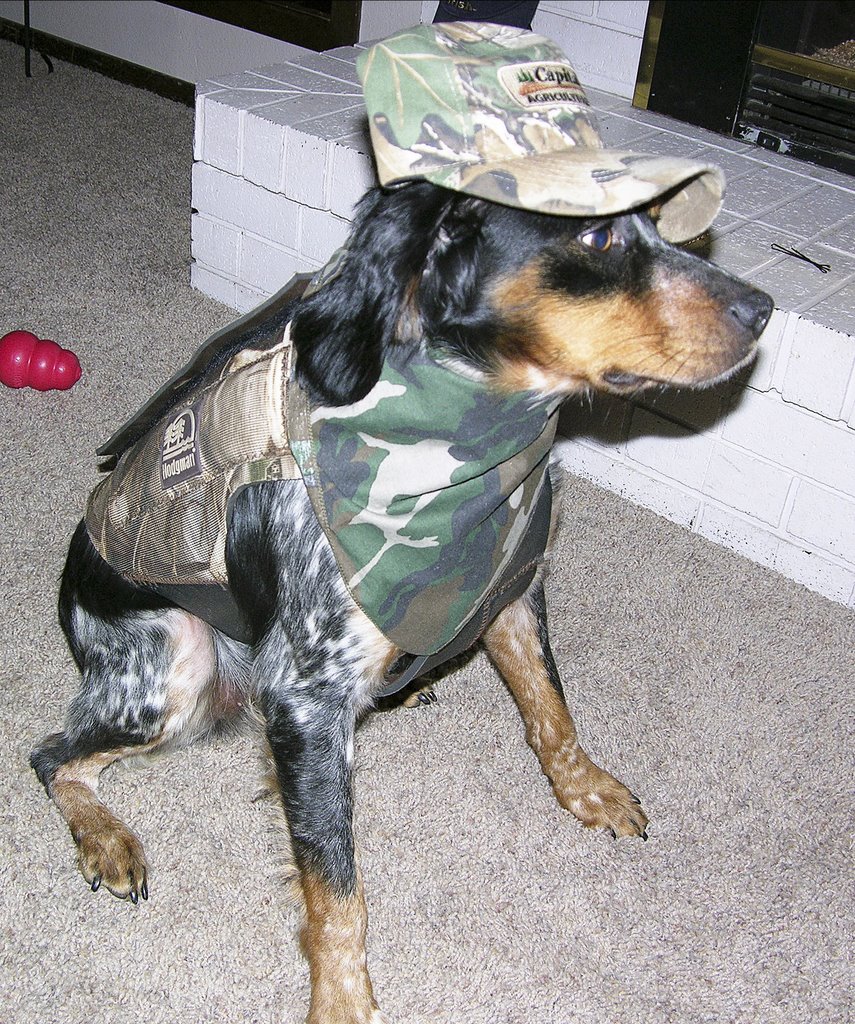
However, with a little bit of coaxing, one of our staff was encouraged to enter his dog.

She’s a hunting dog who successfully tied her owner in how many birds they each got last weekend, and for the last few days she was probably quite proud of her accomplishments.

Until he dressed her in the camouflage outfit last night. With the vest. And hat. And … what appears to be a camouflage bandana.

According to her owner, the poor dog did not enjoy this experience. In fact, the miserable pooch believed she was being punished, and the picture really tells it all. Try to find where she has tucked her tail, look at those sad eyes, look at … well, hopefully the judges will look at the originality, the brilliant idea, the patient work that went into dressing a good hunting buddy like this. I do hope the owner gets a prize.

Particularly because it’s a Capital Press camouflage hat. (Renew now or get a new subscription to Capital Press at 1-800-882-6789 and you too can give a hat like this! For yourself or your favorite pet!)

Of course, back on the farm, seldom were our farm animals and poultry seen as pets, but more often they were our work companions.

For those who weren’t useful chasing skunks or catching mice, those were the ones that had a chance for being dressed.

Usually, that was reserved for Thanksgiving and Christmas only.

And they were delicious.


Thursday, June 08, 2006

Paws for thought


Garfield believes he's king of the world, or at least of this farm.


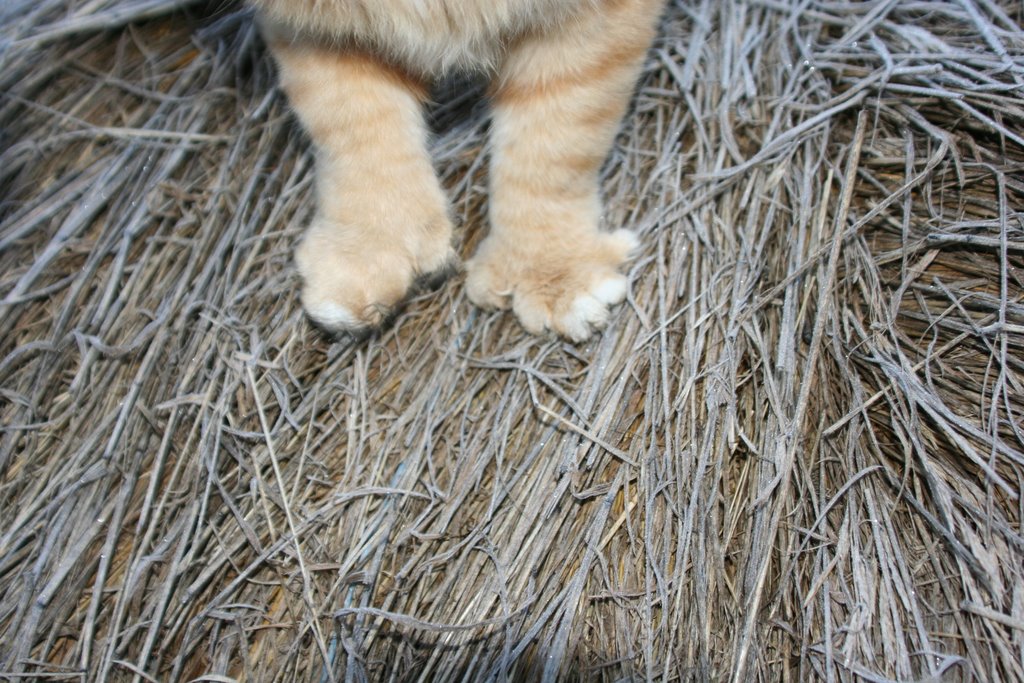
Garfield's extra toes are an example of polydactyly, more commonly seen among cats in Key West that have links to Ernest Hemingway.


By Elaine Shein

When you live on a farm, you never know what animal will enter your yard.

It could be a wild animal — or it could be someone’s abandoned former pet.

Near our farm, different dogs and cats have been unceremoniously dumped in our driveway or in the ditch, followed by vehicles that sped off into the night with their inconsiderate drivers.

However, it did allow us to occasionally adopt new pets — or have the pets adopt us.

Last year, my mother informed me we had a new cat on the farmyard because of this type of easy adoption process.

“He’s a big orange cat, and really has quite the attitude,” she said. “We named him Garfield.” She paused. “And he has extra toes.”

At first I must admit I didn’t know what to think. Extra toes? On a cat? Perhaps I wasn’t sure what to expect because I had just read another of those “someone’s cat had a two-headed Cyclops kitten” stories in one of the local newspapers.

Last summer, on a visit home, I finally met Garfield. The attitude revealed itself quickly. This big fluffy orange cat was either the most stupid or more stubborn of any farm cat we ever had. He had already shown the dog Rex who was boss of the yard: the cat settled himself into sitting on our steps outside the front door of the house, rather than hiding in the barn like the other cats had in the past. Garfield had also decided to help himself to Rex’s food bowl. And if that wasn’t enough insult, Garfield had also decided Rex was great to rub against when he needed to scratch his back.

Poor Rex didn’t know what hit him. I guess originally he tried barking, biting, and even shoving the cat with his nose towards the barn as a hint, but Garfield would have nothing of it.

Perhaps Rex gave up after he also saw the extra toes.

Sure enough, as my mother had said, there were the extra toes, one on each paw, especially noticeable on the front paws. Garfield became quite the talk of the community, as neighbors would occasionally curiously drop by to see this strange cat.

Rex didn’t like this any better than all the other changes in his life. The only time he seemed to warm up to Garfield was on cold nights when he would huddle next to the orange furball to seek some extra heat. But I saw him nip at the cat while pretending he was chasing a flea.

So how rare are extra toes on cats? Surprisingly, not as strange as one would think.

Just type in Polydactyly into Google … or if it’s easier, try Hemingway and cats.

Why Hemingway?

Writer Ernest Hemingway had been given a six-toed cat while he stayed in Key West a few decades ago, and he grew quite fond of the cat and kittens that followed. That cat’s ancestors are still there, and have become a tourist attraction for their extra toes.

Polydactyly means extra digits, and is actually a common trait among cats, especially on part of America’s eastern coast and southwest Britain, according to one website that had an article written by Sarah Hartwell.

One of the interesting things in her article is she wrote that someone had once written in New Scientist magazine that “innermost extra toes on the front paws are often opposable and some cats use them with quite startling proficiency to manipulate small objects with almost human dexterity.”

Remarkable, isn’t it? Or rather, frightening, isn’t it, especially if you’re a dog and your kingdom has already been usurped on the farmyard?

I still dread to hear what Rex versus Garfield stories I might hear next from my mother.

“Garfield yanked Rex’s tail again…”
“Garfield gave Rex a haircut with the lawnmower somehow…”
“It appears Garfield has figured out the tractor gears and … well … I just can’t go on…”

Or perhaps one of these days Garfield will figure out how to open the doorknob to the house front door (using those opposable extra toes on the front paws, while standing on poor Rex) and show all of us who really is in charge of the place.

“Garfield has the remote again…”
“Garfield gave up playing with the computer mouse and seems to have created his own website …”
“It appears Garfield has figured out how to flush the toilet and … well… I just can’t go on..”

Really gives a person paws for thought, doesn’t it?


Wednesday, May 10, 2006

Slugging it out on the West Coast

By Elaine Shein

Like a lot of other people here on the West Coast, I'm slugging it out with slugs. So far, they're winning.

Grass seed farmers worry about the serious damage slugs do in their fields, especially in wet years like this one with above normal rainfall.

Whatever didn't drown those slugs only made them stronger. I swear I saw some surfing my driveway a few times.

Before I moved to Oregon, I had never seen a slug before, and this led to a false hope I would never need to 1) recognize one and its trail of ooze or 2) battle one to its oozy death.

I now find myself asking friends, searching book stores, surfing the internet, and begging anyone for help on how to terminate, kill, destroy, annihilate, slaughter or just downright squash the evil slugs and show no mercy.

Who would have thought such a murderous streak existed within my mild, gentle-mannered self? Until now, such revenge was reserved just for mosquitoes. I grew up in a place with mosquitoes so big ranchers swore that, given the chance, those winged fiends would carry off small calves.

Wait, there was one other revengeful moment in my life: that termite problem I had last year. But let's avoid discussing termites for now and how many two-by-fours they can chomp in a month. I suppose I should admire termites' work ethic, their dedication, and their ability to reduce superior mankind to helpless, sleepless, whimpering mammals.

But I digress. Today's topic is slugs.

Of course, I do blame myself a bit for how these slugs first appeared. First, I have a yard. I seeded certain tasty plants, expanding the slug menu. And then there was the cat dish outside …

I have an indoor cat and an outdoor cat. The outdoor one is a bob-tailed stray cat that adopted our place after I saw how starved she was and offered her some food.

I already had an indoor cat that is quite large and very protective of his turf. He won't let her in, and is extremely jealous of any cat even in the yard he never is allowed to roam.

So I couldn't let the stray cat in. But after living a few years on the tough streets of town, our bob-tailed friend knew a good thing when she finally got it: she began to sleep outside the house door, right on the WELCOME mat.

Finally, I got her a nice chair, a nice cushion for the chair, a warm fuzzy blanket for the cushion, and of course a constant supply of food for this poor starving feline. Because she was a stray, we originally bought the cheap cat food to help fatten her up.

Ironically, we bought cheap fattening formula cat food for the lean cat, and management control formula cat food for the fat one, and the latter cat howls each morning because he wants her food instead of his fine dining selection.

How fat is my fat cat? When he weighed in at the vet's office last year, he was about 20 pounds. I explained I had him on weight management control formula. The vet's assistant nodded, approvingly.

"Well, sometimes it takes a while. It probably takes about three months. How long have you had him on it?"

I growled. "It's been three years now."

"Ohhhhhh. Dear me," she said, concerned. And then said nothing more.

I have learned that whatever is in that cheap cat food attracts more than just cats. That brand of food attracts skunks, raccoons, nutria, possums, stray cats, deer and … slugs.

Slugs crawl from the yard and into the food bowl to savor the fishy-flavored morsels. Massive slugs, several inches long, push the smaller slugs out of the way in their race for the cat food.

So this explains the healthy crop of slugs in the yard and even outside my front door at times, sliming up my welcome mat as they silently sluggishly stampede for the cat food.

As I visit greenhouses, farms, farmers' markets, and anywhere else here on the West Coast, I shamelessly admit I rely on the kindness and goodwill of all those who are more knowledgeable than me.

I casually lead the conversation towards being a valuable (and did I mention shamelessly free?) lesson. "So … got slugs? How on earth do you get rid of them?"

I've heard a variety of methods. Egg shells. Beer bait. Salt defense line. Spiked belt. Miniature electric fence. Loud Polka music (when the advice is free, you get what you pay for…) Bigger boots to stomp slugs. And commercial slug bait formulas.

Smug at the slugs, I returned home. The battle began.

The first thing I did was … move what I treasured the most to a deck 20 feet off the ground. The slugs will never get up here, I thought, laughing fiendishly, as I hauled a dozen heavy containers to the deck.

Neighbors stared uncomfortably at me. Loud fiendish laughter always attracts that kind of attention on a quiet street.

While I might have sounded mean and purposeful when it comes to slugs, when it came time to do the deed, I felt a bit remorseful. I decided the least I could do is help them die happy.

So I decided the first method I'd try to get rid of the slugs would be the beer method. I bought the beer. I even decided to buy them an import brand. It sat two years in my garage, as I procrastinated: it seemed such a waste of good beer. The slugs went forth and multiplied. The six-pack of Corona Cerveza did not.

The slugs surfed this last winter away, the beer grew more stale, and by this spring I found slugs growing to be the size of mini-sumo wrestlers as they began to bench-press the bowl of cat food and scare off the raccoons. I also found a few much more nimble slugs had craftily crawled up a 20-foot rain pipe and began munching on my deck plants. Things were going too far.

Last week, I poured some of the cerveza into containers and carefully set them in the garden. The giant slugs crawled along the containers, sniffed at the beer, turned up their … do they have noses? … and avoided the beer. The beer was two years old, what did they want? A better vintage? Were they raised on the Willamette Valley's pinot noir?

Tonight, I started to use a commercial slug bait to entice those greedy slugs. By next week, I'll see whether that was successful, or whether to try 1) an extra-large salt shaker, 2) extra-heavy stomping boots or 3) heavy-stomping polka music while dancing in my boots and madly shaking the salt shaker.

Or maybe I'll just give up and start fighting the moss on my house roof.

Have other suggestions for slugs, moss, or other West Coast problems? Email eshein@capitalpress.com


Ag in the West social media watch

Capital Press videos on YouTube

Our most popular videos