SAN DIEGO — Bob Stallman’s vision for the future of American agriculture includes a consuming public that understands modern farming and ranching is a business that involves significant risk and tough decisions. Click here for the full story
Tuesday, January 13, 2015
Stallman sees challenges, opportunities for farmers - AgMinute for January 13, 2015
Posted by
CPBTenner
at
1:03 PM
0
comments
Labels: agriculture, American Farm Bureau Federation, Bob Stallman, Farm Bureau, farming, future, outlook, ranching, vision
Friday, November 11, 2011
Podcast: Farewell Steve Appel, a solar energy fight, processing plant closures, and a Christmas tree backlash
It's the end of an era for the Washington Farm Bureau, a bid to put solar panels on farmland is heading to court, Simplot is consolidating its potato-processing facilities in Idaho, a Christmas tree checkoff has exploded in controversy and the Supreme Court is considering slaughterhouse rules.
Subscribe to this podcast in iTunes or your favorite RSS reader.
To listen, click here.
Posted by
Will Koenig
at
12:52 PM
0
comments
Labels: Christmas trees, Farm Bureau, potatoes
Saturday, March 26, 2011
Farm bureau to hold scholarship dinner
From the Shasta County Farm Bureau:
The Shasta County Farm Bureau proudly represents over 1200 farming and ranching families, businesses and agricultural supporters in Shasta County. The non profit organization is once again hosting their annual “fun” raising dinner. The dinner dance will be held on April 1, 2011 in Fusaro Hall.
The purpose of the dinner is to celebrate the future of agriculture by recognizing students that have excelled academically as well as served their community through leadership and volunteerism. $4,000.00 in scholarships will be presented to very deserving Shasta County Students. The 2011 Distinguished Service Award and 2011 Elizabeth Albaugh Memorial Outstanding Woman in Agriculture Award will also be presented to two outstanding community members that have contributed many years of service to bettering their industry and their community.
Be sure to join the fun with the live and silent auctions, gun drawing and desert auction. All funds will be used to support countywide agricultural education programs, and improve the Shasta County Farm Bureau. Items that are currently available are: Wilcox Ranch Fishing Trip, Romantic Wine tasting for 2, BBQ Barrel, 1 ton of Grass Hay, Hat Creek Herford Ranch Camp Ground Camping Trip, baskets, books and art work. More items are coming…please contact us for more details.
This night of fun and festivities would not be possible without our sponsors: Platinum Level-, Hat Creek Construction, Sierra Pacific Industries, State Fund Gold Level – Shasta Livestock & Western Video Market, Lassen Canyon Nursery, Wooten’s Golden Queens, Northern Lights Energy/Muse Trucking, WM Beaty & Associates, Shasta Farm and Equipment, Giles Insurance Services, Stayer’s Quality Queens, North Valley Bank, The Law Offices of Gifford and Harr & the Urrecelqui Family, Miller Equipment, Tri Counties Bank, Palo Cedro Silver Level – LoCoco Insurance, Northern California Farm Credit, Cross Petroleum, Plumas Bank, Ed Staub & Sons, VESTRA Resources Bronze Level –Wilcox Ranch, Cottonwood Creek Sand & Gravel, McArthur Farm Supply, HP Livestock & Hat Creek Grown, Cottonwood Vet Clinic, Valley Rentals & Materials, Goose Valley Farming, LLC, Elwood Ranch, Historic Hawes Farms, Redding Rodeo Association, Spanish Oaks Ranch, Leon Landis Livestock, Umpqua Bank, Palo Cedro Feed, Nor Cal Trees, Bank of Commerce – Redding, Pfeiffer Ranch, Eagleville, Ca., Carrel’s Office Machines Sponsorship opportunities are available.
Tickets are $25.00 each and are available at the Shasta County Farm Bureau Office.
For further information, please contact our office at 530/547-7170 or Julie Wold at 530/228-5412 or via e-mail juliecwold@gmail.com.
Posted by
Tim Hearden
at
2:20 PM
0
comments
Labels: California, education, Farm Bureau
Friday, January 21, 2011
Local Farm Bureau seeking members
Kari Dodd, manager of the Tehama County (Calif.) Farm Bureau, posted this on Facebook:
Tehama County Farm Bureau needs YOU! We are looking for new members who want to support agriculture! Become a member and receive discounts at Red Bluff Yamaha, Allied and Nationwide Insurance, RAM pickups, theme parks and choice hotels, just to name a few. For more information, contact Kari Dodd at 530-527-7882.
Posted by
Tim Hearden
at
9:24 AM
0
comments
Labels: agriculture, California, Farm Bureau
Monday, December 20, 2010
Farm Bureau: Tax bill good for ag
From the California Farm Bureau Federation:
Final passage of legislation extending current tax laws will benefit family farmers and ranchers—and give them time to seek longer-term reforms, according to the California Farm Bureau Federation.
“The tax package is critical to promote growth in the economy. That benefits everyone, including farmers and ranchers,” CFBF President Paul Wenger said, “and parts of the package will be especially critical on the farm.”
Wenger pointed to extension of tax rules for capital gains, gifts, income and small businesses. In particular, he said, family farmers and ranchers will benefit from revised rules regarding the federal estate tax.
“The estate tax forces farming families to take extensive and expensive actions to avoid having their farms broken apart when a family member dies,” he said. “Even then, farmers are often forced to sell land and other assets to pay estate taxes. That’s particularly true in California, where land values are so high. The tax package gives farm and ranch families two more years of certainty, but they still need a longer-term solution.”
Farm organizations including CFBF have co-sponsored legislation by Sen. Dianne Feinstein, D-Calif., and Rep. Mike Thompson, D-Napa, that would defer estate taxes on family farm property as long as the farm remains in operation and stays in the family.
“We will continue to fight for this reform,” Wenger said, “which will assure that farms and ranches can remain family businesses. The two-year extension that Congress just approved will pass quickly. We won’t rest until family farmers and ranchers have permanent relief from the burdens of the estate tax.”
The California Farm Bureau Federation works to protect family farms and ranches on behalf of approximately 76,500 members statewide and as part of a nationwide network of nearly 6.3 million Farm Bureau members.
Posted by
Tim Hearden
at
8:58 AM
0
comments
Labels: agriculture, Farm Bureau, taxes
Monday, December 06, 2010
Farm leader: Advocacy needed
From the California Farm Bureau Federation:
To succeed in advocating for their members, farm organizations must work together and be aggressive and strategic, according to the leader of the state’s largest farm group. California Farm Bureau Federation President Paul Wenger says the coming change in administrations in Sacramento underscores the need for farm groups to enhance their political activity.
In an address to the organization’s 92nd Annual Meeting in Monterey, Wenger noted that cooperation among farm groups has allowed California farmers and ranchers to pass legislation that supports their businesses, and to head off potentially damaging bills. With a new administration and many new legislators taking office in Sacramento, Wenger said farm organizations must step up their commitment to political engagement.
“It has to be that if you cut a farmer, we all bleed,” he said. “We have to pull together and make sure we work for the common good of our industry, because every one of our industries is so dependent upon the other.”
Wenger said farm organizations must focus in particular on assuring reliable water supplies for California. He noted that Farm Bureau supported the water bond originally scheduled for last month’s ballot, which has been postponed until the November 2012 election.
“We cannot grow in this state without new water infrastructure,” he said, adding that forecasts about the impact of global climate change include less snow and more rain for California.
“If that holds true, we need more reservoirs and we need them to be on streams, so we can slow the water so we have less flood damage and we have more water to be used not only for environmental purposes, but also for hydroelectric generation, for municipal and industrial use, and for the production of fresh food for a growing population,” Wenger said.
To achieve the policies that will protect California agriculture, he said, the state’s 45,000 commercial farmers and ranchers must commit their “time, talents or treasure” to political action.
“Because we are so diverse, we need to pull together,” he said. “We need to arm our folks who use their talents on our behalf. We can do better and we must do more.”
The California Farm Bureau Federation works to protect family farms and ranches on behalf of 81,000 members statewide and as part of a nationwide network of more than 6.2 million Farm Bureau members.
Posted by
Tim Hearden
at
2:52 PM
1 comments
Labels: agriculture, California, Farm Bureau
Thursday, November 25, 2010
A Thanksgiving tradition
A poem by Denny Banister of Jefferson City, Mo., the assistant director of public affairs for the Missouri Farm Bureau:
Tradition is tradition, often difficult to explain,
We do it because we do it, not to would be insane.
Nationalities, races and religions have traditions they must follow,
Without traditions, traditional times would be meaningless, void and hollow.
Americans each year at Thanksgiving have a traditional Thanksgiving feast,
The traditional meat served is turkey, we don't feast on just any beast.
How did the turkey gain its place on our traditional Thanksgiving table?
Because that's what the pilgrims feasted upon according to fact and fable.
Now we've all heard how they hunted the bird, but I know the real rendition,
Our forefathers’ gunpowder was damp that day, they were hunting with bad ammunition.
Don't laugh, you'll have to prove me wrong, but that's what I'm here to say,
Our forefathers couldn't have shot a buck - their buckshot was damp that day.
The men marched forward toward the woods, their ranks had one addition,
They took along an Indian scout, you guessed it - it was tradition.
The women all proudly waved good-bye as their protectors left to go hunting,
Then prepared the table for the feast, trimmed with doily, napkins and bunting.
It's a good thing women are blessed with women's intuition,
This first feast had to be done just right or we'd be stuck with unpalatable tradition.
They didn't know what their pilgrim husbands would bring home for the main dish,
So they fixed foods that would go just as well with partridge, venison or fish.
They created something called dressing made from bread a day old,
They had no intention of starting a fad, they just didn't want it to mold.
Meanwhile deep in the forest, our hunters were being harassed,
By the Indian scout who mocked their skills - the pilgrims were very embarrassed.
One spotted an elk, took careful aim, pulled back the trigger - CLICK!!
They discovered damp gunpowder would not fire, the realization made them sick.
What could they have for their Thanksgiving feast, on what would they that night sup?
One of the lads said, "Let's stew our shoes, I'm famished - I'll gobble it up!!!"
They were in no mood for jokes, and one of the blokes flung his musket into the field,
Just as old Tom Turkey, who heard the "gobble" jumped up - his fate was sealed.
What senses he had were knocked out that day, the turkey was plucked stuffed and roasted,
In exchange for his silence the Indian was fed while the hunters exaggerated and boasted.
They truthfully said they didn't fire a shot, they had no need for ammunition.
That's why today we raise turkeys on farms - to shoot them would break with tradition.
The producers of food from the Missouri Farm Bureau want to wish you a happy Thanksgiving,
As to the quality of my poetry, what can I say - it's a living.
So Banister's poetry isn't the greatest, I did as good as I could,
I was inspired by one of the very best, but Charles, I'm not nearly Os- Good.
Happy Thanksgiving, everyone.
Posted by
Tim Hearden
at
6:30 AM
0
comments
Labels: agriculture, Farm Bureau, holiday
Thursday, May 06, 2010
Farm Bureau endorses open primary
From the California Farm Bureau Federation:
‘OPEN PRIMARY’ MEASURE WINS FARM BUREAU SUPPORT
Seeing it as consistent with its long-term effort to reform government, the California Farm Bureau Federation has endorsed the “open primary” measure on the California ballot, Proposition 14.
“Farm Bureau has consistently supported measures to make our state government more responsive,” CFBF President Paul Wenger said. “Proposition 14 will help California break away from special-interest politics and allow for a truly representative state government.”
Proposition 14 would amend the state constitution to require that all voters receive the same primary election ballot for most state and federal offices. The two candidates earning the most votes in the primary—regardless of their political party affiliation—would advance to the general election.
“We see this as an opportunity to elect representatives who will consider all points of view and seek actual compromise,” Wenger said. “California needs office holders who will work across deeply divided party lines to reach solutions that are in the best interests of the entire state. Proposition 14 will help candidates who want to serve the people and will reduce the political polarization that has hampered California for too long.”
The California Farm Bureau Board of Directors considered all five measures on the June 8 ballot. The organization’s complete list of ballot positions:
Proposition 13: Property Tax Assessments/Seismic Retrofitting YES
Proposition 14: Open Primary Elections YES
Proposition 15: Public Funding of Elections NO
Proposition 16: Vote Requirement for Local Electricity Providers NO
Proposition 17: Auto Insurance (No Position)
Posted by
Tim Hearden
at
9:07 AM
0
comments
Labels: California, Farm Bureau, government, politics
Wednesday, September 23, 2009
Bucking the trend?
The Old Farmers Almanac is when it comes to its long-range weather prediction for northern and central California. From the California Farm Bureau Federation:
Northern California can expect above average precipitation this winter, according to the Old Farmers Almanac. However, it says Southern California will be drier than average. The book predicts that snow will be plentiful in the north with storms in November, December and January, and that precipitation will be above average throughout the state in April and May. The almanac uses sunspot activity and earthbound weather to develop its forecasts. It claims an 80 percent accuracy rating overall, but says last year its rating was 88 percent.
That's about the opposite of what just about everyone else in the know has told me about the developing El Nino pattern -- namely, that the best chance for above-average rainfall is in Southern California, not in the north. I'll be flushing that out in the upcoming issue of Capital Press.
Of course, I'm sure many of you are hoping the Old Farmers Almanac is right and the people I talked to are wrong.
Posted by
Tim Hearden
at
9:57 AM
0
comments
Labels: California, Capital Press, drought, Farm Bureau, weather
Tuesday, August 18, 2009
TANC: Gone, but not forgotten
The TANC transmission project may be dead, but former Capital Press freelance writer Dylan Darling has a story this morning analyzing the map of another line envisioned to run from Oregon to Tracy, Calif.
The transmission system, which could be partly owned by PG&E, is still barely in the pencil-on-paper stages. But it appears that it would run through the Northern California community of Round Mountain, which was a hotbed of opposition to the TANC project.
TANC opponents and California Farm Bureau Federation representatives said they didn't think TANC's demise would signal the end of all such power line proposals, and it looks like they were right.
Posted by
Tim Hearden
at
9:11 AM
0
comments
Labels: agriculture, California, Capital Press, energy, Farm Bureau
Wednesday, August 05, 2009
Estate tax "a sad song" for family farms
Iowa manufacturer Eugene Sukup writes for McClatchy-Tribune Information Services (via the California Farm Bureau Federation's Ag Alert):

The recent deaths of Farrah Fawcett, Michael Jackson, Billy Mays and Ed McMahon have many Americans thinking about mortality. If you're a business owner of a certain age, as I am, it's something you think about daily.
Unlike television personalities and performing artists, most business owners labor in relative obscurity. Our legacy, when we pass, is what we've built and perhaps invented—in my case, agricultural equipment most Americans have never heard of—and the hundreds and perhaps thousands of people who depend on us for jobs.
We're unlike television personalities and recording artists in another important respect as well: When we die, the government may lay claim to half or more of our business.
Not directly, but through tax policy.
He continues:
My sons are both active in the business. But they know that when my wife, Mary, and I pass, the estate tax will be so severe—estimated at $15 million to $20 million at today's tax rate—the business may have to be sold. [ ... ]If Sukup Manufacturing is fortunate enough to survive our deaths, the government will claim an additional 45 percent when our sons die (more, if Congress raises the tax rate, or allows it to increase automatically to 55 percent, as it will in 2011 under current law).
And when their children die it will take another bite until the business finally collapses or some future generation says, "We've had enough."
And all for nothing. According to a recent study by economist Stephen Entin for the American Family Business Foundation, of which I am a member, the economic damage the estate tax does to businesses such as ours—and to the economy as a whole—reduces total tax revenues by more than the estate tax brings in to the Treasury.
Read the entire commentary here.The music of Michael Jackson will live on, like Elvis' before him. But our business may not survive our deaths.
Posted by
Tim Hearden
at
2:26 PM
1 comments
Labels: agriculture, Farm Bureau, government, taxes
Friday, December 19, 2008
Fight for your right to farm
A story by Mitch Lies in this week's Capital Press is drawing some attention on our website today. The article, headlines "Farm Bureau jumps into battle over animal rights" is generating the most views on our website today. One reason for that may be because of a blog post on the American Farm Bureau Federation's FBlog by Chris Chinn.
Chinn is urging farmers to post a comment in response to a comment from a non-farmer on the article. As Mace Thornton, deputy director of public relations for the American Farm Bureau Federation, to the Oregon Farm Bureau, farmers need to be part of the discussion. And a lot of that discussion nowadays is taking place on websites, in addition to voting booths and government halls. Agriculture needs to use the tools available to be part of the discussion.
Posted by
Unknown
at
10:29 AM
0
comments
Labels: agriculture, American Farm Bureau Federation, animals, Farm Bureau, Internet, media
Monday, June 11, 2007
Blogger blames Farm Bureau for land-use mess in Oregon
I found this post on a blog site called NW Republican quite interesting. The post's writer spews venum about the Farm Bureau over they whole land-use controversy that just won't die in Oregon.
From what I can tell, the post writer is pro-development, regardless of whether farmland is lost. I won't spoil it for you. This you just have to read for yourself. I would be curious to hear what farmers and ranchers think about the post.
Posted by
Unknown
at
10:03 PM
0
comments
Labels: agriculture, blogging, Farm Bureau, land use, Oregon, politics, Willamette Valley
Thursday, December 07, 2006
Where does peppermint tea come from?

BEND, ORE. — Each year the Women’s Advisory Council of the Oregon Farm Bureau do a great job of teaching people about agriculture in the state. Money they raise at fundraising events, such as a silent auction held at the annual meeting, goes towards supporting such things as the Summer Ag Institute, Ag Fest, Oregon Agriculture in the Classroom and other worthy causes.
Besides teaching the next generation about how diverse agriculture is in the state, members of the council also educate fellow Farm Bureau members of some of the bulk commodities as well as processed or specialty products that originate here in Oregon.
At the annual meeting, there usually is a gift bag that is the teaching tool.
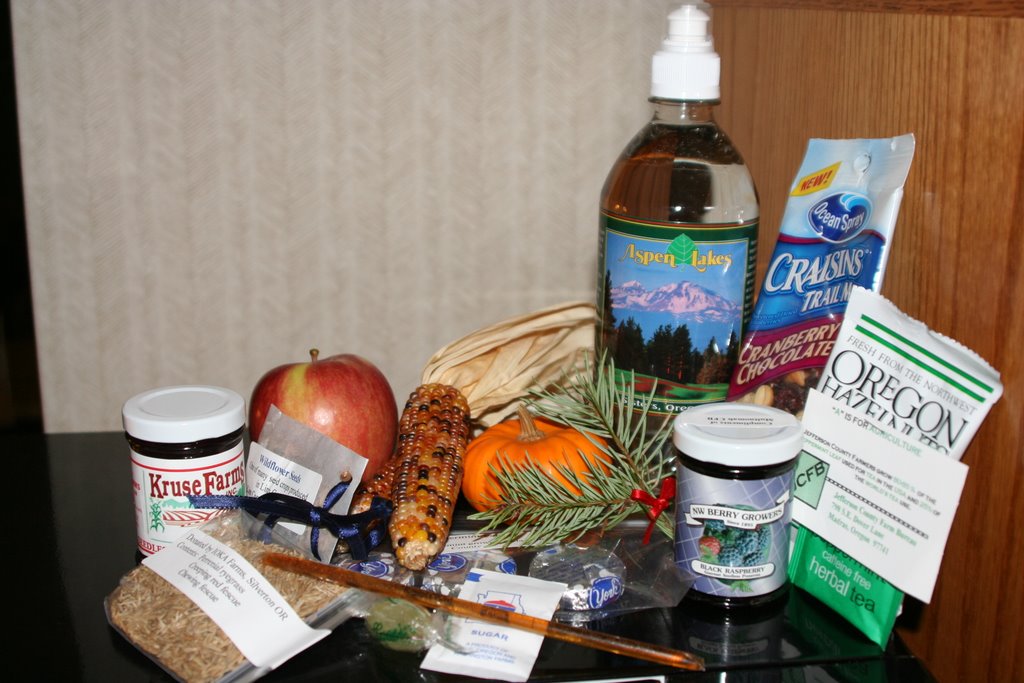
For example, this year the bag included:
Hard candy mints from Benton County
Hazelnuts from Clackamas County
Chocolate cranberries from Coos-Curry
Bottle of water from Deschutes County
Mini pumpkins, corn and jars of jam from Douglas County
Apple from Hood River County
Mint tea from Jefferson County
Peppermint patty mints from Klamath/Lake County
Wildflower seeds from Linn County
Sugar packets from Malheur County
Nursery stock from Washington County
Honey Sticks from Yamhill County
Cheese from Tillamook County
Attached to some of the commodities is information about what is grown in each county. For example, the Jefferson County Farm Bureau includes a card that says “Jefferson County Farmers grow 80-85 percent of the peppermint leaf used for tea in the USA and 25 percent of the world’s tea use.”
Why give these products to the farmers at these events?
Not only does it educate farmers about what is grown by some of their neighbors, but this also creates pride that Oregon’s farmers contribute greatly to the success of agriculture here — and in the rest of the country — and honors their hard work.
Technorati tags:
Agriculture
Oregon Farm Bureau
Women's Advisory Council
food
Posted by
Elaine Shein
at
6:48 PM
0
comments
Labels: Farm Bureau
Wednesday, December 06, 2006
Farm Bureau works to protect communities, farmland
BEND, Ore. — As resolutions came to the floor of the Oregon Farm Bureau House of Delegates in Bend, Ore. this week, a recurring theme emerged: how often farmers and ranchers feel governments and others are claiming good farmland for other uses.
Their frustration was obvious, as well as their concern on how it is hurting their communities they call home. Several of their resolutions had or tried to include words and phrases to try to protect themselves from future land grabs, or at least to get proper compensation for what they and neighbors lost.
One of the good things about holding Farm Bureau meetings is this gives a chance for farmers to share their experiences. They might be from different geographical areas and grow different commodities but they could all relate to what the land means to them and how much it hurts to see valuable farmland lost.
As resolutions were introduced, farmers gave examples of what happened to them and their neighbors and this influenced how their peers voted.
They spoke of cities who wanted to expand beyond their urban growth boundaries; new communities that wanted to turn fields of crops into parks for their children; utility companies that wanted more land for their power poles; expanded highways and road construction; and sometimes private businesses or out-of-state real estate speculators purchasing land and driving up prices.
Will these Farm Bureau policies help save farmland?
These policies are valuable tools that lobbyists as well as Farm Bureau’s elected representatives use to deal with politicians at various levels.
Words in a policy book aren’t enough. Clearly the delegates understood this. More than usual they turned to their peers, elected officials and even lobbyists for advice to help improve the new or amended policies that came from the grassroots members.
Several times the delegates asked what was the best way to word these policies, how should they be titled, and was there any contradictory policies.
What they are really looking for is for an organization — and its people — who understands them, their issues and can do what’s needed to meet the challenges.
Don Schellenberg, an associate director of government affairs, has worked for Oregon Farm Bureau for more than 25 years. His areas for lobbying the government in Salem include labor, land use, education, aggregate, horticulture, transportation and taxation.
During one of the last workshops of the day, Schellenberg shared insight into the various politicians he and others will deal with soon, as well as outlined some of the policy messages he carried to them on behalf of the Farm Bureau.
He handed out and then discussed new, slick, well-produced booklets on Oregon Farm Bureau policies that will be given to politicians and others.
But then Schellenberg passed around small notepads and pens.
“Take that memo pad, and what I want you to do is write on that memo pad two things that you think are the most important things that farm Bureau should do in the next Legislative session. You can put more on there if you want, but give me two … your two suggestions don’t have to come from here,” he motioned to the policy book.
“I’m in the Farm Bureau office, reality is outside the Farm Bureau office. We have the board, we have advisory committees, and to a certain degree Farm Bureau reality is outside of those, too,” he said, as people in the room began to write on the pads.
He went on. “My concern always is yes, we have a legislative agenda — what are we missing? Are we really doing the things that you’re scratching, where the itch it? Or are we doing stuff that is not as important as you think?
“So this is my unofficial way of trying to get a sense of what’s important to Farm Bureau members,” Schellenberg said.
The unofficial pieces of paper he carried with him after the meeting may give him insight to what was on the minds of people in the room. Better yet was the knowledge by the delegates that one of their main lobbyists really cared to hear what the grassroots wanted him to do.
Earlier in the annual meeting, executive vice president Dave Dillon read to delegates the original statement of purpose approved by Farm Bureau members in 1920, a year after the first Farm Bureau was formed in New York state.
The statement said: “The purpose of Farm Bureau is to make the business of farming more profitable, and the community a better place to live.”
Witness the passion of delegates as they create and discuss resolutions at Farm Bureau meetings at county, state and the national level. Listen to the Farm Bureau staff and elected representatives who sincerely care about what the grassroots wants for their farm families and their communities.
As Oregon’s Farm Bureau prepares to celebrate its 75th anniversary next year, these people show this organization has grown and remained strong because it has not strayed far from its original intent.
Technorati tags:
Agriculture
Oregon Farm Bureau
Posted by
Elaine Shein
at
10:39 PM
0
comments
Labels: Farm Bureau
Tuesday, December 05, 2006
OFB president warns of national implications from union deal
BEND, Ore. — Good farm policies for agriculture should have positive solutions for the entire industry, and not just respond to the difficulties faced by a single farm, stressed Oregon Farm Bureau president Barry Bushue.
In his main speech to the annual state Farm Bureau meeting held Dec. 5 in Bend, Ore., Bushue bluntly expressed his disappointment about the recent memorandum of agreement made between Threemile Canyon Farms and United Farm Workers.
He also warned harshly that the deal would have far-reaching consequences.
“I fear frankly that Oregon’s farm workers and farmers are being used as pawns in a much larger chess game at the national level to create a poster child for federal legislation, which would negate an existing secret ballot process for millions of workers in many other industries around the nation.”
Bushue blames Ted Kulongoski for the situation, but also said he hopes and prays that the governor doesn’t believe this agreement signed by only one farm and the union should become the standard for collective bargaining in the agricultural sector.
“Threemile Canyon is anything but your typical Oregon farm. It is a very large corporate entity with an enormous work force. They have been brow beaten into submission, This process has and will continue to incur huge costs for this farm financially, politically, in the market place and within the industry,” he told Farm Bureau delegates.
“It seems very unlikely that any farm in Oregon has the financial strength and access to legal and other experts to withstand such an assault.”
Bushue urged that there should be a secret ballot election process to protect the farm workers as well as the employers, and said that coercion does not lead to a good agreement or serve anyone’s interests if this becomes public policy.
(To see more on Bushue's speech, see www.capitalpress.com)
Links:
Capital Press
Oregon Farm Bureau
United Farm Workers
Technorati tags:
Agriculture
Oregon Farm Bureau
labor
Posted by
Elaine Shein
at
6:39 PM
0
comments
Labels: Farm Bureau
Monday, December 04, 2006
Oregon Farm Bureau kicks off in Bend
While Gary checks out the rodeo finals in Las Vegas, I'm in Bend, Ore. as the Oregon Farm Bureau annual meeting kicks off at the Riverhouse Resort.
While he covers the excitement of cowboys getting bucked off, delegates here and other state farm bureau meetings at this time of year make decisions that impact what happens to those farms and ranches that may be home to some of those cowboys.
The American Farm Bureau Federation is the most powerful agricultural lobbying group in America — indeed, in the world — and it starts with the grassroots. Each year, beginning with the local farm bureaus, debates are held on what policies should be adopted to represent the best interests of agriculture in the country.
From the county farm bureaus, the opinions of the members rise to regional, state and eventually to the national level, where their representatives decide what will be their policy on important issues ranging from world trade organizations to animal identification to what they would like in the next Farm Bill.
The process involving the grassroots means that politicians cannot ignore this organization later: AFBF represents farmers and ranchers from different geographical areas but also of many different commodities. California Farm Bureau, for example, represents a state that has more than 300 agricultural commodities: to speak with one voice at the state and later the national level on behalf of its members is impressive.
The state farm bureau meetings are often ignored by the majority of the media who would rather not spend several days listening to a long list of resolutions. However, the meetings can be fascinating, sometimes by what is said at the microphone ... but more often witnesssing what is happening at the tables, in the back of the room, or even in the hallways as there continues to be debates, political moves, and strategies developed on how to get certain resolutions to the floor of the House of Delegates — or more importantly, passed by the House.
There are some new delegates this year, but also delegates who have served decades representing their areas. Watching how the younger delegates mature, and the older delegates share their experience, gives insight into why final resolutions are passed.
Are all the delegates and their communities always happy with the outcome? No. There are strong geographical, philosophical and personality divides, and the farm bureaus in each state witness battles within. Each state has its own trigger points or heated issues: this year in Oregon, land use will continue to be the most contentious one, but water is always a big one, too, in the West.
The sign of good leaders at the state level is how they hold together the factions within, where people feel they all had a chance to express themselves, share their views, and accept that a majority decision has been made (whether or not it supported their side.)
During the next few days, this blog will highlight some of what is happening here in Oregon. Our California editor Bob Krauter is attending the California Farm Bureau meeting this week and will report on that. Capital Press staff will also be attending the national AFBF annual meeting in Salt Lake, Utah in early January to keep people updated on what is happening there, especially from a Western perspective.
Stay tuned to Blogriculture for more.
Technorati tags:
Agriculture
Farm Bureau
Oregon Farm Bureau
Posted by
Elaine Shein
at
8:58 PM
0
comments
Labels: farm bill, Farm Bureau