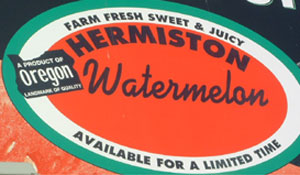
The billboard has been taunting me for weeks. "Look for the sticker" the large sign implores along my daily route home from work.
But it's not the words they got to me. Not those words anyway. It was the image of a ripe, juicy piece of fruit that has been as much a part of summer in my family as the Fourth of July and long, hot sunny days.
Watermelon.
And not just any watermelon. Hermiston watermelon.
My mouth waters every time I drive past the billboard. But I can't just blame the clever marketing campaign for being possessed by the imagery on the sign. No the real blame goes to my grandfather and my father.
My grandfather, my mom's father, introduced me to watermelon when I was very young. Every summer, for as long as the succulent fruit lasted each season, Grandpa Leis had watermelon for lunch and dinner. Or maybe I should say dinner and supper as the midday and evening meals were known by those names respectively in the Nebraska panhandle community where I was born.
Fresh fruit and vegetable, usually from my grandmother's garden, but sometimes from neighboring farms, were part of every summer meal. The canned versions, home-canned mind you, were part of every winter meal too. But you can't can watermelon. It just wound't be right to each watermelon out of a pressure-cooled Bell or Mason jar. You have to sink a knife right into the melon's heart and let the red blood spill out on the counter, your plate and your chin.
Grandpa would cut off a big slice of watermelon and eat it down to the rind, with an occasional shake of salty to add a little zip to the sweet fruit flavor. Then the rind itself was fed to the chickens. Nothing went to waste from a watermelon, well, except maybe those pesky black seeds. But even those could be a source of amusement for a young grandchild enjoying a slice of melon with his granddad.
One year after a summer of meals featuring watermelon, sweet corn, cucumbers and countless other harvest treasures, my dad packed me up, along with my mom, young brother Ron, newborn brother Dean and moved us to Oregon -- smack dab in the middle of a watermelon country. Hermiston watermelon country that is, in Umatilla County in Eastern Oregon.
Every summer, when watermelons turned ripe, there were always plenty of melons at our house. my dad, being an ag pilot, or what folks often refer to as a "crop duster," did work for many of the farmers in and around our area. No one from our family, or anyone on my dad's work crew, could drive a pickup (or any rig for that matter) past one of the farms dad did business with without getting loaded down with food at harvest time. Onions, potatoes, asparagus, sweet corn and of course watermelon. Hermiston watermelon.
A few years after I graduated from college I was back in Hermiston working as the editor for a small weekly paper when then-mayor Frank Harkenrider guilted me in to making a trip to Portland one summer. Harkie -- everyone who know Mayor Harkenrider called him Harkie -- was leading a contingents of local dignitaries delivering a ceremonial first load of melons for the season to Portland. It was 1992 and only the second year of what has now become an annual pilgrimage of produce to Portland that celebrated its 16th anniversary this year. Harkie may have been a small town mayor, but he was a bit flamboyant and knew a publicity opportunity when he saw one.
He was taking the melons straight to Portland City Hall and dropping them, figuratively at least, into the lap of the even more flamboyant Portland mayor, J.E. "Bud" Clark.
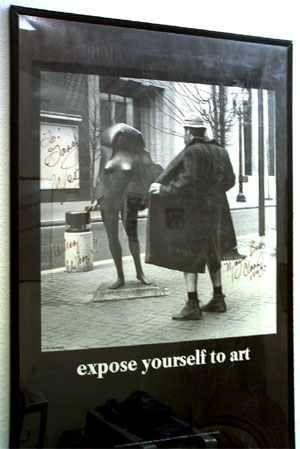
Clark and his trademark "Whoop, whoop" became nationally, even globally, known as the tavern keeper who upset an incumbent mayor and took over leadership of Oregon's largest city. Clark was also known for posing for a famous poster in the 1980s with the slogan "expose yourself to art" while wearing a trench coat and seemingly flashing a sculpture of a woman in downtown Portland. Clark, who sold autographed copies of the poster to help pay off his campaign debt, signed several copies of his poster for the Hermiston delegation on that summer day back in 1992. It was his last year in office. He even signed one for a certain young journalist, who still has it hanging on a wall in his home.

But perhaps I digress. Needless to say, watermelons, and Hermiston watermelons in particular have long been a summer favorite. But during 10 years I spent in California, they were impossible to find. And California melons, though most of them were seedless and tasted fine, just didn't taste the same. Anyone who has had a Hermiston watermelon will tell you they are special. And if they people are from the Hermiston area, they'll tell you Hermiston melons are the best.
So over the weekend I had the opportunity to take my daughter back to visit family in Eastern Oregon and we stopped to visit Grandma Leis, who is now living in my parents' home. Grandpa Leis, who would have celebated his 92nd birthday Aug. 21, has been gone 23 years now. But Grandma is still here, and celebrates her 92nd birthday on Wednesday, Aug 23. And that baby brother, just a newborn on that trek West by air over the Oregon Trail, turns 33 on Friday, Aug. 25.
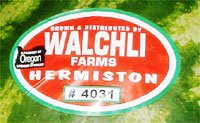
And in the fridge during that visit there was a big, ripe Hermiston watermelon in the fridge, and two more in the utility room by the back door. The one in the fridge tasted great, I can assure you, and one of the ones in the utility room was liberated. It made the trip back to Salem with me. Complete with its "A Product of Oregon" sticker, attesting to the fact that it is indeed a Hermiston watermelon, "Grown & Distributed by Walchli Farms."
And all it cost me was $60 worth of gas and seven hours on the road to get it.
I hope everyone is enjoying some fresh "locally grown" produce this summer and making some lifelong memories with their family and friends too. Thanks for going along on the ride with me Suzanna. And thanks from teaching me how to eat watermelon, Grandpa. Oh, and happy birthday Grandma. And yea, you too Dean. Thanks for the melon, Mom and Dad. And thank the Walchli's for me too.
That billboard isn't haunting or taunting me any more.
(Read a related post about the 2007 watermelon giveaway: Blogriculture: Former melon thief now gives 'em away
Agriculture
Summer
Oregon
Hermiston watermelon
Locally grown
Tuesday, August 22, 2006
Watermelon worth the price
Posted by
Unknown
at
8:39 PM
3
comments
Labels: agriculture, Eastern Oregon, Hermiston, watermelon
Friday, August 18, 2006
The Farm Bill is a burning issue … literally
By Elaine Shein
Time is ticking — anyone who wishes to submit formal input, as long as they want, into what they believe should be in the Farm Bill for 2007, from a Western point of view — has until this Sunday to do so. Other brief comments can be given beyond that date, following instructions found at http://agriculture.senate.gov/
This week the Senator Committee on Agriculture, Nutrition and Forestry held a Farm Bill Field Hearing in Redmond, Ore. (See www.capitalpress.com for stories and audio clips).
One of the topics discussed was forestry, how it was affected by the 2002 Farm Bill and what changes should be made in future farm bills.
Some people in the audience noted that the speaker from the department of forestry had a longer speaking opportunity than the closely monitored maximum three minutes that other speakers had for their opening comments. There were 12 speakers in total that morning.
The chairman of the committee, Senator Saxby Chambliss (R-Ga.) said in a later interview that one of the reasons he was so interested and had so many questions on forestry was that a day earlier he saw forest fires first-hand. Senator Gordon Smith (R-Ore.) had flown in a helicopter with Chambliss and they covered a lot of ground, examining some of the fires as well as efforts to fight them.
It seemed appropriate that during the hearing at the South Sisters hall on the Deschutes Fair and Expo grounds, the roar of planes could be occasionally heard from the nearby airport as they took off to fight fires at nearby Lake George.
While the smoke could be detected at Redmond, it was much worse at Sisters, where it was noticeably hazy in the streets and was stinging the eyes. The longest lineups in town were at an outside bulletin board with fire information, and at the local homemade ice cream shop along the main road through town. It was obvious a lot of tourists, as well as local residents, wanted to know which areas were dangerous or no longer open to them.
Why should people care about what’s in the next Farm Bill? There are so many parts to it, not just supporting certain commodities. Part of it includes food stamps, school lunches, conservation programs, and yes, fighting fires. If people want to have a say on what should or shouldn’t be done on forestry lands to help prevent — or to salvage logs after — fires, they should also take the time to write in their opinions to the committee.
As for the parts of Oregon and other parts of the nation that are burning, good luck to the firefighters on the ground and also by air. May they be successful at the dangerous work they do, but also may they return safely to their homes later.
Links:
www.capitalpress.com Capital Press
http://agriculture.senate.gov/ Senate Committee on Agriculture, Nutritious and Forestry
Tags:
Senate Committee on Agriculture, Nutrition and Forestry
Agriculture
Senator Gordon Smith
Senator Saxby Chambliss
forest fires
Oregon Department of Forestry
Senate Farm Bill Field Hearing
Posted by
Elaine Shein
at
3:11 PM
0
comments
Labels: farm bill
Wednesday, August 09, 2006
Bloggers beware?
By Elaine Shein
Can people write whatever they want in a blog?
What happens to a newspaper if one of its reporters or editors writes a blog and someone decides to sue?
Does it make a difference if this was a work blog or written as a personal blog?
In the August edition of Editor & Publisher there is a great story that encourages discussion and stirs debate on the world of blogs.
According to the story, it states that Technorati “estimates that some 75,000 blogs are created every day, nearly one per second, joining the more than 40 million blogs already populating cyberspace. That’s twice as many blogs as there were just six months ago.”
And then comes the questions: who is legally responsible for the material that appears in these blogs?
While blogs were created to encourage freedom to publish a diversity of opinions and subjects on the world wide web and become the bulletin board, diary or soapbox of anyone who wishes, legal experts are warning people to be careful.
In the case of bloggers tied to the traditional media, the print or broadcast owners may be responsible for libelous material that occurs on a blog by someone on their staff — even if the material was published as a personal blog.
Some of the issues that appear in the E&P article to think about:
Publishers need to think about “the balance between editing for liability and preserving the spontaneity of a blog.”
What kind of crosschecking on content was done on blogs before they were posted?
Newspapers need to check if their libel insurance will cover freelancers who blog on the company’s website.
If a staff person writes a personal blog from home, it may still be subject to defamation suits because of who the staff person is and the weight that that person’s job carries for the company.
If some of the comments or blogs from outsiders are edited by a company before they are posted online (even if it was to take out profane or offensive language), the company may bear some legal responsibility because they have been active in editing and decision making.
Newspapers may want to post on their websites that comments will be monitored and that “viewers should notify a newspaper’s online site about reputed errors, omissions or potentially libelous third-party postings.”
A disclaimer should also be added that the views expressed don’t reflect the “newspaper or its staff or its advertisers.”
Codes of ethics or guidelines for staff at media outlets should also add something about blogging.
The E&P article also suggested buying more insurance against libel, to cover blogging activity — and be prepared to answer how content is edited to protect against libel.
So what do fellow bloggers think of all this?
I invite you to respond to opinion@capitalpress.com.
Agriculture
Posted by
Elaine Shein
at
4:50 PM
1 comments
Friday, August 04, 2006
Spit and polish hat makes fashion statement

Photo by Jenny Sullivan, Oregon Agri-Business Council.
By Elaine Shein
If you’re looking for the ol’ spit-and-polish look for special occasions, there is a spitty (er, spiffy) top hot that will make anyone look ready for such occasions.
It’s the watermelon top hat. And they are rolling into cities in the Northwest.
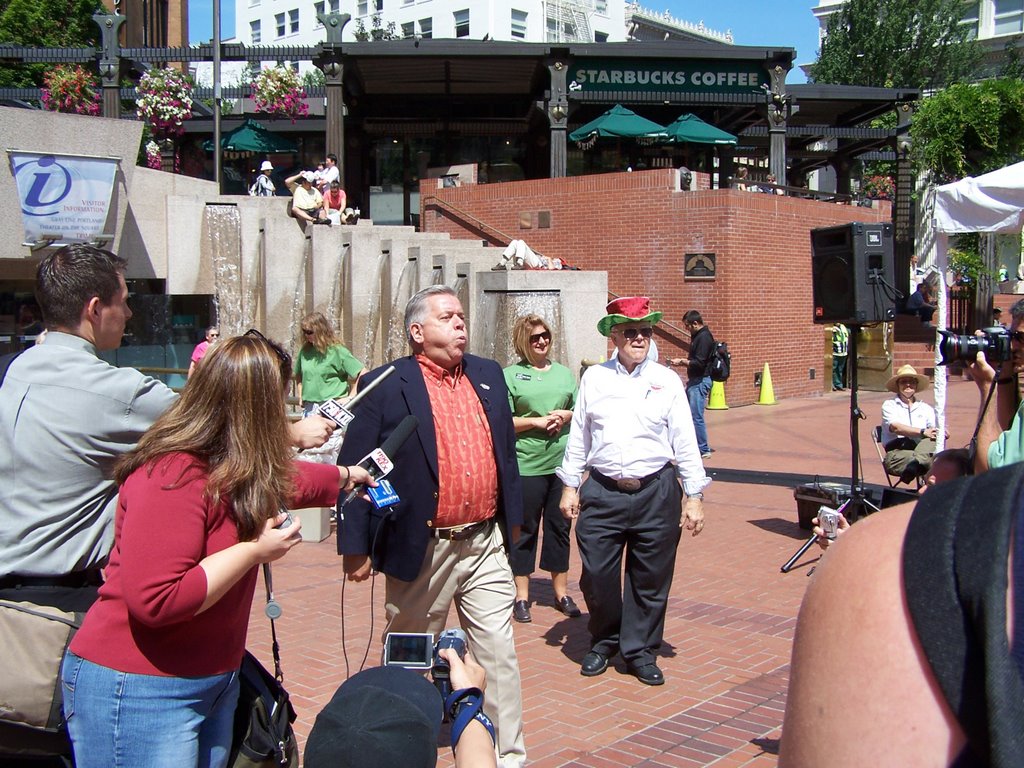
Bob Severson, the mayor of Hermiston, wore the dashing hat at Portland’s Pioneer Square today as he helped inspire Portland’s mayor Tom Potter to try his skill at a watermelon seed spitting contest.
Not to be confused with some of the cherry pit or pumpkin seed spitting contests that take place in the northwest at other times, this was a great promotion for Hermiston’s watermelons which are some of the best tasting ones you can find this time of year in stores and farmers’ markets.
This event definitely attracted the media attention. One can see the daring reporters leaning in close enough to catch the spitting sound on their microphones but keeping enough distance away to avoid being spit upon.
Wimps.
My thanks and hats off to Jenny Sullivan, from Oregon’s Agri-Business Council, who witnessed this event and kindly sent in the picture — as well as where people can buy these hats if they lack skills to create the hats themselves. (Remember, farmers are not responsible for any unfortunate incidents that involve people cutting up fresh fruit and smucking the half-carved fruits on top of their heads. And never use power tools to try this at home.)
These hats also make great gifts for the family members you adore and feel are in dire need of making a fashion statement, whatever that statement might be.
(www.elopehats.com/licensed/wally.php)
Agriculture
Posted by
Elaine Shein
at
4:27 PM
0
comments
Three minutes to save the Farm Bill?
By Elaine Shein
Three minutes.
That’s all the time that will be given to people who want to influence the Senate when it holds hearings on the Farm Bill in different parts of the nation.
On August 15, Deschutes County Fairgrounds in Redmond, Ore. will be one of the few places to host a hearing. While the list of presenters has not yet been made public, some of the people who are invited to speak have said that it was very clear that they only had three minutes to make their case on what they think should be done with the Farm Bill.
They can also offer written documents to support their viewpoints — they can write 50 pages or more, if they want — but the truth is that probably these short face-to-face exchanges that have the most impact on the influential politicians who will visit the state.
The Farm Bill is huge, costly and complicated but has a lot of areas in it that are critical to farmers across the country, particularly in some commodity and geographical areas.
While some farmers may feel they receive little benefit from the bill, there are probably parts of it affecting their businesses that they may not even be aware of unless all the programs suddenly ended.
For many, the Farm Bill was a way to offer domestic support for farmers at least until a level trading field could be guaranteed internationally. With the demise of the recent Doha World Trade Organization talks, farmers are more anxious to continue some form of stability in their markets and programs.
One of the messages that the Senate hearings will receive is that a large number of agricultural groups will want an extension of the Farm Bill for at least another year past its expiry date. This allows more details to be worked out for domestically helping farmers, but also leaves some wiggle room for perhaps international talks to be revived.
With only three minutes to make a case, that might be the only message that can get to the Senators during their summer tour.
If they seriously want to learn the best advice on how to have a better Farm Bill, they better consider longer trips next time and give more time to speakers to make their case.
Agriculture
Posted by
Elaine Shein
at
10:35 AM
0
comments
Labels: farm bill
Thursday, August 03, 2006
Neighborhood Watch helps prevent crimes
By Elaine Shein
When you live in a rural community, you often know your neighbors for a few miles around. You meet them at local events, you call them when the cattle have escaped through a broken fence and you share local gossip.
City life is different. You can live across the street or down the block from neighbors and not know even what their faces look like.
The only time you might see them is when you’re collecting your mail at the same time, dealing with some weather related incident, being approached by them for fundraising events for their kids or they’re attempting to get you signed up for a political party during an election year.
Sometimes it might be a crime in the area that stirs neighbors to finally unite in an effort to share information and prevent further crimes from taking place.
The Neighborhood Watch program is a good one that is built on the latter reason to unite neighbors, but also gives an opportunity for neighbors to meet each other socially.
This week across the country there was an event called National Night Out, encouraging people to get together with events such as potluck dinners so they can get to know each other better but also learn tips on how to fight crime.
In Salem, Ore. alone there were a record 132 block parties held on August 1. Police representatives received more than a hundred requests to attend these parties, and really attempted to get to as many as possible. Some officers attended several in one evening, with helpers to keep them on track.
Attending the local potluck event in my area, I realized just how many people I didn’t know from down the street or even within a 4-block area. There were the familiar greetings of “which street do you live on? Which house is yours?” but also questions like “What vehicle do you drive? Do you have any kids? Pets?”
Depending on your answers, it could open up a great conversation or lead to some awkward moments. “Oh, that’s YOUR dog that barks all the time? That car that speeds all the time belongs to YOUR husband? You mean those loud teenagers that hang out at 2 a.m. on our street with the blaring stereos are YOUR horrible, undisciplined offspring?”
And of course there is the realization that those ignored healthy dandelions hidden in your yard might be the ones happily replanting themselves in the yards of these nice neighbors.
Awkward moments aside, the meeting was a success. Contact sheets were handed out so people know who their neighbors are and how to contact them at work and home in case of emergency. The police officer gave details on programs to prevent car thefts, mark possessions better in case they are stolen, and encouraged people to know more about each other — such as when are people away on vacation, or on prolonged business trips — so they can contact the police department if something suspicious happens in the area.
Among the suggestion was that people write or engrave OR (for Oregon) and their drivers’ license number on possessions so if they’re stolen, police can quickly return the possessions if they are found later.
Another suggestion was that people buy $2 stickers from the police department to put on vehicles. If that vehicle with its sticker is spotted on the streets between 1 a.m. and 5 a.m., the police will stop it to ensure the car has not been stolen.
While some people thought this was a great idea, other people admitted being paranoid of having stickers that invite police to follow and stop them. After all, what if that person was occasionally out driving during those times? Or maybe was not wearing a seatbelt or had a few too many social drinks earlier?
The police officer gave a lot of statistics at the block party, but perhaps the most convincing one was that 98 percent of the crimes done in this city are in neighborhoods that don’t have Neighborhood Watch programs.
On that reason alone people should consider bonding together under Neighborhood Watch programs more to help prevent crimes in their areas, whether in urban or rural areas.
In rural areas, distances between neighbors leads to crime problems since they can’t see each other’s houses or fields. It has been terrible that rural areas have been hit for theft for everything from fuel to cattle to irrigation equipment parts that are resold as scrap metal by meth addicts.
But hopefully warning signs and vigilance by neighbors will help protect areas in the future while also encouraging people to feel more like a protective community, rather than a group of single vulnerable dwellings.
Agriculture
Posted by
Elaine Shein
at
11:36 AM
0
comments
Labels: crime