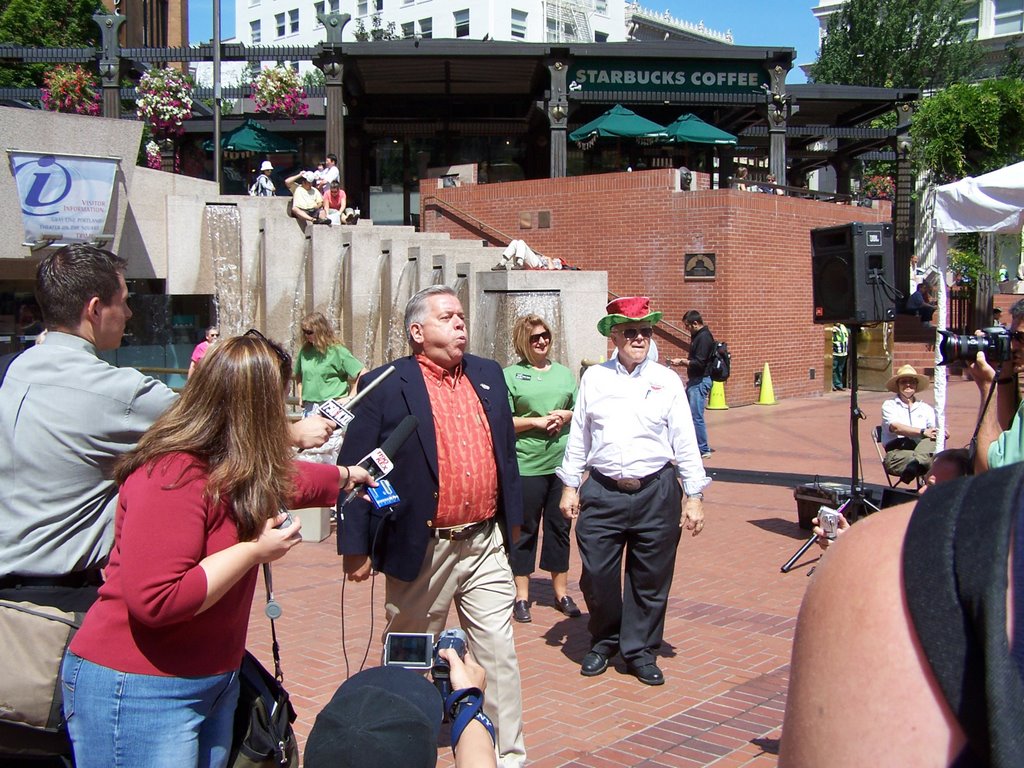
Photo by Jenny Sullivan, Oregon Agri-Business Council.
By Elaine Shein
If you’re looking for the ol’ spit-and-polish look for special occasions, there is a spitty (er, spiffy) top hot that will make anyone look ready for such occasions.
It’s the watermelon top hat. And they are rolling into cities in the Northwest.
Bob Severson, the mayor of Hermiston, wore the dashing hat at Portland’s Pioneer Square today as he helped inspire Portland’s mayor Tom Potter to try his skill at a watermelon seed spitting contest.
Not to be confused with some of the cherry pit or pumpkin seed spitting contests that take place in the northwest at other times, this was a great promotion for Hermiston’s watermelons which are some of the best tasting ones you can find this time of year in stores and farmers’ markets.
This event definitely attracted the media attention. One can see the daring reporters leaning in close enough to catch the spitting sound on their microphones but keeping enough distance away to avoid being spit upon.
Wimps.
My thanks and hats off to Jenny Sullivan, from Oregon’s Agri-Business Council, who witnessed this event and kindly sent in the picture — as well as where people can buy these hats if they lack skills to create the hats themselves. (Remember, farmers are not responsible for any unfortunate incidents that involve people cutting up fresh fruit and smucking the half-carved fruits on top of their heads. And never use power tools to try this at home.)
These hats also make great gifts for the family members you adore and feel are in dire need of making a fashion statement, whatever that statement might be.
(www.elopehats.com/licensed/wally.php)
Agriculture
Friday, August 04, 2006
Spit and polish hat makes fashion statement
Posted by
Elaine Shein
at
4:27 PM
0
comments
Three minutes to save the Farm Bill?
By Elaine Shein
Three minutes.
That’s all the time that will be given to people who want to influence the Senate when it holds hearings on the Farm Bill in different parts of the nation.
On August 15, Deschutes County Fairgrounds in Redmond, Ore. will be one of the few places to host a hearing. While the list of presenters has not yet been made public, some of the people who are invited to speak have said that it was very clear that they only had three minutes to make their case on what they think should be done with the Farm Bill.
They can also offer written documents to support their viewpoints — they can write 50 pages or more, if they want — but the truth is that probably these short face-to-face exchanges that have the most impact on the influential politicians who will visit the state.
The Farm Bill is huge, costly and complicated but has a lot of areas in it that are critical to farmers across the country, particularly in some commodity and geographical areas.
While some farmers may feel they receive little benefit from the bill, there are probably parts of it affecting their businesses that they may not even be aware of unless all the programs suddenly ended.
For many, the Farm Bill was a way to offer domestic support for farmers at least until a level trading field could be guaranteed internationally. With the demise of the recent Doha World Trade Organization talks, farmers are more anxious to continue some form of stability in their markets and programs.
One of the messages that the Senate hearings will receive is that a large number of agricultural groups will want an extension of the Farm Bill for at least another year past its expiry date. This allows more details to be worked out for domestically helping farmers, but also leaves some wiggle room for perhaps international talks to be revived.
With only three minutes to make a case, that might be the only message that can get to the Senators during their summer tour.
If they seriously want to learn the best advice on how to have a better Farm Bill, they better consider longer trips next time and give more time to speakers to make their case.
Agriculture
Posted by
Elaine Shein
at
10:35 AM
0
comments
Labels: farm bill
Thursday, August 03, 2006
Neighborhood Watch helps prevent crimes
By Elaine Shein
When you live in a rural community, you often know your neighbors for a few miles around. You meet them at local events, you call them when the cattle have escaped through a broken fence and you share local gossip.
City life is different. You can live across the street or down the block from neighbors and not know even what their faces look like.
The only time you might see them is when you’re collecting your mail at the same time, dealing with some weather related incident, being approached by them for fundraising events for their kids or they’re attempting to get you signed up for a political party during an election year.
Sometimes it might be a crime in the area that stirs neighbors to finally unite in an effort to share information and prevent further crimes from taking place.
The Neighborhood Watch program is a good one that is built on the latter reason to unite neighbors, but also gives an opportunity for neighbors to meet each other socially.
This week across the country there was an event called National Night Out, encouraging people to get together with events such as potluck dinners so they can get to know each other better but also learn tips on how to fight crime.
In Salem, Ore. alone there were a record 132 block parties held on August 1. Police representatives received more than a hundred requests to attend these parties, and really attempted to get to as many as possible. Some officers attended several in one evening, with helpers to keep them on track.
Attending the local potluck event in my area, I realized just how many people I didn’t know from down the street or even within a 4-block area. There were the familiar greetings of “which street do you live on? Which house is yours?” but also questions like “What vehicle do you drive? Do you have any kids? Pets?”
Depending on your answers, it could open up a great conversation or lead to some awkward moments. “Oh, that’s YOUR dog that barks all the time? That car that speeds all the time belongs to YOUR husband? You mean those loud teenagers that hang out at 2 a.m. on our street with the blaring stereos are YOUR horrible, undisciplined offspring?”
And of course there is the realization that those ignored healthy dandelions hidden in your yard might be the ones happily replanting themselves in the yards of these nice neighbors.
Awkward moments aside, the meeting was a success. Contact sheets were handed out so people know who their neighbors are and how to contact them at work and home in case of emergency. The police officer gave details on programs to prevent car thefts, mark possessions better in case they are stolen, and encouraged people to know more about each other — such as when are people away on vacation, or on prolonged business trips — so they can contact the police department if something suspicious happens in the area.
Among the suggestion was that people write or engrave OR (for Oregon) and their drivers’ license number on possessions so if they’re stolen, police can quickly return the possessions if they are found later.
Another suggestion was that people buy $2 stickers from the police department to put on vehicles. If that vehicle with its sticker is spotted on the streets between 1 a.m. and 5 a.m., the police will stop it to ensure the car has not been stolen.
While some people thought this was a great idea, other people admitted being paranoid of having stickers that invite police to follow and stop them. After all, what if that person was occasionally out driving during those times? Or maybe was not wearing a seatbelt or had a few too many social drinks earlier?
The police officer gave a lot of statistics at the block party, but perhaps the most convincing one was that 98 percent of the crimes done in this city are in neighborhoods that don’t have Neighborhood Watch programs.
On that reason alone people should consider bonding together under Neighborhood Watch programs more to help prevent crimes in their areas, whether in urban or rural areas.
In rural areas, distances between neighbors leads to crime problems since they can’t see each other’s houses or fields. It has been terrible that rural areas have been hit for theft for everything from fuel to cattle to irrigation equipment parts that are resold as scrap metal by meth addicts.
But hopefully warning signs and vigilance by neighbors will help protect areas in the future while also encouraging people to feel more like a protective community, rather than a group of single vulnerable dwellings.
Agriculture
Posted by
Elaine Shein
at
11:36 AM
0
comments
Labels: crime
Monday, July 31, 2006
Ag Media Summit stirs ethical discussion
By Elaine Shein
The Ag Media Summit has ended in Portland, Ore. and was called a great success. Number-wise, about 525 people attended the summit that has agricultural communicators from across the country.
However, numbers isn’t the only thing that reveals how successful a meeting can be for any organization.
Meetings such as this summit provide a valuable networking opportunity. There are also opportunities to develop skills, discuss the challenges and opportunities in the industry, and more importantly what are the standards that the agriculture publications should set and live up to if the media wishes to earn or retain the respect of readers.
The American Agricultural Editors Association has followed the leads of other organizations and has now adopted a code of ethics. While this is an effort that should be applauded, unfortunately there is no disciplinary action against any members who do not follow these ethical guidelines. And thus, that is what they remain: unenforceable guidelines rather than laws that govern an organization.
At the very least, the ethical code will stir yet once again within the industry a lively discussion of what is happening and why some media organizations, advertisers, and marketing agencies do certain things that might be seen as questionable in the eyes of customers.
This isn’t the first time such discussions have been held, nor will it be the last, but an excellent point was made at the Portland meeting.
Media executives, as well as someone from the advertising side, stressed how much integrity and respect means to an organization.
They stressed that if a newspaper or magazine has been around for 100 years, 75 years, or even a handful of years, there is a relationship of trust and integrity built with customers. The reputation of that publication is what attracts readers but also advertisers who know that readers put a lot of weight on what they read in those respectable publications.
So why throw away a hundred years of history, credibility, integrity and trust with one stupid decision, was the final conclusion of the panel at the meeting.
One short-sighted decision by a newspaper executive to allow a questionable advertising practice happen at the publication could mar all those years of credibility and hurt the long-term growth and viability of the publication.
Forget the generations who trusted that paper before: if a false cover, unidentified advertorial page, or some other unethical practice occurs and confuses, irritates or strongly upsets readers, it will take a long time (if ever) for the customers to ever trust again that source of information.
Agriculture
Posted by
Elaine Shein
at
10:29 PM
0
comments
Labels: Ag Media Summit
Saturday, July 22, 2006
Heading for the summit
The Agriculture Media Summit kicks off this weekend in Portland, Ore. For the next few days several staff members from Capital Press will be attending the event to attend workshops that may help us do our jobs more effectively, talk with other people at agriculture media organizations and meet with some of the agriculture companies who want to get their message out to or through the ag media.
This will be my first time attending the event so I don't quite know what to expect. The good news for us is that the event is taking place fairly close to our home office. So we are going to be about to have several of our newsroom staff members there and I think some people from other departments will be attending as well. The bad news is that the days of the conference fall right on our heaviest production days of the week. So only one or two people may be able to go to the summit for more than one day.
The gathering is, as I understand it at this point, sort of a combination training workshop, convention and trade show for three organizations -- Livestock Publications Council, the American Agricultural Editors' Association and the American Business Media Agri Council.
Farmers and ranchers probably don't care a bit about the gathering. They are too busy to care about people from newspapers, magazines, websites and other media companies getting together. However, the gathering is for the people who produce media specifically for agriculture industries. The things that happen at that gathering, for good or ill, may affect what people see in their trade industry media in the future and how that message is delivered.
There are definitely some ag companies who think this is an important conference to attend. I can tell, because in recent weeks there has been a noticeable change in the mail coming to my desk. Since registering for the conference I've been getting mail from agribusiness firms who plan to have representatives there who can't wait for the opportunity to talk to agriculture journalists about their products or innovations. Some companies are making some of their high-ranking officials available for interviews during the conference. The reason? They want those reporters, writers and editors to do stories so their message gets into the hands of farmers and ranchers.
If you look at the list of sponsors for the AgMedia Summit, you'll notice something interesting as well. Competing agribusiness companies are allied in their support of this event. In most cases where sponsorships of events are involved, the event organizers offers some sort of exclusivity for people who are willing to help put money, goods or services in to cover the cost of the event and do the things that make events possible. For example, if you go to a big sporting event, you may see Budweiser signs, or Coors signs, or perhaps some other beer company sign. Whichever company is the official beer -- or hot dog, or car, or pickup, or whatever -- of the event almost always gets a monopoly. They get to fly their flag and sell their product exclusively on the grounds of an event for their product category. Ag event sponsorships usually work the same way. If John Deere signs on as a sponsor, Case IH or New Holland can't or won't. If Monsanto is in as a sponsor then Bayer, Syngenta and Pioneer are out. That is often at the sponsoring company's request or insistence. You want their money and help, then don't let their competitors have the same or better access or promotional space, or whatever. But for the AgMedia Summit you see some interesting sponsor banners "flying" together.
So, if you look closely at the ag industry trade publications and websites in the coming days, weeks and months, you could be seeing a fair amount of coverage that comes directly, or indirectly, from the things seen, said and done at the Agriculture Media Summit this coming week.
Look for an increase in Portland, Ore., datelines. That might be one big clue.
Agriculture
Agriculture Media Summit
Media
Posted by
Unknown
at
12:54 PM
0
comments
Labels: Ag Media Summit
Tuesday, July 18, 2006
A sentinel of summer memories
By Elaine Shein
As the summer temperatures rise, and dry winds tickle the leaves and whisper through pine needles, an image floats back to my mind: my grandfather peacefully sitting in the shade of a backyard evergreen tree that loomed over the small house he called home.
Grandpa loved summers best. He’d shuffle across the lawn with his cane to his weather-battered rusted lawn chair, ease himself down and lean his cane on the arm of the chair or else against the tree.
“Oy,” he’d say, catch his breath, gaze at the large garden he weeded only a few days earlier but which already wrestled with eager thistle.
The front and back yards spanned more space than the house on the lot, but he didn’t complain. Instead he’d complain about his health, frigid winters, crime, my grandmother and anything else but the garden with its abundant crop of hardy vegetables that stored well for the winter.
With his straw hat on, he’d push an old mower whose blades had long lost their sharp edge, and patiently reverse over the same grass again to catch the stubborn ones that resisted the first cut.
In a part of the city known more for crime, poverty and abusive addictions, Grandpa each morning shuffled to the front yard, slowly bend to gather any abandoned beer bottles and fix any loose boards knocked from the fence by inebriated teenagers during the night.
“Oy, oy oy,” he’d sigh and shake his head.
The hours of exercise outside provided escape from the confines of the modest house on Avenue J South.
That tiny house was all he could really afford in ’69 after he sold a small farm almost 100 miles away that had more trees, rocks, ponds, geese and deer than good pasture for his small herd. The cropland often froze. It had been tough to raise a family of four young kids as a widower for several years after his wife had died of breast cancer before she even reached 40.
He didn’t remarry until almost the time to auction the farm and move to the city. By then the kids were gone.
They returned for the auction, gathered in a tight group far from the chanting auctioneer, smoked cigarettes and carried young children in arms. Neighbors fanned themselves, drank Fanta and Crush pop from a cooler than had been moved specially to a porch that day, and watched a ring of children chant “Ring around the Rosie, pockets full of Posie.” An outburst of giggles accompanied when they all FELL DOWN, and drowned out the rising bids and auctioneer’s declaration of “SOLD!”
The neighborhood in the city hadn’t been that bad in 1969 when my grandparents first moved there. A lot of eastern European ethnic groups similar to their own had settled in that part. Knowing little English, my grandpa walked or caught the bus to the businesses that often served him in his native language. The bank, the credit union, the meat shop, the liquor store, some restaurants, doctors and lawyers: usually each business had someone to help people like him who had immigrated decades before but had found English too difficult to master.
As time passed, fewer businesses had such employees. Life became tougher to comprehend and to survive for Grandpa, but relatives and neighbors helped with the taxes, the bills and the pile of mail on the hallway shelf that sometimes sat unread weeks until someone could translate.
In 1969, a young evergreen tree in the backyard had welcomed my grandparents to their new home. Only a few feet high, its sappy spine aimed straight to the sky like my grandfather’s posture. Right from the start, Grandpa loved that tree. He watered its roots in summer droughts, knocked snow off branches after winter blizzards, and gravitated towards its kind shade for special occasions.
Each summer, he gathered near the tree with family and friends as they came to visit with cards, cakes and Kentucky Fried Chicken.
The top of the cane was worn from bearing the weight of the proud but poor retired farmer who always dressed up in his best dress pants, ironed shirt and his hat when he had company.
Patiently sitting in the lawn chair, he listened as grandchildren babbled excitedly in English about school, weather, pets, friends, TV shows and anything else. With the few words he knew, he struggled to participate when a silent pause from the kids demanded response.
“For sure?” he asked, and raise a heavy white eyebrow. “Son of a gun. Son of a gun.”
Weather always interested him the most. “How the farm?” he’d ask with a heavy accent. “And the crops? The cows?” He’d smile and nod when he heard of bumper crops, but shook his head in sympathy when he heard that another frost, another hailstorm, another drought or downpour had ended a season’s work too early.
Years passed: Grandpa’s weight dropped, his pace slowed, his hair grew whiter, his eyesight dimmed and he bent over a bit more while the tree stretched beyond neighborhood rooftops and dwarfed the house.
An electric mower replaced the push mower. Grandchildren tackled the grass, picked the bottles and fixed the fence. The garden grew more weeds, and relatives casually wandered through the crooked rows, plucked the offenders and pretended to just gather berries and vegetables for supper.
Each afternoon until his early 90’s, Grandpa ventured to his favorite spot under the tree. He could no longer read and sometimes could barely see who visited him, but he closed his eyes and listened to the robin’s sweet song, planes overhead, thunder in the distance. He smiled when he heard the gate open in the front yard and recognized familiar voices of relatives and friends coming down the sidewalk along the side of the house towards the tree.
After more than nine decades of experiences, Grandpa shared what he marveled the most in life: how he and the tree were still around, and how long they enjoyed each other’s company on summer days.
The lawn chair is gone. Years have passed like the summer breeze through the branches. The tree remains a solemn sentinel whispering my grandfather’s memory.
Agriculture
Posted by
Elaine Shein
at
11:17 PM
2
comments